What Are the 11 Super Genres in Screenwriting?
Why do some scripts feel clear from page one while others feel impossible to pin down?
Most new writers know their story. They know their characters. But they don’t know their genre. Not really. And that one missing piece creates a mess. The pitch sounds vague. The tone feels uneven. The story drifts.
That’s the problem the 11 super genres solve. They give your screenplay a foundation. A clear identity. A promise to the audience before the first scene even starts.
In this guide you’ll learn:
- What the 11 super genres are and where they come from
- How super genres differ from regular film genres
- What each super genre means for your story
- How to pick the right one for your screenplay
- Common mistakes writers make with genre
Let’s get into it.
What Are the 11 Super Genres?
Simple Definition of Super Genres
Think of super genres like the foundation of a house. Before you pick paint colors or furniture, you need to know what the structure is built on. Super genres are that structure.
A super genre is a broad storytelling category that defines the emotional experience of a screenplay. It tells you what kind of conflict drives the story. It tells you what the audience feels. And it tells you what kind of ending they’re expecting.
Super genres are bigger than labels like “drama” or “comedy.” They live at the root level of story.
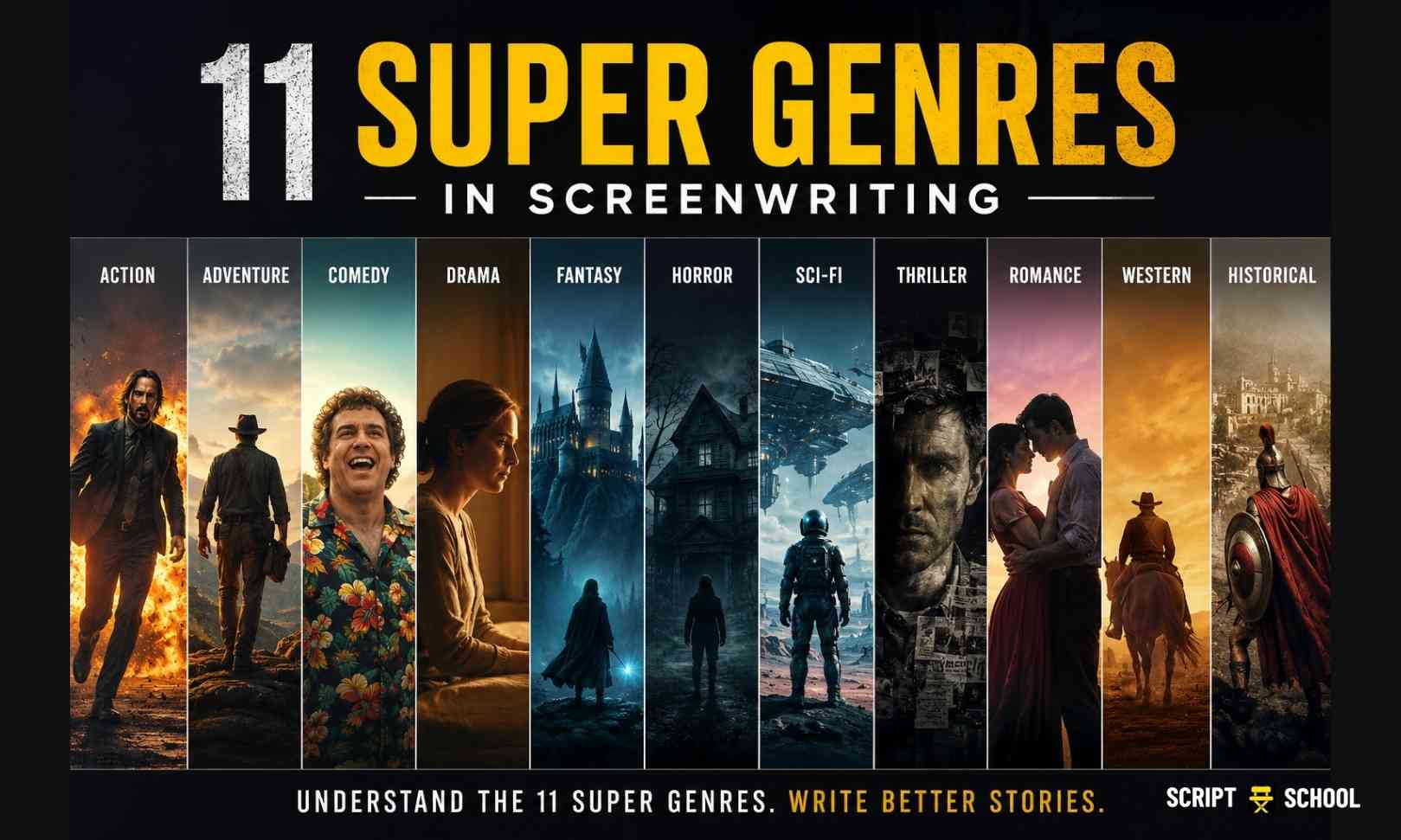
Quick Answer: The 11 Super Genres List
- Action
- Crime
- Fantasy
- Horror
- Life
- Romance
- Science Fiction
- Sports
- Thriller
- War
- Western
Why Super Genres Matter in Screenwriting
Genre is a promise to the audience. When someone buys a ticket to a horror film, they’re not there for a love story. When someone watches a sports movie, they want the underdog moment. They want to feel something specific.
If your screenplay breaks that promise, the audience feels cheated. Not because your story is bad. But because the expectations didn’t match the delivery.
Super genres help you make the right promise from the start. That’s what makes them so powerful for writers. They align your story intention with audience expectation. And that alignment is where great scripts live.
Want to write more with this foundation already built in? Check out the Screenwriting 101 course at Script School and start with the structure professionals use.
Where Do the 11 Super Genres Come From?
Eric R. Williams and The Screenwriters Taxonomy
The 11 super genres come from Eric R. Williams and his book The Screenwriters Taxonomy. Williams is a screenwriter, professor, and story analyst who spent years mapping how Hollywood stories actually work. His goal wasn’t theory. It was practical. He wanted writers to have a clear system they could use on the page.
The result is one of the most useful frameworks in modern screenwriting education. Instead of vague labels, it gives writers a structured language for story. That language starts with the 11 super genres.
Williams built this system to close the gap between “I have an idea” and “I know what I’m writing.” That gap is where most scripts stall out.
Why Traditional Genre Labels Can Be Confusing
Ever notice how almost every serious movie gets called a drama?
The Godfather is a drama. 12 Years a Slave is a drama. La La Land is a drama. So is Parasite. And There Will Be Blood.
These films have almost nothing in common. But they all wear the same label. That’s the problem with traditional genre tags. They’re too broad. They describe tone or mood, not story structure. They tell you how a film feels but not how it works.
Super genres fix that. They cut through the noise and get specific about story.
How Super Genres Create a Clear Story Language
The old system gave you a mood. Super genres give you a map.
With the old system, you’d say “it’s a drama with thriller elements.” That’s vague. A producer doesn’t know what they’re buying. A collaborator doesn’t know what they’re building.
With super genres, you say “it’s a Thriller with a Crime subplot.” Now everyone knows exactly what the story is doing. The conflict is clear. The emotional arc is clear. The audience promise is clear.
That’s a better creative language. And better language leads to better scripts.
Super Genre vs Genre vs Subgenre
These three terms mean different things. Here’s how they stack up.
What Is a Genre?
A genre is a storytelling category defined by shared conventions. These include setting, character types, conflict styles, and emotional beats. Genre tells the audience what kind of story they’re in. Think Crime, Romance, or Horror as recognizable story flavors.
Genre operates at the mid-level of story taxonomy. It’s more specific than a super genre but broader than a subgenre.
What Is a Super Genre?
A super genre sits above genre. It’s the broadest category in the taxonomy. It defines the dominant emotional experience of the entire screenplay. Every story fits into one primary super genre, even if it touches others.
Super genres are about what the audience fundamentally feels watching your film. Fear. Love. Wonder. Tension. That’s the super genre at work.
What Is a Macrogenre?
A macrogenre is a larger cluster within a super genre. It groups related story types together. For example, within the Crime super genre, you might cluster detective stories, heist stories, and mob stories into related macrogenre families.
Macrogenres help writers understand the storytelling neighborhood their script lives in.
What Is a Microgenre?
A microgenre is a highly specific storytelling niche. It’s the most granular level of genre taxonomy. “Slasher horror” is a microgenre within Horror. “Courtroom drama” is a microgenre within Crime. “Found footage” is a microgenre within Horror or Science Fiction.
Microgenres are where audience communities form. Fans of cozy mysteries, Nordic noir, or found footage horror are all responding to microgenre conventions.
Simple Example of Genre Layers
Let’s use Get Out as an example across all four levels:
- Super Genre: Horror
- Macrogenre: Psychological Horror
- Genre: Social Horror
- Microgenre: Body Horror with Sci-Fi elements
Same film. Four different levels of specificity. That’s how the taxonomy system works. Each layer adds precision. Each layer gets you closer to exactly what your story is doing.
The 11 Super Genres Explained
Here’s what each super genre actually means for your screenplay. Not just a definition. But the emotion it promises, the conflict it demands, and the insight it gives you as a writer.
1. Action
Emotional Promise: Excitement and release.
Core Conflict: Physical. Bodies in motion. Survival. Power.
Action stories put the protagonist in immediate physical danger. The audience wants movement. Stakes. Speed. Spectacle. Think Mad Max: Fury Road or Die Hard. The characters don’t just have problems. They have enemies coming at them right now.
Writer Insight: Action doesn’t mean mindless. It means the primary story engine is physical conflict. Your hero has to move or they die.
2. Crime
Emotional Promise: Tension and moral complexity.
Core Conflict: Law vs. lawlessness. Order vs. chaos.
Crime stories live in the space between what’s legal and what’s human. Think Chinatown, The Departed, or Fargo. The protagonist is either investigating a crime, committing one, or caught somewhere in between.
Writer Insight: Crime audiences don’t just want a mystery. They want moral weight. Why did someone cross the line? Was it worth it?
3. Fantasy
Emotional Promise: Wonder and escape.
Core Conflict: Good vs. evil in a world with different rules.
Fantasy builds a world beyond reality. Magic exists. Rules are different. The stakes are cosmic. Think The Lord of the Rings or Pan’s Labyrinth. The world itself becomes a character.
Writer Insight: Your fantasy world needs internal logic. Audiences forgive dragons. They don’t forgive rules that change when convenient.
4. Horror
Emotional Promise: Fear and dread.
Core Conflict: Survival against an unstoppable threat.
Horror makes the audience feel unsafe. The threat can be supernatural, psychological, or deeply human. Think The Shining, Hereditary, or A Quiet Place. The protagonist is not in control. And that loss of control is the point.
Writer Insight: Fear works best when the audience cares about the character before the danger arrives. Spend time building connection first.
Ready to write horror that actually terrifies? The Horror Movie Screenplay Writing course at Script School will show you exactly how the best horror scripts are structured.
5. Life
Emotional Promise: Recognition and emotional truth.
Core Conflict: Internal. Human. Quiet but real.
Life stories are about the ordinary moments that carry extraordinary weight. Think Boyhood, Lady Bird, or The Florida Project. No villain. No magic. Just people trying to figure out who they are and what they want.
Writer Insight: The Life super genre is where most scripts get mislabeled as “drama.” The key is that the central conflict is internal and relational, not plot-driven.
6. Romance
Emotional Promise: Hope and connection.
Core Conflict: Two people who belong together kept apart by obstacles.
Romance is the oldest story engine in human culture. Think When Harry Met Sally, Crazy Rich Asians, or Normal People. The audience roots for the relationship. Every scene either brings the couple closer or pulls them further apart.
Writer Insight: The obstacles in Romance must feel real. If the audience can’t understand why these two people aren’t together, the story loses tension.
7. Science Fiction
Emotional Promise: Curiosity and awe.
Core Conflict: Humanity vs. technology, the future, or the unknown.
Science Fiction asks “what if?” and follows the answer to its logical extreme. Think Arrival, Ex Machina, or Interstellar. The best Sci-Fi uses speculative premises to explore deeply human questions.
Writer Insight: The science is the vehicle. The human story is the destination. Don’t let your concept outrun your character.
8. Sports
Emotional Promise: Triumph and inspiration.
Core Conflict: The underdog vs. impossible odds.
Sports stories are about more than the game. They’re about what it costs to compete and what it means to win or lose. Think Rocky, Moneyball, or Whiplash. The sport is the arena. The real story is about identity, sacrifice, and belief.
Writer Insight: The climactic game or competition only works if the audience already loves the character. Build the human stakes before the scoreboard.
9. Thriller
Emotional Promise: Suspense and urgency.
Core Conflict: A protagonist under threat, racing against time or a hidden danger.
Thrillers keep the audience on edge. The threat is real and present. Every scene escalates. Think Gone Girl, No Country for Old Men, or Knives Out. Unlike Horror, the threat in a Thriller is usually human and rational.
Writer Insight: Thrillers live or die on information control. What the audience knows, what the protagonist knows, and when they each find out are your most powerful tools.
10. War
Emotional Promise: Sacrifice and the cost of conflict.
Core Conflict: Survival, loyalty, and the human experience in combat.
War stories put people in the most extreme human conditions. Think Saving Private Ryan, Full Metal Jacket, or 1917. The battlefield exposes character. It strips everything else away.
Writer Insight: War films rarely glorify war without consequence. The most powerful War scripts use the conflict to ask what it costs to survive, and whether survival was worth it.
11. Western
Emotional Promise: Freedom and justice.
Core Conflict: Civilization vs. the frontier. Order vs. chaos.
Westerns are about the moment before rules existed. Think Unforgiven, True Grit, or No Country for Old Men. The protagonist often stands at the line between justice and vengeance, between staying and leaving.
Writer Insight: The Western super genre isn’t locked to the American frontier. Any story set in a lawless landscape where one person must create or restore order carries Western DNA.
How the 11 Super Genres Help Screenwriters
Knowing your super genre changes how you write. Here’s what it unlocks.
It Sharpens Your Pitch
Producers hear thousands of pitches. The ones that land fast are the ones that are instantly clear. “It’s a Thriller about a whistleblower” lands differently than “it’s a story about truth and power.” Super genres give your pitch immediate shape.
It Guides Your Character Choices
Every super genre demands a certain kind of protagonist. A Crime story needs someone willing to cross a line. A Romance needs someone capable of vulnerability. When you know your super genre, you know what your lead character has to be able to do.
It Builds the Right World
The world of your screenplay should serve your super genre. A Horror world should feel unsafe. A Fantasy world should feel limitless but rule-bound. Your setting isn’t decoration. It’s an extension of your genre promise.
It Prevents Tonal Drift
Without a clear super genre, scripts wander. Comedy bleeds into melodrama. Thriller loses tension when it stops to explore backstory. Your super genre is a tonal anchor. It tells you when a scene is working for your story and when it’s pulling you off course.
It Helps You Find Your Audience
Genre audiences are loyal. Thriller fans read every Blake Crouch novel. Horror fans show up opening weekend without a trailer. When you know your super genre, you know who you’re writing for. And writing for someone specific always produces better work than writing for “everyone.”
Want to apply this to a real script? A private consultation at Script School can help you identify your super genre and build the right story around it. Learn more about how consultations work here.
Super Genres vs Save the Cat Genres
If you’ve studied screenwriting before, you’ve probably met Blake Snyder’s genre system from Save the Cat. It’s famous. It works. And it’s different from super genres in important ways.
What Save the Cat Genres Do
Blake Snyder’s system identifies 10 story types based on a hero’s emotional transformation and the type of problem they face. His categories include things like “Monster in the House,” “Dude With a Problem,” “Rites of Passage,” and “Buddy Love.”
Snyder’s genres are built around story structure and character transformation. They answer: what kind of journey is the hero on?
What Super Genres Do Differently
Super genres answer a different question: what does the audience feel?
They’re built around emotional delivery and genre convention, not narrative structure. A Super Genre tells you the promise. Save the Cat tells you the shape of the journey.
Which System Should You Use?
Both. They solve different problems. Use super genres to identify your story’s emotional identity. Use Save the Cat genres to understand your hero’s transformation arc. Together, they give you a clearer screenplay than either system alone.
| Feature | Super Genres (Williams) | Save the Cat Genres (Snyder) |
|---|---|---|
| Focus | Audience emotion and genre promise | Hero transformation and story shape |
| Number of categories | 11 | 10 |
| Primary use | Genre identity and tonal clarity | Story structure and character arc |
| Best for | Pitching, world building, tone | Plotting, character, three-act design |
Can a Screenplay Have More Than One Super Genre?
What happens when horror meets science fiction?
You get Alien. One of the greatest films ever made.
Yes. Screenplays can absolutely blend super genres. Most great films do. But there’s a rule that separates successful blends from confused ones.
Primary vs Secondary Super Genre
Every screenplay needs one primary super genre. That’s the dominant emotional promise. That’s the foundation. The secondary super genre adds texture, dimension, and complexity.
Alien is Horror first. The Science Fiction elements create the world. But the emotional engine is fear. That’s Horror.
Arrival is Science Fiction first. There’s deep emotional grief running through it. But the story is ultimately about first contact and the human mind. That’s Sci-Fi.
When Blending Works
- The primary super genre remains clearly dominant
- The secondary genre deepens character or world without shifting tone
- The audience promise stays consistent
When Blending Fails
- The script tries to be two genres equally
- The tone shifts back and forth between genre promises
- The audience doesn’t know how to feel
Genre blending is a creative superpower. But it requires discipline. Lock in your primary super genre first. Then layer in the secondary one with intention.
How to Choose the Right Super Genre for Your Screenplay
You don’t have to figure this out through guesswork. There’s a framework for it.
Step 1: Start With the Emotion
Ask yourself: what do I want the audience to feel? Not think. Feel.
If your answer is “scared,” you’re writing Horror or Thriller. If your answer is “hopeful,” you might be writing Romance or Life. If your answer is “thrilled and pumped,” you’re writing Action.
The dominant emotion you want to create is your first signal.
Step 2: Identify the Central Conflict
What is the primary battle in your story?
- Physical danger = Action or War
- A crime being committed or solved = Crime
- Two people falling in love = Romance
- Something terrifying and unstoppable = Horror
- An impossible world with different rules = Fantasy
- Technology or the future changing everything = Science Fiction
- A hidden danger closing in = Thriller
- A competition with everything on the line = Sports
- Real human life in all its messiness = Life
- Combat and the cost of war = War
- A lawless world needing justice = Western
Step 3: Think About the Ending Expectation
What does your audience expect to feel at the credits?
Romance audiences expect emotional satisfaction, whether happy or bittersweet. Horror audiences expect resolution of the threat, one way or another. Sports audiences expect the climactic moment of truth, win or lose. Matching your ending to your super genre expectation is how you leave audiences satisfied.
Step 4: Test It Against Your Protagonist
Your protagonist should fit the demands of your super genre. A great Horror protagonist gets scared and makes desperate choices. A great Action protagonist takes physical action. A great Life protagonist changes internally.
If your protagonist doesn’t naturally fit the super genre’s demands, either change the character or reconsider the genre.
Step 5: Say It Out Loud
Try saying: “I’m writing a [super genre] screenplay about [story].”
If that sentence feels right, you’ve found your genre. If it feels off, keep testing. The right super genre will make your whole story feel more coherent, not more complicated.
Not sure which genre fits your idea? Start with Screenwriting 101 and learn how to shape your idea into a clear, compelling script from the ground up.
Quick Comparison Table of the 11 Super Genres
Here’s the full breakdown at a glance. Use this as a reference while you develop your screenplay.
| Super Genre | Emotional Promise | Core Conflict | Common Protagonist |
|---|---|---|---|
| Action | Excitement and release | Physical danger and survival | Warrior, soldier, hero under fire |
| Crime | Tension and moral weight | Law vs. lawlessness | Detective, criminal, witness |
| Fantasy | Wonder and escape | Good vs. evil in another world | Chosen hero, reluctant adventurer |
| Horror | Fear and dread | Survival against an unstoppable threat | Ordinary person in extraordinary danger |
| Life | Recognition and emotional truth | Internal and relational conflict | Everyday person navigating real life |
| Romance | Hope and connection | Two people kept apart by obstacles | Person looking for love or belonging |
| Science Fiction | Curiosity and awe | Humanity vs. technology or the unknown | Visionary, scientist, outsider |
| Sports | Triumph and inspiration | Underdog vs. impossible odds | Athlete, coach, competitor |
| Thriller | Suspense and urgency | Hidden danger closing in | Ordinary person in extraordinary peril |
| War | Sacrifice and cost of conflict | Survival and loyalty under fire | Soldier, commander, civilian in conflict |
| Western | Freedom and justice | Civilization vs. the frontier | Loner, gunfighter, lawman |
Common Mistakes Writers Make With Genre
Knowing the 11 super genres is one thing. Applying them correctly is another. Here are the most common mistakes to avoid.
Mistake 1: Confusing Genre With Tone
The mistake: Writers say “it’s a dark drama” when they mean it’s a Crime screenplay with a bleak tone.
The fix: Tone is how the story feels. Genre is what the story does. Dark, funny, hopeful, and gritty are tone descriptors. They don’t replace super genre. Identify the genre first. Then layer in the tone.
Mistake 2: Trying to Serve Two Genres Equally
The mistake: A script tries to be equally a Romance and a Thriller. Every scene splits its energy between love story beats and suspense beats. Neither works fully.
The fix: Pick one primary super genre. Let it dominate. The secondary genre supports. It doesn’t compete.
Mistake 3: Ignoring Audience Expectation
The mistake: A writer labels their script a Horror film but spends 80 pages on character relationships with almost no scares. The final act tries to deliver terror but the foundation isn’t there.
The fix: Genre is a promise made early. Deliver on it throughout the script, not just at the end. Plant your genre signals in the first 10 pages.
Mistake 4: Choosing Genre Based on What’s Trending
The mistake: A writer hears that Thriller scripts are selling, so they reframe their story as a Thriller even though it’s naturally a Crime film. The script feels forced.
The fix: Choose the super genre that fits your story’s natural strengths. The best scripts are written by people who love the genre they’re working in. Passion shows. Trend-chasing doesn’t.
Mistake 5: Using “Drama” as a Default
The mistake: Any serious story gets labeled as “drama.” The writer thinks that’s specific enough. It isn’t.
The fix: Drama is a tone, not a super genre. Push past it. Ask yourself what the story actually delivers. If the answer is tension and a hidden threat, it’s a Thriller. If it’s human relationships and quiet emotional truth, it’s a Life screenplay. Get specific.
Final Answer: What Are the 11 Super Genres?
Here’s the full list one more time:
- Action — physical conflict, survival, excitement
- Crime — law vs. lawlessness, moral complexity
- Fantasy — world-building, wonder, good vs. evil
- Horror — fear, dread, survival
- Life — emotional truth, relationships, identity
- Romance — love, hope, connection
- Science Fiction — curiosity, the future, humanity vs. the unknown
- Sports — triumph, sacrifice, competition
- Thriller — suspense, urgency, hidden danger
- War — sacrifice, survival, the cost of conflict
- Western — justice, freedom, the frontier
Every script you write starts here. Pick your super genre. Build from the foundation. Keep your genre promise through every scene. That’s how you write a screenplay that connects with the people watching it.
A genre does not limit your story. It gives your story direction.
Ready to put this into practice? At Script School, every course is built on professional frameworks like this one. Whether you’re writing your first script in Screenwriting 101, building a pilot in the TV Pilot Lab, or learning to pitch in the Pitching and Packaging course, you’ll work with the tools that working writers actually use.
And if you want to know which course fits your creative goals, book a private consultation. It’s the fastest way to find the right path for your screenplay.
Your story already has a genre. Now go write it.