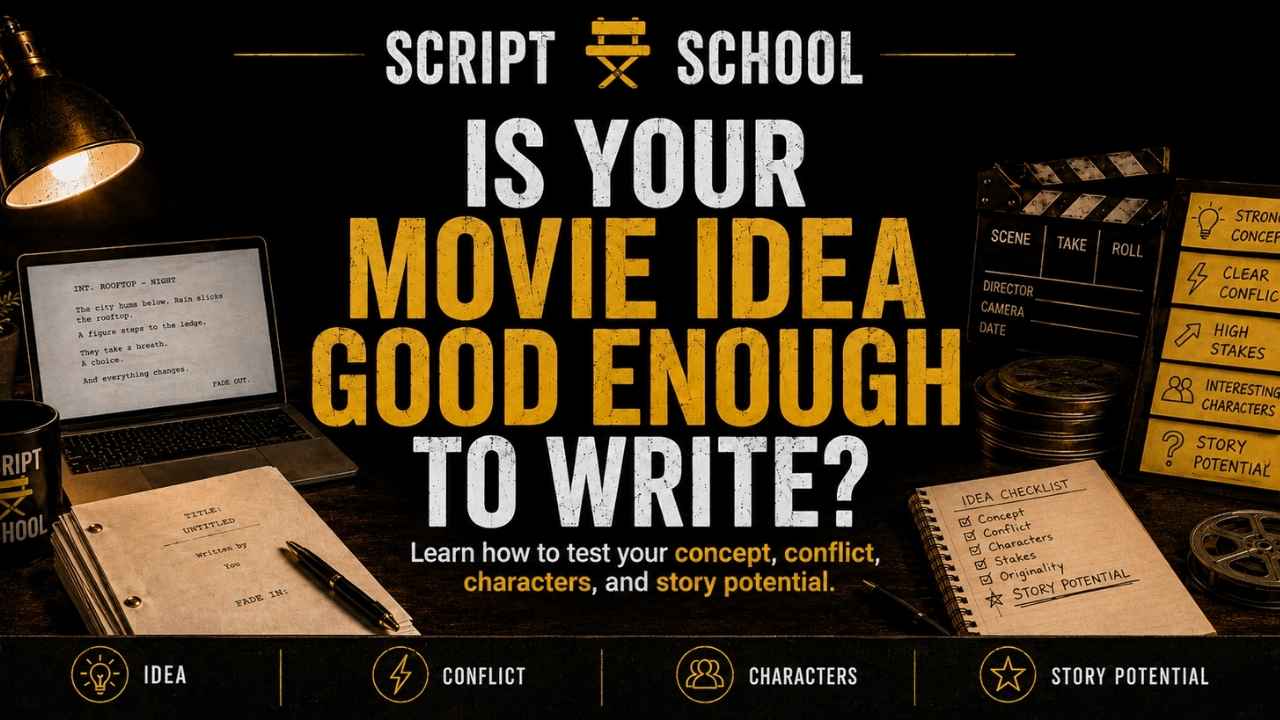
How to Know If Your Movie Idea Is Good Enough to Write
You have an idea. It shows up in the shower. It shows up at red lights on the 405.
And then the doubt shows up too. Is this thing actually good? Or are you about to burn six months on a script nobody wants?
Here is the honest truth. Most writers never find out, because they never test the idea before they start typing.
They jump straight to page one. Then they hit page 40, the story stalls, and they quietly close the laptop.
That is not a talent problem. That is a testing problem. Measure twice, cut once.
This guide gives you seven real tests you can run this week. No fluff, no guru talk, no vague “follow your passion” advice.
By the end, you will know if your movie idea can carry 100 pages. You will also know what to do if it cannot.
The Short Answer: What Makes a Movie Idea Good Enough to Write
A movie idea is good enough to write when it has conflict, change, and stakes you can name out loud.
That is it. Everything else is decoration.
If you can say who wants what, who blocks them, and what breaks if they fail, you have a story. If you cannot, you have a mood.
Moods are lovely. Moods do not survive a second act.
Here is the quick gut check, in plain terms:
- A person we care about wants something specific
- Something real stands in the way, and it pushes back hard
- The cost of failing hurts, and we feel it
- The character is different at the end than at the start
- You can picture at least ten scenes without straining
Hit four of those five and you are in good shape. Hit two and you need more cooking time.
Ask yourself this. Would a stranger lean in if you told them this story at a bar? Or would they check their phone?
Idea, Premise, Concept, and Story Are Not the Same Thing
This trips up almost everybody. And it is the single biggest reason scripts die in act two.
An idea is a spark. “A lighthouse keeper who hears voices in the fog.”
A premise adds a situation. “A lighthouse keeper hears voices in the fog, and one of them is his dead brother.”
A concept adds a hook. Something a producer can repeat to a boss without notes.
A story adds change. Somebody wants something, fights for it, and comes out different.
Most writers fall in love with the idea and never build the story. That is like buying a killer front door and no house.
You need all four layers. The spark gets you excited. The story gets you to page 100.
Try this. Write your idea on one line. Then ask “so what happens?” three times in a row.
If you can answer all three, your idea has legs. If you run dry at question two, it is still a spark.
Quick reality check. Plenty of people wonder whether they even belong in this game before they worry about the idea itself. If that is you, our take on whether anyone can write a screenplay is a better first read than this one.
Test 1: Can You Say It in One Sentence?
Say your movie in one sentence. Out loud. To an actual human.
That sentence is called a logline. It names your lead, their goal, and what stands in the way.
If you need ninety seconds and three “wait, let me back up” moments, the idea is muddy. Muddy ideas make muddy scripts.
A working logline has four moving parts:
- Who the story follows, in three words or less
- What they want, stated as an action
- Who or what blocks them
- What it costs if they lose
Here is a weak one. “It is about grief and memory and the ocean.”
Here is a strong one. “A widowed lighthouse keeper must prove the voices in the fog are real before the coast guard commits him.”
See the difference? One is a feeling. The other is a movie.
Why this test works. A logline is a pressure test in disguise. Vague ideas cannot survive one sentence.
Run it on strangers, not friends. Friends are kind. Kindness will not tell you the truth.
Watch their face while you talk. If their eyebrows move, you have something. If their eyes drift, keep digging.
Test 2: Does Your Idea Have an Engine?
Every movie needs an engine. The engine is the thing that keeps forcing the next scene.
Without one, you get a slideshow. Pretty pictures with no reason to keep watching.
An engine usually comes from one of these:
- A ticking clock. The bomb, the wedding, the deadline, the surgery
- A chase. Somebody hunts, somebody runs
- A mystery. A question the audience needs answered
- A pressure cooker. People locked in a space with a problem
- A goal with a hard obstacle. Want plus wall, over and over
Ask yourself what makes scene 12 happen. Then scene 30. Then scene 60.
If your only answer is “then some more stuff happens,” you do not have an engine yet. You have a setting.
Here is the sneaky part. A great engine can make a simple idea feel huge.
A guy wants to make a phone call. Boring, right? Now he is trapped in a coffin with six percent battery. Suddenly it is a movie.
Same idea. Different engine. That is the whole trick.
Do not put the cart before the horse. Find the engine before you write the opening scene.
Test 3: Can You See the Ending?
You do not need the perfect ending. You need an ending.
Writers who start with no ending usually write in circles. They pad. They add characters. They add a dream sequence.
Then they quit around page 65 and blame writer’s block. It was never block. It was navigation.
Answer these three questions right now:
- What is the final decision your lead has to make?
- What do they give up to make it?
- What does the last image show us about who they became?
If you can rough out those answers, you can outline. If you cannot, your idea is still a room with no exit.
A rough ending is a compass, not a contract. You are allowed to change it later.
Most working writers do change it. But they change it while moving, not while stuck.
Think of it like driving to Santa Monica. You can take a different route. You still need to know it is Santa Monica.
Test 4: Will You Still Care on Page 78?
Page 78 is where the honeymoon ends. Every writer meets that page.
The novelty is gone. The structure gets hard. The doubt gets loud.
So ask the real question. Will you still want to be in this story eight months from now?
Here is a test that actually works. Do not write. Just think about the story for four days.
Take a walk. Do the dishes. Sit in traffic. Let the idea run in the background.
Then check in on Friday:
- Did new scenes show up on their own?
- Did a character say something you did not plan?
- Did you feel a pull to open a notes app?
- Did you get a little protective of it?
If the answer is yes, you have fuel. That pull is the closest thing to a guarantee this business offers.
If the idea felt like homework by Wednesday, be honest with yourself. That is useful information, not failure.
Passion is not fluffy advice here. It is the tank of gas that gets you through the rewrite nobody claps for.
Test 5: Has Somebody Already Made It?
Do this before you write a word. It takes twenty minutes and saves months.
Search your logline. Search the core hook. Search your setting plus your genre.
You are looking for two things:
- Direct copies. Same hook, same twist, already released or shooting
- Comparable titles. Films close enough that fans of them would like yours
Direct copies are a warning. Comparable titles are a gift.
Why a gift? Because comps prove an audience exists. They also give you language for a pitch later.
Now here is the nuance most advice gets wrong. Similar is fine. Identical is not.
There are maybe a dozen story shapes in existence. Your voice is the variable, not the shape.
Heist movies keep getting made. Haunted house movies keep getting made. The angle is what changes.
So do not panic when you find something close. Ask what your version does that theirs does not.
If you cannot answer that, keep working. If you can, you just found your selling point.
There is nothing new under the sun. There is plenty new under your specific point of view.
Test 6: Can This Story Actually Get Shot?
This is the test that separates dreamers from writers who get made. And most blogs skip it entirely.
Every page you write becomes money somebody has to spend. So think like a producer for ten minutes.
Run a quick scope audit on your idea:
- How many locations does it need?
- How many speaking roles?
- Any crowds, stunts, animals, water, or children?
- Any period costumes or heavy visual effects?
- Does it need a city to shut down a street?
None of that makes an idea bad. It just changes who can say yes.
A contained thriller with four actors and one house can get made by almost anybody. A space war with 200 extras needs a studio.
If this is your first script, smaller is smarter. Tight scope means fewer things can break.
Scope also shapes length. A sprawling idea balloons past 120 pages fast, and readers notice.
Most features run somewhere between 90 and 120 pages, and that page count maps to real screen time. If you are unsure how many beats fit in a feature, our breakdown of how many scenes are in a 2-hour movie makes the math concrete.
One more thing. Format is part of feasibility. A script that reads clean gets read all the way through.
If you have never seen a professional page up close, look at what a screenplay looks like before you start. Sluglines, action, and dialogue have rules, and they are easy to learn early.
Do not bite off more than you can chew on script one. Ambition is great. A finished script is better.
Test 7: Does It Make Somebody Feel Something?
Structure gets you a competent script. Feeling gets you a memorable one.
Here is the thing nobody tells beginners. Readers forget plot. They remember how a story made them feel.
So name the feeling. Not the theme, not the message. The feeling.
Dread. Longing. Relief. Rage. Belonging. Grief with a laugh inside it.
Then ask what scene delivers it hardest. If you cannot picture that scene, the emotion is not built in yet.
Try this quick exercise. Describe your movie’s best moment in two sentences.
Not the twist. Not the setup. The moment you want somebody to still be thinking about on the drive home.
If that moment lands when you say it out loud, you have an emotional core. Guard it.
If you shrug through it, keep digging. The feeling is usually hiding one layer under the plot.
The proof is in the pudding here. Read your favorite film’s best scene and notice how little plot it carries.
High Concept or Small and Human? Both Work
New writers hear “high concept” and panic. They think every idea needs a shark or a time loop.
Not true. But you do need to know which lane you are in.
High concept means the hook does the selling. You hear it once and you get it.
“A shark terrorizes a beach town.” “A man relives the same day forever.” Easy to pitch, easy to market.
Character driven means the execution does the selling. The premise sounds ordinary until you read it.
“A woman drives across the country after her mother dies.” That is nothing on paper and everything on the page.
Both get made. Both win awards. They just need different strengths from you.
High concept needs a killer hook and clean structure. Character driven needs unforgettable people and real dialogue.
Here is how to tell which one you have. Say the logline to five people.
If four of them say “oh, that’s cool,” you have high concept. If they say “how would that work?” you have character driven.
Neither answer is wrong. Knowing the answer tells you where to spend your effort.
Nine Red Flags Your Movie Idea Is Not Ready Yet
Be honest here. Every one of these is fixable, but only if you spot it.
- You keep describing the world, never the story. Rich settings are not plots.
- Your lead reacts to everything and chooses nothing. Passive protagonists kill scripts.
- You cannot name what your lead wants. If you cannot, neither can the audience.
- The conflict is internal only. Feelings need external pressure to become scenes.
- Every problem gets solved by coincidence. Luck is not a story engine.
- You have a great first act and total fog after. Very common. Very fatal.
- The idea is really a scene, not a movie. Some ideas are short films. That is fine.
- You are writing it because it seems commercial. Readers can smell that from page three.
- You cannot picture a single line of dialogue. If nobody talks yet, they are not people yet.
Spot two or three of these? Do not throw the baby out with the bathwater.
Fix the idea before you draft. It is way cheaper than fixing it on page 90.
Eight Green Lights That Say Start Writing Today
The flip side matters just as much. Here is what a ready idea looks like.
- You have a logline that lands without a follow-up explanation.
- You know your lead’s want and their wound. External goal, internal need.
- Scenes keep showing up uninvited. Your brain is already drafting.
- You know roughly how it ends, even if the details shift.
- You feel a little defensive about it. That means it is yours.
- You can name three comparable films without stretching.
- The scope matches your resources. You are not writing a $200 million debut.
- It scares you a bit. The good ideas usually do.
Five or more green lights? Stop researching. Start outlining.
Do not wait for perfect. Perfect is a stalling tactic wearing a nice suit.
Make hay while the sun shines. The excitement you feel right now has a shelf life.
The 48-Hour Idea Stress Test
Here is a simple two-day process. Run it before you commit months to a draft.
Set a timer. Do not overthink it.
Hour 1: Write the logline. One sentence. Lead, goal, obstacle, stakes.
Hour 2: Write the ending. One paragraph. What is the last choice and the last image?
Hour 3: List ten scenes. One line each. Do not judge them.
Hour 4: Name the engine. Clock, chase, mystery, pressure, or goal versus wall.
Hour 5: Find three comps. Films close enough to yours to be useful.
Hour 6: Do a scope audit. Locations, cast size, effects, budget reality.
Then walk away for 24 hours. No writing. No note taking. Just live.
Day two, hour 1: Read it all cold. Pretend a stranger wrote it.
Day two, hour 2: Pitch it to three people. Watch their faces, not their words.
Day two, hour 3: Score it. Use the seven tests above. Mark each pass or fail.
Five or more passes means write it. Three or four means develop it more.
Two or fewer means shelve it kindly. Not forever. Just for now.
This whole thing takes less time than one weekend of aimless drafting. And it saves you from the page 40 wall.
What to Do the Day Your Idea Passes
Congratulations. Now do not just start typing.
First, outline. Even a loose one. Twelve to twenty beats is plenty.
Outlining feels like a delay. It is actually the fastest route to a finished draft.
Second, write a one-page treatment. Prose, present tense, the whole story start to finish.
If the treatment reads flat, the script will read flat. Fix it here, where it is cheap.
Third, protect the work. You can register it with the WGA West Registry before you send it anywhere.
That documents your claim of authorship on a given date. It is not the same as copyright, but it is a smart first step.
Fourth, set a page target. Aim for a finished first draft, not a good one.
Nobody writes a good first draft. They write a finished one and then make it good.
Fifth, book your feedback early. Do not wait until draft four to hear an outside opinion.
A stitch in time saves nine. One honest note at the outline stage saves three rewrites later.
What to Do When Your Idea Fails the Test
Failing the test is not a verdict on you. It is data.
And most failed ideas are not dead. They are just early.
Here is how to salvage one:
- Raise the stakes. Make failure cost something the character cannot replace
- Add a clock. Give the story a deadline it cannot dodge
- Flip the lead. The most interesting person may not be who you picked
- Cut a subplot. Sprawl often hides the real story
- Change the genre. Same premise, new rules, new energy
- Shrink it. A great short film beats a mediocre feature every time
- Combine it. Two half ideas sometimes make one whole one
Keep an idea file. Every writer has one.
Ideas that fail today often click in two years, once you know more craft. That is normal.
You can lead a horse to water, but you cannot force an idea to be ready. Give it time and come back.
Why Outside Feedback Beats Guessing
Here is the uncomfortable part. You cannot fully judge your own idea.
You know too much. You see the version in your head, not the version on the page.
That gap is where scripts die. And no amount of self-editing closes it.
So who should you ask?
Not your family. They love you. That makes them useless as readers.
Not random online forums. Free advice from strangers is worth what you pay.
Someone who reads scripts for a living. That is the whole game.
A working writer can tell you in one conversation whether your idea has an engine. They have seen a thousand ideas fail the same way.
That is not gatekeeping. That is pattern recognition you have not built yet.
At Script School, that outside read is the point. It is a non-profit film education organization, and every course is taught by working industry mentors, not academics.
Classes stay small. You get real feedback on your actual pages, not a lecture and a worksheet.
If you want the idea checked before you commit, a private consultation is the fastest route. One session can save you a year of writing in the wrong direction.
Ready to find out if your idea holds up? Book your free consultation and get an honest read from a working writer. No pressure, no obligation, no pitch about how great we are.
How Script School Helps You Test an Idea Before You Waste a Year
Most film schools want four years and a mortgage. That is not the only path anymore.
Here is what we actually do, in plain terms.
Small classes with real mentors. You get feedback from people with credits, not just theory.
Online and in person. We teach from Los Angeles and Austin, and students join from more than fifteen countries.
Project based. You do not just learn structure. You apply it to your script, week by week.
Upfront pricing. Courses run roughly $99 to $299. No hidden fees, no surprise add-ons.
Programs for where you actually are. Beginners, career changers, novelists, actors, retirees, and teens.
If you are starting from zero, Screenwriting 101 covers the fundamentals. If you are aiming at television, the TV Pilot Lab is built for pilots.
There are also genre specific paths. Horror writing, pitching and packaging, film financing, casting, and acting.
What we will not do. We will not tell you an idea is brilliant when it is not.
That kindness costs writers years. We would rather cost you one honest hour.
You get what you pay for in this industry. Cheap feedback is usually expensive later.
What This Actually Costs You
Let us talk money, since nobody else will.
A full film degree can run six figures. A workshop weekend can run $500 and give you nothing you can use.
Our courses sit in the $99 to $299 range. That is the price of a nice dinner in LA.
Here is the math that matters more. A wrong idea costs you eight months of your life.
You cannot buy that back. You can buy a conversation that prevents it.
So the real question is not “can I afford a course.” It is “can I afford another abandoned draft.”
Put your money where your mouth is, or do not. Just make the choice on purpose.
Frequently Asked Questions
How do I know if my movie idea is original enough?
Search your logline and your core hook first. Look for direct copies, not similar films.
Similar is normal. Every genre repeats shapes. Your angle and voice make it yours.
If you find an identical project already in production, change your angle or shelve it.
Should I write a bad idea just to finish something?
Yes, actually. Finishing a weak script teaches you more than abandoning ten strong ones.
Just do it on purpose. Call it practice, set a short deadline, and move on after.
Your first script is a training script. Almost nobody sells it, and that is fine.
What if my idea is just a feeling or an image?
That is a starting point, not a story. Build outward from it.
Ask who is in that image. Ask what they want. Ask who stops them.
Keep asking until the feeling has a person, a goal, and an obstacle attached.
How long should I develop an idea before writing?
Give it one to three weeks of thinking, plus a real outline. Not six months.
Endless development is procrastination with better branding. At some point you have to write.
If the outline holds together, start drafting. You will learn the rest by doing.
Can a simple idea make a good movie?
Absolutely. Simple ideas with strong execution beat complicated ideas with weak execution.
A man wants to make a phone call. A woman drives to a funeral. Both became strong films.
The idea is the invitation. The execution is the party.
Do I need film school to write a screenplay?
No. You need craft, feedback, and finished pages.
Formal degrees help with networks, not with talent. Focused courses and real mentorship do more, faster.
Plenty of working writers came through workshops, not universities.
What is the difference between a movie idea and a logline?
An idea is a spark you have in your head. A logline is that spark tested in public.
The logline forces you to name a lead, a goal, an obstacle, and stakes. Ideas can hide. Loglines cannot.
How many pages should my script be?
Feature scripts usually land between 90 and 120 pages. One page runs about one minute of screen time.
Going long signals a structure problem to readers. Coming in short usually signals a thin second act.
Is my idea too small for a feature?
Maybe. Small ideas can still work if the stakes feel enormous to the character.
If it truly is small, write it as a short. A great fifteen minute film opens more doors than a shaky ninety minute one.
Should I tell people my idea, or will they steal it?
Tell people. Ideas are cheap and execution is rare.
The real risk is not theft. The real risk is protecting a weak idea from feedback until it is too late to fix.
Register the work before you send full drafts to strangers. Then talk freely.
Your Idea Deserves an Honest Answer
Here is where we land. Most movie ideas are not good or bad. They are tested or untested.
An untested idea is a coin flip. A tested idea is a plan.
You now have seven tests, a two-day process, and a list of red flags. That is more than most writers ever run.
So run them. Today, if you can. The idea you are protecting from scrutiny is the one most likely to waste your year.
And if you want a second opinion from somebody who has actually sold work, you can get one. Book your free consultation with Script School and find out if your idea holds up before you write page one.
It costs you nothing but an honest hour. That is a pretty good trade for a year of your life.
Go make the thing. The blank page is not your enemy. The untested idea is.