What Are Common Screenplay Mistakes?
Writing a screenplay feels exciting at first. Then you hit page 30 and something feels off. The story drags. Characters blur together. Readers stop turning pages.
The good news? Most screenplay mistakes are fixable once you know what to look for. This guide walks you through the ones that trip up almost every new writer.
What Are Common Screenplay Mistakes?
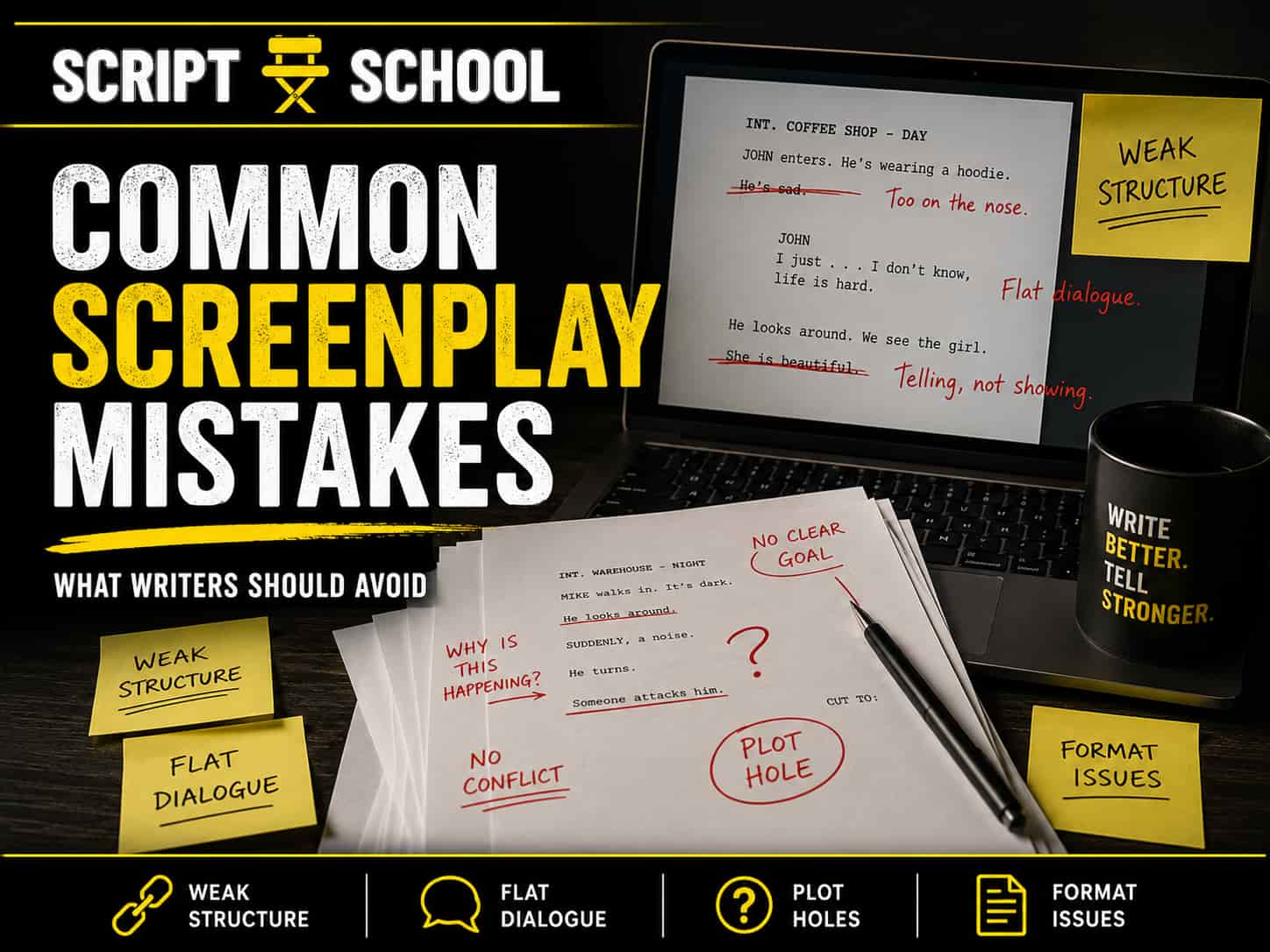
Screenplay mistakes are the small (and big) errors that pull readers out of your story. Some are technical, like bad formatting. Others are creative, like flat characters or weak conflict. Most beginner scripts have a mix of both.
Quick Answer: The Most Common Screenplay Mistakes
Here’s the short list most pros agree on:
- Bad formatting that screams “amateur” on page one
- Weak protagonists with no clear goal
- Flat dialogue that explains instead of reveals
- Slow openings that don’t hook readers
- Scenes with no conflict or purpose
- Overwriting in action lines
- No clear story structure
Fix these and your script jumps ahead of 90% of the pile.
Why Small Screenplay Mistakes Can Hurt a Script
Readers form opinions fast. A typo on page two. A wrong slugline. A character named “Bob” who sounds exactly like “Rob.” These small slips chip away at trust.
A script is a sales document. If it looks sloppy, no one believes the story inside is sharp.
How Readers, Producers, and Contest Judges Notice Mistakes
Pro readers scan hundreds of scripts a month. They spot weak openings in seconds. They notice when action lines feel like a novel. They catch dialogue that sounds the same for every character.
The bar is high. But the upside is real. A clean, focused script stands out fast.
Screenplay Mistakes vs Story Problems: What’s the Difference?
Screenplay mistakes are craft and format issues. Bad sluglines. Long speeches. Camera directions.
Story problems run deeper. No clear goal. No stakes. No reason to care.
You can fix formatting in a day. Story problems take real rewrites. Both matter. Both need attention.
Screenplay Formatting Mistakes
Using Incorrect Screenplay Format
The industry uses one format. Courier 12pt. Specific margins. Standard spacing. If your script doesn’t match, readers notice before they read a single word.
Use software like Final Draft, WriterDuet, or free tools like Fade In. Don’t fight the format.
Writing Sluglines the Wrong Way
A slugline is the line that starts a scene. It should be simple:
INT. KITCHEN - NIGHT
Not “Inside the kitchen at nighttime.” Not “Kitchen scene.” Keep it tight. Location. Time of day. Done.
Overusing Transitions Like CUT TO and DISSOLVE TO
Old scripts used these a lot. Modern ones rarely do. Every new scene is already a cut. You don’t need to label it.
Use transitions only when they mean something special.
Putting Action Inside Parentheticals
Parentheticals are for short acting beats, like (whispers) or (laughs). They’re not for action. If a character throws a cup, that goes in the action line, not in parentheses under their name.
Using Camera Directions Too Often
“PUSH IN ON HER FACE.” “ZOOM OUT.” Skip these. That’s the director’s job. Your job is to make the moment so strong the camera move is obvious.
Writing Long Blocks of Action Description
Walls of text scare readers. Keep action lines to 3-4 lines max. Break them up. Use space.
Forgetting White Space on the Page
A page packed edge to edge feels heavy. A page with breathing room feels readable. White space is your friend.
Story Structure Mistakes
Starting Without a Clear Logline
A logline is one sentence that sums up your story. If you can’t write it, your story isn’t clear yet. Start there.
Having No Clear Main Character
Whose story is this? If readers can’t answer that by page 10, you have a problem. Pick one protagonist and follow them.
Giving the Protagonist a Weak Goal
What does your hero want? Make it specific. “Be happy” is weak. “Win the cooking contest to save the family restaurant” is strong.
Writing a Story With No Real Conflict
No conflict, no story. Your hero needs obstacles. Internal struggles. External enemies. Without push-back, nothing matters.
Creating a Plot That Feels Random or Unfocused
Every scene should connect to the next. If you can move scenes around without changing the story, the plot is too loose.
Weak Opening Pages That Do Not Hook the Reader
The first 10 pages decide everything. Open with something specific. A clear character. A clear problem. Pull readers in fast.
Ending Without a Strong Payoff
The ending should feel earned. If readers say “that’s it?” you’ve missed the landing. Set up your finale early. Then deliver.
Character Mistakes in Screenplays
Creating Too Many Characters
Five strong characters beat fifteen forgettable ones. Combine roles. Cut the extras. Focus.
Giving Characters Similar Names
Mark, Mike, Matt, Marcus. Pick different starting letters. Different syllable counts. Help readers track who’s who.
Writing Overly Detailed Character Descriptions
You don’t need to describe every freckle. Give us the vibe in a line or two. “Sara, 30s, looks like she hasn’t slept in years.” That’s enough.
Making Characters Sound the Same
Cover the character names. Can you still tell who’s talking? If not, work on voice.
Giving Characters No Clear Motivation
Every character wants something. Even the small ones. Know what each person needs in every scene.
Forgetting the Character Arc
Your hero should change. Where do they start? Where do they end? The journey between those two points is the arc.
Writing Passive Characters Who Do Not Drive the Story
Heroes act. They don’t just react. If your character only responds to things happening around them, push harder. Make them choose. Make them move.
Dialogue Mistakes
Writing Dialogue That Sounds Too On-the-Nose
On-the-nose dialogue says exactly what the character feels. “I’m sad because my dad died.” Real people don’t talk like that. They circle. They deflect. They show feelings without naming them.
Using Dialogue to Explain Everything
If dialogue is just info dumping, cut it. Find ways to show information through action or visuals.
Making Every Character Speak the Same Way
A teen, a grandma, and a doctor shouldn’t sound alike. Give each voice its own rhythm and word choices.
Writing Long Speeches Without Purpose
Long monologues kill pace. Unless the speech matters big-time, break it up. Let other characters react. Cut it short.
Ignoring Subtext in Dialogue
Subtext is what’s underneath the words. “I’m fine” can mean “I’m broken.” That gap is where good dialogue lives.
Writing Dialogue That Does Not Move the Scene Forward
Every line should do something. Reveal character. Push plot. Build tension. If a line just fills space, cut it.
Scene Writing Mistakes
Starting Scenes Too Early
Skip the small talk. Start scenes as late as possible. Drop us in the middle of the action.
Ending Scenes Too Late
End scenes the moment the point lands. Don’t linger. Cut out before the energy drops.
Writing Scenes Without Conflict
Every scene needs tension. Even calm scenes can have hidden friction. Two people having coffee can be war if you write it right.
Including Scenes That Do Not Change Anything
If a scene doesn’t shift something (a relationship, a stake, a piece of info), it doesn’t belong.
Forgetting Visual Storytelling
Film is visual. Show us things. A character cleaning their wedding ring tells us more than a speech about marriage.
Writing Unfilmable Thoughts and Feelings
“He remembers his childhood.” We can’t see that. Find a visual way to show memory. A photo. A look. A small action.
Repeating the Same Type of Scene Too Often
Five argument scenes in a row get old. Mix it up. Vary the locations, the moods, the energy.
Description and Action Line Mistakes
Overwriting Action Lines
Less is more. “John walks into the room” beats “John strides confidently across the threshold of the dimly lit chamber.”
Describing Things the Audience Cannot See
If the camera can’t capture it, don’t write it. Inner thoughts. Backstory. History. Save those for the visual moments that suggest them.
Directing Actors Instead of Writing Behavior
“She says sadly” isn’t your job. Write actions that show sadness. Let the actor find the emotion.
Using Novel-Like Prose Instead of Screenplay Language
Screenplays aren’t novels. Skip the metaphors. Skip the long descriptions. Keep it tight and visual.
Writing Too Much Detail About Costumes or Props
Unless a costume or prop matters to the story, leave it alone. Costume designers and prop teams handle that.
Forgetting That Screenplays Are Visual Blueprints
A script is a plan for a movie. Every word should help someone see the film in their head.
Pacing Mistakes
Slow First Act
The first 25-30 pages set everything up. If they drag, readers quit. Get to the inciting incident fast.
Too Many Subplots
Pick two or three subplots, max. More than that and the main story gets lost.
Scenes That Do Not Build Momentum
Each scene should raise stakes or push the story forward. If pace dips, ask why.
Repeating Information the Audience Already Knows
Trust your readers. If you’ve shown something once, you don’t need to show it again. Move on.
Weak Midpoint or Second Act Sag
The middle is where most scripts die. Build a strong midpoint twist. Raise the stakes. Make things worse for your hero.
Rushed Ending
Don’t sprint to the finish. Give your climax room to breathe. Set up the payoff. Then deliver.
Genre and Tone Mistakes
Choosing the Wrong Genre for the Story
If your story is about a family healing, that’s a drama. Don’t force it into a thriller frame because thrillers sell.
Mixing Genres Without Control
Mixing genres can work. But you need control. A horror-comedy needs to nail both. A romance-thriller needs both threads strong.
Breaking Genre Expectations by Accident
Readers come in with expectations. A romance needs a love story. A horror needs scares. Break the rules on purpose, not by accident.
Inconsistent Tone From Scene to Scene
If your script is funny on page 10 and dark on page 20 with no bridge, readers feel whiplash. Set the tone early. Hold it.
Writing a Script That Does Not Know What It Wants to Be
Pick a lane. Drama, comedy, thriller. Be clear from the first page. Confusion kills scripts.
Technical and Professional Mistakes
Typos, Grammar Errors, and Spelling Mistakes
These scream “I didn’t proofread.” Use spell-check. Read it out loud. Get fresh eyes on it.
Inconsistent Character Names
If “Sara” becomes “Sarah” on page 40, readers notice. Lock in names early. Stay consistent.
Wrong Page Length
Features run 90-120 pages. TV pilots run 30-60. If your feature is 180 pages, you’ve got problems.
Missing Title Page Information
Your title page needs the title, your name, and contact info. That’s it. Don’t overload it.
Submitting a Script Before It Is Ready
First drafts aren’t ready. Second drafts usually aren’t either. Be honest with yourself before you send it out.
Not Reading Professional Screenplays
Read the scripts of movies you love. Notice the format. The pace. The voice. You learn more from reading than from any book about writing.
Beginner Screenwriter Mistakes
Writing Before Understanding the Story
Outline first. Even a loose one. Going in blind wastes weeks and burns motivation.
Copying Movies Instead of Learning Structure
It’s fine to be inspired. It’s not fine to copy. Learn why your favorite films work, then build your own thing.
Explaining Theme Instead of Dramatizing It
Don’t have a character say “this story is about forgiveness.” Show forgiveness through action. Let viewers feel it.
Avoiding Rewrites
The first draft is just the start. Real writing happens in rewrites. Embrace them.
Ignoring Feedback
If three people give you the same note, listen. Even if it stings.
Thinking Formatting Software Fixes the Story
Final Draft makes your script look pro. It doesn’t make it good. Story comes first.
How to Fix Common Screenplay Mistakes
Create a Strong Logline First
Before you write a scene, write your logline. One sentence. Hero, goal, obstacle. If you can’t pitch your story in a line, the story isn’t clear.
Identify the Protagonist, Goal, Stakes, and Conflict
Write these four things on a sticky note. Look at it every day. Every scene should serve at least one of them.
Cut Scenes That Do Not Move the Story Forward
Be ruthless. If a scene doesn’t push the plot or reveal character, cut it. Even if you love it.
Rewrite Dialogue for Subtext
Take your most direct lines. Rewrite them with something unsaid. Watch the scene get better instantly.
Keep Action Lines Short and Visual
Three lines max per chunk. Break things up. Make the page easy on the eye.
Read the Script Out Loud
Bad dialogue jumps out when you say it. Awkward phrasing too. Your ear catches what your eyes miss.
Proofread Before Submission
Run spell-check. Read it word by word. Then have someone else read it. Typos kill credibility fast.
Get Feedback Before Sending the Script Out
Trade scripts with other writers. Join a writers group. Find people who’ll be honest, not just kind.
Common Screenplay Mistakes Checklist
Formatting Checklist
- Courier 12pt font
- Standard margins
- Proper sluglines
- No camera directions
- Action lines under 4 lines
- Clean transitions
Story Checklist
- Clear logline
- Strong protagonist
- Specific goal
- Real conflict
- Hook in first 10 pages
- Earned ending
Character Checklist
- Distinct names
- Unique voices
- Clear motivations
- Visible character arc
- Active, not passive
- No bloated cast
Dialogue Checklist
- Subtext over on-the-nose
- Each character sounds different
- No long info dumps
- Moves scenes forward
- Cut filler lines
Scene Checklist
- Conflict in every scene
- Late starts, early endings
- Visual storytelling
- Each scene changes something
- Varied locations and moods
Final Polish Checklist
- Proofread twice
- Consistent names
- Right page length
- Title page clean
- Feedback from at least three people
- Final read aloud
FAQs About Common Screenplay Mistakes
What is the biggest mistake new screenwriters make?
Starting to write without a clear story. They have a cool idea but no logline, no clear hero, no real conflict. Fix the foundation first.
How do I know if my screenplay is bad?
Read it out loud. Show it to three honest people. If the same problems keep coming up, trust the pattern.
What should you avoid in a screenplay?
On-the-nose dialogue, weak openings, too many characters, overwritten action lines, and camera directions. Those are the top offenders.
Are camera directions bad in a screenplay?
Usually, yes. They pull readers out of the story and step on the director’s toes. Use them only when they matter to the plot.
How long should a screenplay be?
Feature films: 90-120 pages. TV pilots: 30-60 pages depending on format. Stay within those ranges.
How many characters should a screenplay have?
Fewer than you think. Most strong features have 5-10 named characters. Combine roles when you can.
Why is screenplay formatting important?
Format is the industry standard. Bad format makes you look amateur before anyone reads your story.
How many drafts does a screenplay need?
At least 5-10 for most writers. Pro scripts often go through 20+ drafts. Rewriting is the job.
Should I use transitions like CUT TO?
Rarely. Modern scripts skip them. Every new scene is already a cut.
How can I improve my screenplay quickly?
Cut 10 pages. Read it out loud. Strengthen your logline. Tighten your dialogue. Those four moves change scripts fast.