Is Script Writing a Good Job? An Honest Career Guide for Beginners
So you love stories. You watch a film and think, I could write that. And now one question keeps circling in your head. Can you actually build a career from writing stories, or is that just a nice daydream?
Here’s the honest answer up front. Yes, script writing can be a good job. But it works very differently from a normal nine-to-five. It rewards creativity, but it demands discipline. It offers real freedom, and it asks for real patience.
Before you choose this path, you deserve a clear picture. Not the glossy version. The true one. Script writing is often a marathon, not a sprint, and this guide walks you through every mile. Let’s get into it.
Is Script Writing a Good Job?
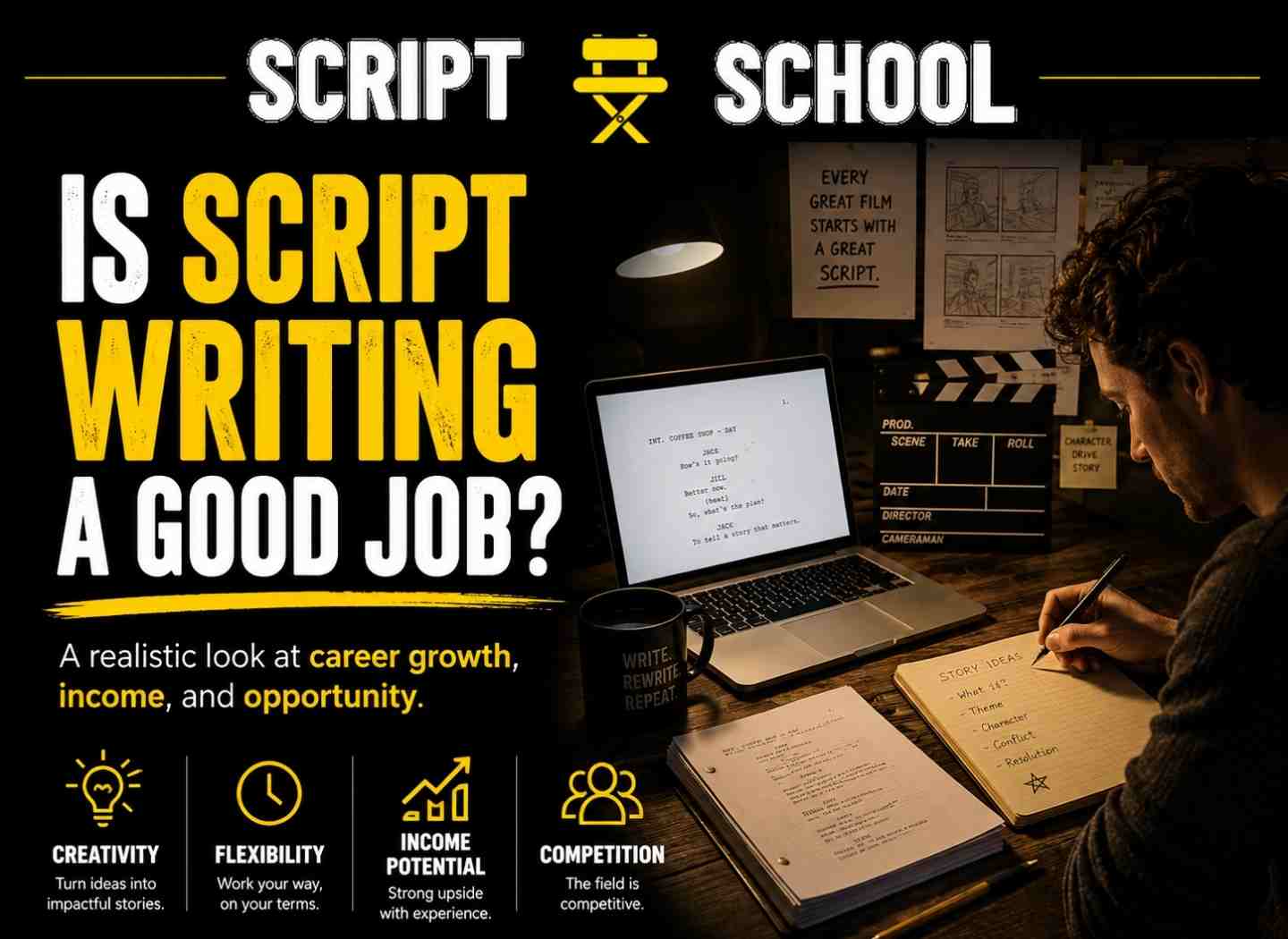
Short version? It’s a good job for the right person. Script writing gives you creative freedom, flexible hours, and the thrill of seeing your ideas come alive on a screen. That’s the upside, and it’s a big one.
But it isn’t for everyone. Income can swing. Rejection shows up often. And success usually takes longer than people expect.
Here’s a quick reality check before you commit.
What makes it great:
- You get paid to tell stories.
- You control your schedule and your style.
- There’s no single road in, so talent can beat pedigree.
- The work feels meaningful when a project lands.
What makes it hard:
- Money comes in waves, not a steady stream.
- You’ll rewrite the same pages many times.
- The field is crowded and competitive.
While many people love the work, the lifestyle catches some off guard. So is it the right career for everyone? No. It rewards creativity, but it tests patience. If that trade sounds fair to you, keep reading. We’ll help you figure out where you fit.
The Short Answer: Yes, But Only for the Right Person
Script writing is a good career if you genuinely enjoy the craft, not just the dream of it. That’s the whole filter.
Ask yourself one thing. Do you enjoy writing even when nobody is watching? The writers who last tend to love the process. They’d write anyway. The recognition is a bonus, not the fuel.
The ones who succeed usually share a few traits. They’re curious about people. They handle notes without falling apart. They finish what they start. And they treat a blank page as a fun problem, not a threat.
Some people love the craft. Others only love the idea of being a “writer.” That gap matters. If you light up at the actual work of building a scene, you’re already on the right track.
Why Script Writing Is Different From a Regular Job
Most jobs hand you a desk, a salary, and a clear path. Script writing hands you a blank page and says, go. That’s the big shift.
A script writing career behaves more like a startup than a traditional office job. You market yourself. You manage clients. You chase the next project before the current one ends. Many writers treat it like a small business, not just a creative hobby.
Here’s the trade in plain terms.
- Regular jobs: steady paycheck, fixed hours, a boss, less freedom.
- Script writing: variable pay, flexible hours, many clients, full creative ownership.
So what happens when your next paycheck depends on your next project? You learn to plan ahead. Regular jobs offer structure. Script writing offers freedom. You decide which one fits your life right now.
Script Writing vs Screenwriting: Are They the Same Job?
People mix these up all the time, so let’s clear it up fast.
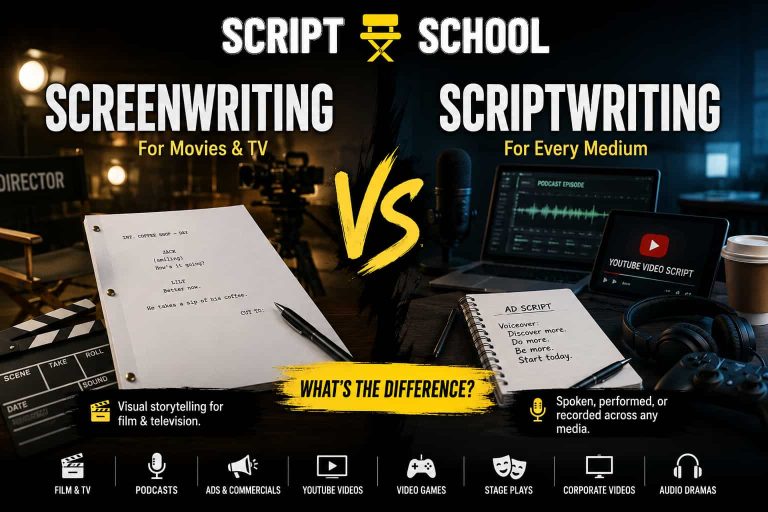
Script writing is the broad term. It covers any script, from a 30-second ad to a video game to a corporate training video. Screenwriting is the more specific term for film and television scripts.
Think of it this way. Are all screenwriters script writers, but not all script writers screenwriters? Pretty much, yes. One term is broader. The other is more specific.
In real life, many employers use both words to mean the same thing. But some roles want deep screenwriting craft, like feature structure and three-act pacing. We break this down further in our guide on screenwriting vs scriptwriting if you want the full picture.
What Does a Script Writer Actually Do?
A script writer acts as the architect of a story. You design the blueprint that directors, actors, and crews build from. But the day-to-day is more varied than most people imagine.
So what does a script writer actually do all day? You create stories, but you also solve problems. You brainstorm, draft, rewrite, take notes from a producer, then rewrite again. Most professional writers spend more time fixing pages than first-drafting them.
Here’s what the job really looks like.
Develops Story Ideas and Concepts
Every project starts with a spark. A “what if” question. A character who won’t leave your head. A real event that bugs you.
Strong concepts often start with a single compelling question. What if one idea could become a film, a series, or a game? That question becomes the engine of months of work.
You’ll pitch loglines, sketch outlines, and test ideas before a single scene exists. Our post on turning story ideas into a screenplay is a great place to practice this exact skill.
Writes Scenes, Dialogue, Action, and Character Arcs
This is the part everyone pictures. You write the scenes. You build the dialogue. You map how each character changes from page one to the end.
Good dialogue sounds natural, but it’s carefully built. Real people ramble. Characters speak with purpose. Every line should reveal something or push the story forward.
Dialogue is the engine that moves scenes ahead. Action lines paint the picture. Character arcs give the audience a reason to care. You juggle all three at once, scene after scene.
Revises Scripts Based on Feedback
Here’s a hard truth. The first draft is only the beginning of the real work. Pros expect to revise, a lot.
You’ll get notes from directors, producers, and editors. Some will sting. Most will help. Your job is to take useful feedback and reshape the script without losing its heart.
Practice makes perfect, and rewriting is where the magic happens. The story you imagined becomes the story that works.
Works With Directors, Producers, and Creative Teams
Writing may start alone, but production rarely does. Once a project moves forward, you join a team.
You’ll talk through changes with directors. You’ll adjust scenes to fit a budget. You’ll answer questions from actors who want to understand a moment. Writers who communicate well often get invited back.
That collaboration is one of the most rewarding parts of the job. Writing may start alone, but production rarely does. Strong relationships keep the work coming.
Is Script Writing a Stable Career?
Let’s tackle the question that keeps most beginners up at night. The honest answer? The work can feel unstable month to month, but the career can be stable year to year.
Here’s the key idea. A script writing career often looks more like a portfolio than a ladder. You don’t climb one rung at a time. You collect clients, credits, and recurring gigs that add up over time.
While income can fluctuate, that doesn’t mean the career is fragile. Many successful writers stop chasing stability from one project. Instead, they build it from a spread of clients and ongoing work. Can a career be successful even if every paycheck looks different? Absolutely.
Let’s look at how this plays out.
Most Script Writing Work Is Freelance or Project-Based
Here’s the part newcomers miss. Most script writing isn’t a salaried desk job. It’s freelance and project-based.
You sign on for a project, deliver it, then move to the next. Freelance work moves in seasons. Some months overflow. Others go quiet.
So what happens after a project ends? You hunt for the next one. The writers who stay busy usually network between gigs instead of waiting for the phone to ring. You gain flexibility, but you lose predictability. That’s the deal.
Income Can Be Unpredictable
Let’s be straight about money. Script writing income rises and falls.
Some months bring multiple contracts. Others bring none. When projects overlap, you feel rich. When they dry up, you feel the squeeze. That swing is normal, not a sign you’re failing.
So can you handle months that run slower than others? Smart writers can, because they plan for it. Many budget using yearly income, not monthly. They save during the busy stretches to cover the quiet ones. For real numbers, our screenwriter salary breakdown shows what the swings actually look like.
Many Writers Build Multiple Income Streams
Here’s the move that turns chaos into stability. Don’t rely on one client. One client creates income. Multiple clients create stability.
Experienced writers spread their work across several lanes. A few examples:
- Commercial and ad scripts
- YouTube and digital video scripts
- Corporate and training videos
- Script consulting and editing
- Their own film or TV projects on the side
Don’t put all your eggs in one basket. That old line is the whole strategy. Mix steady, lower-stakes work with the bigger dream projects. The steady stuff pays the bills while the dream stuff grows.
How Much Do Script Writers Get Paid?
Now for the question you really want answered. The honest truth? Pay ranges wildly. Beginners may earn little. Top writers earn six figures and more.
The biggest income driver isn’t years spent writing. It’s reputation and credits. As writers gain experience, their rates climb fast. Income grows like a snowball when credits stack up.
Can script writing become a six-figure career? Yes, for some. But it builds slowly. Beginners compete for exposure. Professionals compete for opportunities. Here’s how the climb works.
Entry-Level Script Writers May Start With Low or Unpaid Projects
Let’s set expectations. Many beginners start with small, low-pay, or even unpaid projects. That’s the norm, not a scam.
You have to crawl before you walk. Early jobs build your portfolio, your contacts, and your confidence. Early projects build experience. Later projects build income.
A short film for a student director might pay nothing. But it gives you a credit, a sample, and a relationship. Those become your launchpad.
Professional Writers Can Earn More With Credits and Experience
Once you have produced work behind you, the picture changes. Each credit becomes another brick in your professional reputation.
One produced project often carries more weight than years of unpublished scripts. A buyer wants proof you can deliver something audiences actually watch.
As your credits grow, so does your leverage. You raise your rates. You get bigger projects. You start picking clients instead of begging for work. That’s the real payoff of sticking with it.
Pay Depends on the Type of Script
Not all scripts pay the same. A YouTube script and a feature film script live in different worlds. Different scripts require different skills and command different rates.
Here’s a rough sense of the lanes.
- Feature films: big potential payouts, long development, high competition.
- TV: strong pay and steadier work once you’re in a room.
- Commercials and corporate: smaller per-project, but reliable and frequent.
- Video games and digital: growing fast, with varied rates.
Is a YouTube script worth the same as a feature script? No. But commercial and corporate scripts often provide steadier income than film projects. Many writers blend both.
Why Script Writing Income Is Hard to Predict
So what determines your paycheck next month? A lot of things you don’t fully control. Client demand. Project cycles. Timing. Budgets.
Income often moves in waves rather than straight lines. One quarter booms. The next one stalls. That’s why planning beats guessing.
The good news? Predictability improves over time. Once you build recurring clients and long-term relationships, the waves get gentler. Talent helps create opportunities. Consistency helps sustain them.
What Makes Script Writing a Good Job?
After all that talk of risk, here’s the flip side. Writers stick around for real reasons. The path may be difficult, but the work can be deeply rewarding.
Script writing gives ideas a stage before they ever reach an audience. That feeling is hard to match. And the perks go well beyond the creative high.
So why do writers stay in the industry despite the challenges? Many stay for the creative satisfaction long before the big money arrives. Even when projects take time, the craft keeps pulling them back. Here’s what makes the job worth it.
Creative Fulfillment
This is the heart of it. You turn ideas, feelings, and stories into something real. A script is the blueprint of a story, and you get to draw it.
What does it feel like to watch characters you created come to life? Writers describe that moment as one of the best of their careers. Words on a page become a performance that moves people.
You create something from nothing, then watch others bring it to life. That kind of purpose is rare in any job. For many writers, it’s the whole reason they keep going.
Flexible Work Environment
Want to write at 6 a.m. in your kitchen? Go for it. Prefer midnight in a quiet café? That works too.
Script writing offers serious flexibility in where, when, and how you work. Many writers build their day around peak creativity hours instead of a clock. No commute. No cubicle. No one watching the clock for you.
Would you rather sit in traffic, or write from a space that inspires you? Most writers know their answer. You manage your schedule, but you stay responsible for results. Freedom and accountability go hand in hand.
Collaboration With Creative People
Writing starts solo, but the best part is often the team. You get to work with directors, producers, actors, and editors who care about the same story you do.
A production team works like an orchestra, and the script provides the score. Everyone plays their part to bring your pages to life. That sense of shared purpose feels great.
Writing begins as an individual act, but production becomes a team effort. And here’s a quiet secret. Strong relationships often create more opportunities than strong scripts alone.
No Single Required Degree Path
Good news for self-taught dreamers. A degree can help open doors, but strong writing keeps them open.
What matters more, a diploma or a script that keeps people reading? In this field, the writing wins. Industry decision-makers usually read your samples before they check your résumé.
That makes script writing one of the most accessible creative careers. You don’t need permission to start. You need pages. If you want structure while you learn, our courses and the foundational Screenwriting 101 class give you a clear path without a four-year commitment.
Multiple Career Paths Beyond Hollywood
Who says script writing only exists in Hollywood? The industry has many doors, not just one entrance.
You can write for film and TV, sure. But you can also write for video games, YouTube channels, ad agencies, corporate clients, and training programs. The demand for clear, compelling scripts keeps growing.
Where there’s a will, there’s a way. Many writers earn steady income from commercial and digital work while chasing bigger creative goals. Some writers chase movies. Others build careers across many industries. Both are valid. Both can pay.
What Are the Downsides of Script Writing?
Let’s keep it real. The opportunities can be exciting, but the obstacles are very real. A good career guide tells you the hard parts too.
The industry often feels like a crowded stage where everyone wants a speaking role. Standing out takes time, skill, and grit. Most writers who stay learn to manage uncertainty before they learn to maximize income.
Although the rewards can be meaningful, the challenges trip up plenty of talented people. So what keeps gifted writers from succeeding? Usually it’s one of these. Nothing worth having comes easy, so let’s look at what you’re signing up for.
It Is Highly Competitive
There’s no soft way to say it. Script writing is crowded. How many scripts compete for a single opportunity? Often hundreds.
Breaking in can feel like trying to stand out in a packed theater. Everyone has a script. Everyone thinks theirs is the one. Getting noticed takes real effort.
But competition isn’t a wall, it’s a filter. The strongest portfolios often beat the longest résumés in creative fields. Talent helps you enter the conversation. Consistency helps you stay in it.
Rejection Is Part of the Job
You will get rejected. A lot. At every level. Even produced writers hear “no” more than “yes.”
What if rejection is simply part of the process, not proof of failure? That mindset shift matters. Many great scripts were turned down many times before the right buyer said yes.
If at first you don’t succeed, try again. That’s not a cliché here, it’s the job. One rejection ends an opportunity. Persistence creates another. The writers who last build thick skin and keep submitting.
Your Work May Not Get Produced
Here’s a tough one. A great script doesn’t guarantee a finished film. Writing a script is one challenge. Producing it is another.
A script can sit on a shelf for years before it reaches a screen. Sometimes longer. Sometimes never. Can a great script still go unproduced? Sadly, yes.
But it’s usually not about quality. Many strong scripts stall because of timing, budgets, or market demand. Knowing that protects your confidence. A “no” today might become a “yes” when the market shifts.
Deadlines and Rewrites Can Be Stressful
The flexible schedule has a flip side. Deadlines hit hard, and rewrites pile up.
What happens when a major rewrite lands the night before a deadline? It happens more than you’d think. When production schedules tighten, the pressure lands on the writer. You adapt or you fall behind.
Pros plan for this. They reserve extra time for revisions because feedback almost always arrives after the first draft. Creativity inspires the draft. Discipline finishes it.
Financial Security Takes Time
Last one, and it’s important. Money stability usually comes after career growth, not before it.
Rome wasn’t built in a day. A writing career is built brick by brick, not overnight. Your first year may feel like all effort and little reward. That’s normal.
Stability tends to arrive once you build repeat clients, production credits, and a referral network. Early years build experience. Later years build security. Patience is part of the plan, not a sign something’s wrong.
Who Is Script Writing a Good Job For?
Skills can be learned. Mindset is harder to fake. So let’s talk about who actually thrives here.
The people who last longest in script writing aren’t always the most talented. They’re often the most persistent. Skill opens doors. Mindset keeps them open.
The right mindset acts as fuel for a long creative journey. Even when progress feels slow, certain traits keep writers moving. So what kind of person thrives in a script writing career? See if you recognize yourself below.
People Who Love Storytelling
Do you find yourself imagining stories everywhere you go? In a coffee shop, you wonder about the couple arguing in the corner. In traffic, you build a backstory for the driver next to you.
If that’s you, good sign. Story ideas become seeds that can grow into entire productions. Writers who naturally study movies, shows, and characters tend to develop sharper instincts.
Some people watch stories. Others feel compelled to create them. The second group usually finds a home in this work.
People Who Can Handle Feedback
Here’s a make-or-break trait. Can you improve without hearing what needs improvement? In this field, you can’t.
Notes are constant. Producers, directors, and editors will pick apart your pages. The pros separate criticism of the script from criticism of themselves. That one habit protects your sanity.
Feedback may feel uncomfortable today, but it can improve your work tomorrow. If you can take a note without taking it personally, you’re built for this.
People Who Are Patient and Self-Motivated
No boss will stand over your desk. No alarm forces you to write. That freedom is a trap for some people and a gift for others.
A writing career is a long-distance race, not a sprint. Slow and steady wins it. Most scripts get finished because of discipline, not a burst of inspiration.
Motivation starts the project. Discipline finishes it. If you can show up on the dull days, the ones with no spark, you’ll outlast most of the field.
People Who Enjoy Film, TV, Theatre, Games, or Digital Media
This one’s simple. Do you love the medium? Not just one type, but storytelling in many forms?
What if your favorite form of entertainment could become your career? Writers who study film, TV, theatre, games, and digital media tend to be more versatile, and versatility means more work.
Some writers focus only on films. Others build careers across many media formats. The more curious you are, the more doors you’ll find. If hands-on experience appeals to you, our take on why hands-on filmmaking experience matters is worth a read.
Who Should Think Twice Before Choosing Script Writing?
Honesty time. This career isn’t for everyone, and that’s okay. The dream can be exciting, but the process can be difficult.
The biggest source of frustration usually isn’t the work itself. It’s unrealistic expectations. Look before you leap. The industry rewards endurance more than quick wins.
So ask yourself a hard question. Are you pursuing the craft, or only the outcome? If you see yourself in the groups below, slow down and think it through before you jump in.
People Who Need Immediate Stable Income
If you need a steady paycheck starting next month, script writing alone is risky. The early income is too unpredictable.
Can you handle uncertainty while building experience? If the answer is no right now, that’s fine. Many successful writers start part-time while keeping another income source. There’s no shame in it. It’s smart.
Some careers provide immediate security. Script writing often requires patience first. Match the path to your real life, not the fantasy.
People Who Dislike Rewriting
Love writing but hate revising? This might frustrate you daily. Rewriting is the job, not a side task.
The first draft is raw clay. Rewriting shapes the final sculpture. Many professional scripts go through dozens of revisions before production. Dozens.
Writing creates the foundation. Rewriting strengthens it. If polishing the same pages over and over sounds painful, weigh that carefully.
People Who Struggle With Rejection
Rejection in this field is constant. If a single “no” knocks you down for weeks, the day-to-day will hurt.
Fall seven times, stand up eight. That’s the rhythm. Many pros keep a steady submission pipeline so one rejection never defines their progress. They always have another shot in motion.
Rejection closes one door. Persistence opens another. You don’t need to enjoy rejection. You just need to survive it without quitting.
People Who Only Want Fame or Money
If fame or fast money is the only goal, this path will likely disappoint you. Both come slowly, if at all.
Would you still write if nobody knew your name? That question reveals a lot. Fame is a spotlight, but craft is the foundation beneath it. The writers who focus on skill tend to get better long-term results than those chasing only recognition.
Recognition may arrive later. But skill must arrive first. Get the order right and the rest has a chance to follow.
What Skills Do You Need to Become a Good Script Writer?
Good news. Script writing is a learnable craft, not just a born talent. Talent starts the journey. Skills sustain it.
Skills are the tools that build every successful script. And here’s a secret. Most pros improve faster by mastering the basics than by chasing fancy techniques.
So what separates an aspiring writer from a professional one? Usually these core skills. Build them in order, and the whole job gets easier.
Story Structure
Story structure is the skeleton that supports the entire script. Without it, even great scenes collapse.
Many weak scripts fail because of structure problems, not idea problems. The setup, the turns, the climax, the resolution. They all need to land in the right place at the right time. Learn the shape first, then fill it with your voice.
Character Development
Would anyone care about the story if they didn’t care about the characters? No. People come back for characters.
Audiences often remember characters longer than plot details. So you build people, not just plot points. Give them wants, flaws, and a reason to change. That’s what hooks viewers and keeps them watching.
Dialogue Writing
People talk in real life. Characters communicate with purpose. That’s the difference good dialogue captures.
Strong dialogue reveals character while moving the story forward at the same time. It sounds natural but never wastes a line. Cut the small talk. Keep the lines that do double duty.
Visual Writing
Film and TV are visual first. Visual writing paints pictures with words. You describe what the audience sees, not just what they hear.
Film audiences remember what they see more than what they hear. So you learn to “show, don’t tell.” A glance can say more than a paragraph of dialogue. Master that and your scripts feel cinematic.
Formatting and Industry Standards
First impressions matter. Poor formatting can stop a script from being taken seriously before page one.
Producers and readers expect a clean, standard format. Messy pages signal an amateur. Clean pages signal a pro who respects the craft. Learn industry formatting early. It’s a quick win that pays off forever.
Research and Adaptability
The best writers keep learning. Research improves accuracy. Adaptability improves longevity.
You’ll write about worlds you don’t live in, so research matters. And markets shift, so you adapt. Writers who adjust to changing trends and tools tend to find more opportunities than those who stand still.
How Do Beginners Start a Script Writing Career?
Feeling ready? Here’s the roadmap. The journey of a thousand miles begins with a single step, and your first step is closer than you think.
Here’s the secret most beginners miss. Writers who finish scripts consistently progress faster than those who endlessly study theory. Learning creates knowledge. Practice creates results.
So where should a beginner start? Follow these steps in order. Don’t skip ahead.
Learn the Basics of Script Format
A map helps before a journey begins. Learn industry-standard formatting before you write your first feature.
It takes a weekend to learn and saves you years of looking like an amateur. Get the margins, sluglines, and structure right from day one.
Read Professional Scripts
Success leaves clues. Study produced scripts to understand pacing, structure, and voice.
Read the scripts of films you love. Notice how little is on the page and how much it does. Reading great writing is one of the fastest ways to write better yourself.
Start With Short Scripts
Small wins build big results. Short scripts teach structure faster than giant projects.
A five-page short forces you to be tight and clear. You finish it. You learn from it. Then you do it again. Momentum beats ambition early on.
Build a Writing Portfolio
Your work speaks before you do. A portfolio proves skill better than any claim ever could.
Collect your best finished pieces. A short film, a spec scene, a pilot. When opportunity knocks, you’ll have proof ready to show, not promises.
Get Feedback and Rewrite
Good becomes great through refinement. Revision often creates the strongest version of a script.
Share your pages. Take notes. Rewrite. Repeat. This loop is where real growth happens. A private consultation can speed this up with focused, expert feedback on your actual pages.
Submit to Contests, Fellowships, Jobs, and Producers
You miss 100% of the shots you don’t take. Get your work in front of people.
Enter contests. Apply to fellowships. Pitch producers. Exposure creates opportunities even when you don’t win. Each submission builds your network and your nerve. When you’re ready to pitch, our pitching and packaging course helps you present your work like a pro.
Is Script Writing Still Worth It With AI?
Big question for 2026. AI writing tools are everywhere now. So can technology replace human imagination? Not the part that matters.
Here’s the balanced view. AI generates words. Humans create meaning. The writers who learn AI tools often gain a speed advantage without giving up their creative edge.
AI changes the workflow. It doesn’t erase the need for real storytelling. Here’s how to think about it.
AI Can Help With Drafting, Brainstorming, and Organization
Used well, AI is a handy assistant. It can spark ideas, organize notes, and rough out a draft you then shape.
Use AI to speed up routine tasks, not creative judgment. AI can be a calculator for ideas, not a replacement for creativity. You still decide what’s good, what’s true, and what moves people.
Human Storytelling Still Matters
Here’s what AI can’t fake. Lived experience. People connect most strongly with authentic human emotion.
People remember emotions more than information. A machine can arrange words. It can’t feel heartbreak, or joy, or the weird ache of a memory. That’s your edge, and it’s a big one.
Future Script Writers Need Both Craft and Adaptability
The smart play is to combine both. The most successful future writers will pair strong storytelling with tech literacy.
Adapt or get left behind. That’s the simple rule. Learn the craft deeply, then learn the tools that make you faster. Do both and you stay valuable no matter how the industry shifts.
Script Writing Job Options and Career Paths
The script writing industry contains many roads to success. You don’t have to pick just one. Some writers specialize. Others diversify.
Many full-time writers earn from several script categories at once. Here are the main lanes you can explore.
Film Screenwriter
Every movie begins with a script, and that’s your job here. You write features for the big screen.
Feature films often require the longest development cycles. The payoff can be huge, but patience is required. This is the classic dream role.
TV Writer
Television rewards consistency. You write episodes, often inside a writers’ room with a team.
Collaboration skills are critical in writers’ rooms. If you like steady work and creative teamwork, TV is a strong path. Our TV Pilot Lab is built to get you room-ready.
Video Game Writer
Players shape the experience, so the writing works differently. You build branching stories and interactive dialogue.
Interactive storytelling requires different techniques than film. This field is growing fast and hungry for fresh voices.
Advertising and Commercial Script Writer
Every second counts in a commercial. You write short, punchy scripts that sell.
Clear messaging often matters more than complex storytelling here. The projects are quick, the work is frequent, and the pay is reliable.
YouTube and Digital Video Script Writer
Attention is the new currency. You write scripts built to hook viewers in seconds.
Audience retention drives every script decision. This space is booming, and creators constantly need sharp writers.
Corporate and Training Video Writer
Information becomes action through clear communication. You write scripts for businesses, training, and internal videos.
This niche often provides more consistent work than entertainment projects. It’s not glamorous, but it pays steadily and builds your skills.
Is Script Writing Better as a Job, Side Hustle, or Passion Project?
Now for a smart strategic question. You don’t have to quit everything to start. Some writers start full-time. Others build momentum gradually.
Most successful writers began part-time. They went full-time only after building a portfolio, a network, and a client base. A side hustle can act as a bridge between interest and career.
Don’t bite off more than you can chew. Evaluate your finances before you choose a path. Here’s how to think it through.
Starting as a Side Hustle Is Often Smarter
For most beginners, the side hustle route wins. It removes the panic of “I need money now.”
Financial pressure often hurts creativity. A side hustle gives you time to improve without the fear. Slow and steady wins the race. A side hustle creates a safety net while your skills grow.
You earn stability from one job while building another. That balance keeps you sane and keeps you writing.
Full-Time Script Writing Requires Proof of Work
Want to go full-time? You’ll need proof. Why would someone pay for your writing before they’ve seen your work?
Most hiring decisions ride on scripts, credits, and results, not résumés. So build samples first. Earn a few credits. Then make the leap when the proof backs you up.
Passion starts the journey. Proof creates opportunities. Don’t quit your day job until your portfolio can carry you.
Passion Projects Can Lead to Paid Opportunities
Here’s a hopeful truth. Many writers got their first paid gig because of a personal project that showed their skill.
A passion project can become a calling card for your career. That short film you made for fun? It might be the sample that lands you a paying client. The project may start as personal work, but it can create professional results.
So make the thing you care about. It’s never wasted.
Final Verdict: Is Script Writing a Good Job?
Time to land the plane. The career is uncertain, but the opportunity is real.
Yes, script writing can be a genuinely good job. It offers creative freedom, flexible hours, and meaningful work. It also brings competition, rejection, and slow money. Both sides are true at once.
The people who succeed long-term usually enjoy the process, not just the outcome. The best time to plant a tree was years ago. The second-best time is today. So here’s your decision framework.
It Is a Good Job If You Love Story and Can Handle Uncertainty
If you love storytelling and can ride out the ups and downs, this is a great fit. Creative freedom grows alongside uncertainty.
Passion and persistence often matter more than perfect circumstances. If the work itself excites you, the hard parts feel worth it. You’re likely built for this.
It Is Not a Good Job If You Need Guaranteed Stability Right Away
If you need a guaranteed paycheck starting today, script writing alone isn’t the move yet. Look before you leap.
There’s no shame in building creative work alongside a traditional job. Many great writers did exactly that. Protect your stability while you grow your craft.
The Best Path Is to Learn the Craft, Build Samples, and Grow Slowly
For almost everyone, the smart path is the same. Learn the craft. Build samples. Grow slowly.
A script writing career is built one page at a time. Consistent output beats occasional bursts of inspiration. Start small, stay steady, and let your body of work do the talking.
Ready to take the first real step? Start writing and building your samples today. If you want a guided path, explore our screenwriting courses or book a private consultation to map your next move. Young writers can start early with our youth programs. And if you have questions, reach out anytime.
FAQs About Script Writing as a Job
Is script writing a good job?
Yes, script writing is a good job for people who love storytelling and can handle uncertain income. It offers creative freedom, flexible hours, and meaningful work. But it rewards patience and persistence, since steady money usually takes time to build.
Is script writing a stable career?
Script writing is stable over the long term, but not month to month. Most work is freelance and project-based, so income rises and falls. Writers create stability by building multiple clients, recurring gigs, and a strong portfolio over time.
Can script writers make good money?
Yes, script writers can make good money, though earnings vary widely. Beginners often start low or unpaid. Experienced writers with credits can reach six figures. Pay depends on the script type, your reputation, and how many income streams you build.
Is script writing hard to get into?
Script writing is competitive but accessible. There’s no required degree, so anyone can start. The challenge is standing out. A strong portfolio, consistent writing, and steady networking help you break in faster than waiting for luck.
Do you need a degree to become a script writer?
No, you don’t need a degree to become a script writer. Industry decision-makers usually judge your writing samples before your education. Courses and workshops help you learn faster, but a strong script matters more than a diploma.
What does a script writer do every day?
A script writer develops story ideas, writes scenes and dialogue, and revises drafts based on feedback. They also collaborate with directors and producers. Most days mix creative writing with rewriting, since pros spend more time revising than first-drafting.
Is script writing the same as screenwriting?
Not exactly. Script writing is the broad term for any script, including ads, games, and corporate videos. Screenwriting refers specifically to film and television scripts. All screenwriters are script writers, but not all script writers focus on screenplays.
Can beginners become script writers?
Yes, beginners can become script writers. Start by learning script format, reading produced scripts, and writing short pieces. Build a portfolio, get feedback, and submit your work. Consistent practice and persistence matter more than where you begin.
How long does it take to become a script writer?
The timeline varies a lot. Some writers land paid work within a year. Others take several years to build skills, samples, and contacts. Your speed depends on how often you write, how fast you improve, and how widely you network.
Will AI replace script writers?
No, AI is unlikely to replace scriptwriters. AI helps with drafting, brainstorming, and organization, but it can’t replicate authentic human emotion and lived experience. The strongest future writers will combine storytelling craft with smart use of AI tools.
This is a sensitive topic for anyone weighing a big career change. If you’re feeling stuck or uncertain about your path, talking it through with a mentor or career advisor can help. Want a personal game plan? Book a consultation or browse our blog for more guides.