Is 130 Pages Too Long for a Screenplay?
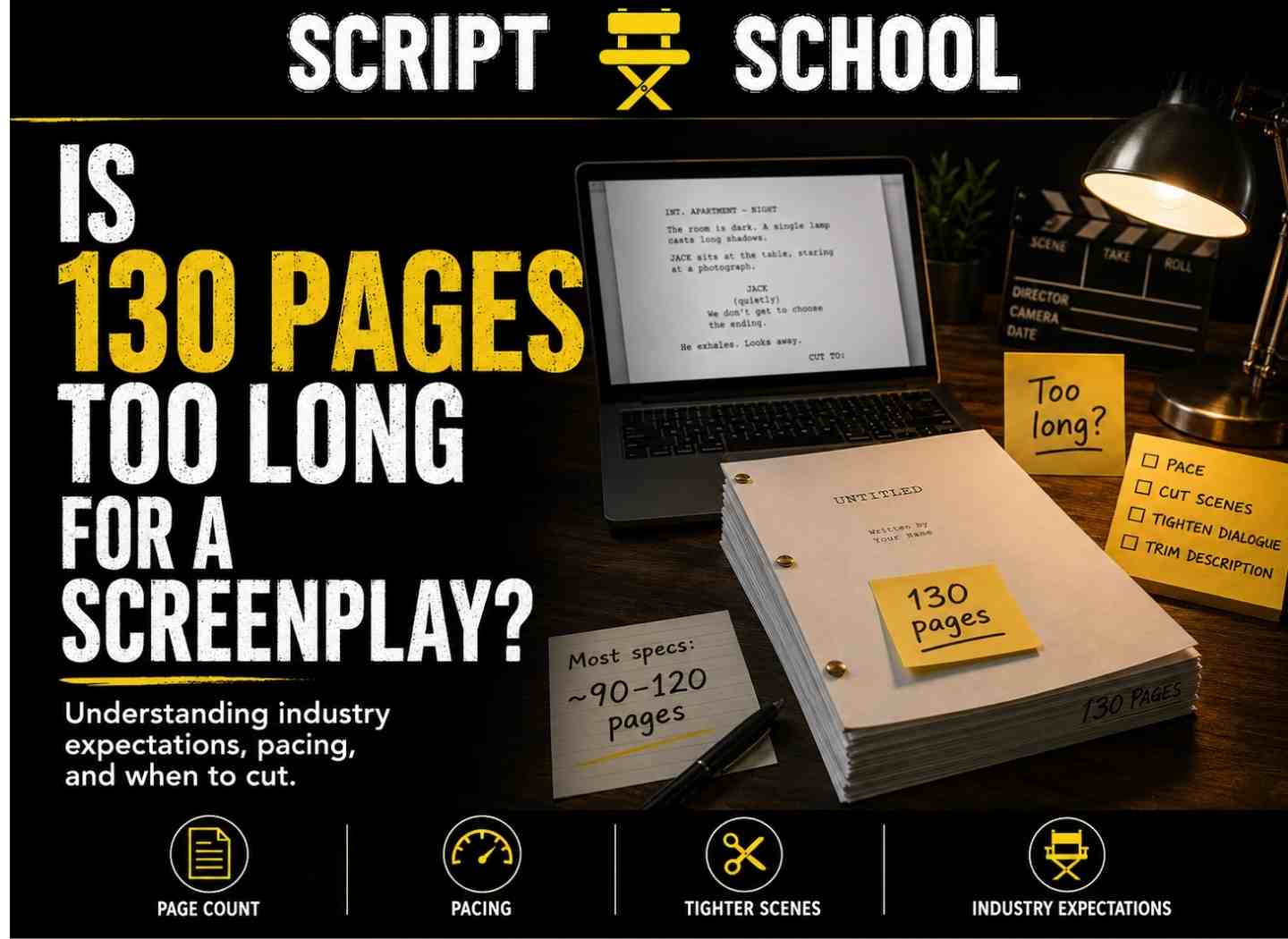
You finished your screenplay. Now you’re staring at the page count and wondering if 130 pages will scare away agents, producers, or contest readers. Here’s the short answer. 130 pages sits above the preferred industry range of 90 to 120 pages, so it reads as long, but it isn’t an automatic rejection. Pacing, genre, and execution decide your fate far more than the number in the corner. Keep reading, because the answer might surprise you.
Is 130 Pages Too Long for a Screenplay in Austin, TX?
Most industry pros prefer scripts between 90 and 120 pages, which makes 130 pages longer than average. That’s the honest benchmark. But longer than average is not the same as too long. A reader can fall in love with a 130-page script that moves. A reader can also bail on a 95-page script that drags.
So take a breath. Page count is a signal, not a verdict.
Austin makes this a little more interesting. The city runs on independent film energy, and many local producers and the screenwriting crowd around festivals like Austin Film Festival care more about voice and story than a rigid page ceiling. Still, tight pacing wins everywhere.
Here’s what the industry generally expects:
- Sweet spot: 90 to 120 pages for most feature specs
- Comfortable read: 95 to 110 pages
- Soft ceiling: 120 pages for many contests
- Above standard: 130 pages, which invites extra scrutiny
A screenplay doesn’t succeed because it’s longer. A screenplay succeeds because every page earns its place. If you want a second set of eyes on yours, a private consultation can tell you fast whether your length is working for you or against you.
Overview of Screenplay Length Standards
Length standards exist because readers are busy and budgets are real. Think of screenplay length like a movie trailer. It should promise enough without overstaying its welcome.
Most contests, agents, and readers use length as an early screening filter. They glance at the page count before they read a single line. A number inside the expected range feels safe. A number outside it raises a quiet question about discipline.
Quick reference for feature scripts:
- Standard feature: 90 to 120 pages
- Most readable zone: 95 to 110 pages
- Flags for review: 130 pages and up
None of this is law. It’s the lens readers bring before page one. If you want to understand the wider craft conversation, our breakdown of screenwriting vs scriptwriting clears up a lot of the basics.
Industry Standard Length Guide
Studios often prefer shorter scripts. Fewer pages mean less reading time and lower production risk. That preference shows up in the typical ranges by script type.
| Script Type | Average Pages |
|---|---|
| Comedy | 90 to 100 |
| Horror | 90 to 100 |
| Action | 95 to 110 |
| Drama | 100 to 120 |
The pattern is clear. Faster, leaner genres trend shorter. Heavier, character-driven stories earn a few more pages. A 130-page script lands above every row in this table, which is why it draws a second look.
One Page Equals One Minute Rule
The classic rule says one screenplay page roughly equals one minute of screen time. So 120 pages often points to a two-hour film. What happens when a screenplay reaches 130 pages?
You’re now signaling a runtime closer to 2 hours and 10 minutes. That’s longer than most commercial features aim for.
But the rule bends. Heavy action sequences often play out in fewer screen minutes than their page count suggests. Dialogue-light pages move quickly on screen. So 130 action-heavy pages can feel shorter than 110 talky ones. Use the rule as a guide, not a stopwatch.
Standard Screenplay Length Guidelines in Austin, TX
The accepted benchmark for a feature spec is 90 to 120 pages, with 95 to 110 as the comfort zone. That range keeps readers engaged and keeps producers calm about budget. Austin’s indie scene leans flexible, yet local readers still expect a script that respects their time.
Here’s the practical view:
- Feature spec: 90 to 120 pages
- Contest entries: often capped near 120 pages
- Studio comfort: 100 to 110 pages
- Above standard: 130 pages, which needs to justify itself
One more thing worth knowing. Most scripts shrink during development. Many lose 5 to 15 pages before they reach production. So a script that arrives lean tends to survive the process better.
Typical Feature Film Screenplay Length
Most feature films land between 90 and 120 pages. The commercial sweet spot is even tighter.
- Common range: 90 to 120 pages
- Most successful specs: near 100 to 110 pages
- Theatrical features: rarely below 80 pages
The takeaway is simple. If your story can land its full impact in 105 pages, that’s often the strongest version to send out.
Industry Standard Page Counts
Readers notice page count before they read page one. That first glance shapes their expectation of your skill.
| Page Count | Reader Reaction |
|---|---|
| 90 to 110 | Confident, on standard |
| 111 to 120 | Acceptable, watch the pacing |
| 121 to 130 | Long, needs to earn it |
| 131 and up | Risky for unknown writers |
The numbers above are perception, not policy. But perception moves fast in a stack of scripts.
Ideal Screenplay Length (90 to 120 Pages)
The ideal screenplay length for most features is 90 to 120 pages. That range balances depth with readability and keeps budget talk friendly.
Many contests treat 120 pages as an unofficial ceiling. Cross it and you may trigger a quiet bias before the read even starts.
A short summary to hold onto:
- Lower bound: 90 pages
- Upper bound: 120 pages
- Best target for new writers: 95 to 110 pages
Measure twice, cut once. The same wisdom that guides a carpenter guides a smart screenwriter.
Preferred Maximum Length for Modern Executives
Modern executives lean toward efficient scripts. Streaming raised the volume of projects they read, so they reward stories that get moving and stay moving.
That shift matters for you. The preferred maximum for most spec features now hovers around 120 pages, and many readers feel happiest under 115.
Readers reward momentum, not page count. They reward clarity, not complexity. A 130-page script can still win, but it has to prove every extra page pulls weight. If your story leans episodic or serialized, our TV Pilot Lab might be the better home for that scope.
Is 130 Pages Considered Too Long for a Screenplay in Austin, TX?
130 pages exceeds standard expectations, but it is not automatically disqualifying. That’s the nuanced truth. Professional readers rarely reject a script just because it hits 130 pages. They reject scripts that feel like 130 pages.
You may be staring at your draft and worrying those extra ten pages will cost you opportunities. The better question is this. Do those pages make the story stronger?
Here’s the quick read:
- 130 pages with strong pacing: often survives scrutiny
- 130 pages with slow scenes: usually gets cut or passed on
- 130 pages with epic scope: can be fully justified
Austin readers tend to value bold voice, but they still want momentum. So the bar is the same. Earn the length or trim it.
Expectations for Spec Scripts
Spec scripts face the strictest page-count expectations. You’re an unknown quantity to the reader, so length becomes a proxy for discipline.
A few realities:
- Established writers often get extra pages
- New writers usually must earn every page
- Submission guidelines may set hard limits
Treat the spec as your audition. A lean, confident page count tells the reader you know the craft. If you want your submission to feel airtight, Screenwriting 101 covers the fundamentals that keep specs tight.
Exceptions for Epic and Historical Films
Some stories need a larger canvas. An epic screenplay often paints with broader strokes than a contained thriller.
Historical dramas, fantasy films, and large-scale epics tend to justify longer runtimes. They carry more world, more characters, and bigger stakes.
Where longer length reads as acceptable:
- Period pieces with deep historical context
- Fantasy worlds that need rules and lore
- Multi-generational or war epics
- Stories with many interwoven arcs
If your project lives in this space, 130 pages may be exactly right. The genre buys you room.
When a 130-Page Script May Be Acceptable
A 130-page script works when the story demands it and the pacing delivers it. A fast-moving 130-page screenplay often beats a sluggish 110-page screenplay.
Use this checklist to test your draft:
- Every scene advances plot, reveals character, or raises conflict
- The midpoint and climax hit on schedule
- No subplot stalls the main story
- The genre supports a longer runtime
- Readers report the pages fly by
If every scene advances the story, should page count alone decide your screenplay’s value? Probably not. But if you can’t check most of these boxes, the length is a warning sign. A script consultation can pinpoint which scenes are pulling weight.
When a Longer Screenplay May Be Acceptable
Length gets easier to defend when the project has built-in demand. Recognizable intellectual property, proven commercial appeal, or an attached director can all buy extra pages.
Other situations that support longer scripts:
- Layered narratives with multiple strong threads
- Source material with a loyal audience
- A writer with a track record
The pattern holds. The more value a project carries on its own, the more flexibility readers give the page count.
Industry Expectations for Screenplay Length in Austin, TX
Agents, managers, producers, and readers all use length as a quick read on your craft. They form pacing judgments within the first ten pages and page-count judgments before page one.
The issue is not whether a screenplay reaches 130 pages. The issue is whether readers believe it needed 130 pages.
Across the board, the expectation lands here:
- Agents and managers: prefer market-ready lengths near 100 to 110 pages
- Producers: weigh length against budget and runtime
- Contest readers: often cap near 120 pages
- Austin indie producers: flexible, but still want tight pacing
Recommended Length for Spec Scripts
The safest spec script length sits between 95 and 110 pages. That zone is the industry’s most comfortable reading range.
| Range | Verdict |
|---|---|
| 90 to 110 | Recommended |
| 111 to 120 | Acceptable |
| 121 to 130 | Long, justify it |
| 131 and up | High risk for new writers |
Aim for the recommended band when you can. It removes one easy reason to pass.
Expectations of Agents and Producers
Agents care less about length and more about whether length creates friction during evaluation. A clean, fast read keeps them turning pages. A bloated one gives them an exit.
Writers often worry about page count. Producers usually worry about pacing, budget, and audience engagement. Those are the levers that move a yes.
What they really watch:
- Does the read feel effortless?
- Does the budget feel manageable?
- Will an audience stay engaged?
Nail those three and your page count fades into the background.
Balancing Story Depth and Readability
You can keep depth without adding bloat. The trick is making every scene work overtime.
A sharp knife cuts deeper than a dull one. The same applies to your pages.
Run each scene through this filter:
- Does it advance the plot?
- Does it reveal character?
- Does it raise conflict?
Every scene should hit at least one. The best scenes hit all three. When a scene checks none, it’s filler, and filler is where your extra pages hide.
How Producers and Readers View Long Screenplays in Austin, TX
When a producer or reader sees a long screenplay, the page count sets an expectation before the first line. They brace for slow pacing and a bigger budget. That bias is real, and it starts working against you the moment they open the file.
The good news is you can flip it. A long script that reads fast resets the reader’s mood within ten pages.
Here’s how the psychology breaks down across the next sections.
Reader Fatigue and Attention Span
Readers move through stacks of scripts, so attention is a scarce resource. A screenplay that feels fast often reads shorter than its actual page count.
Would you rather read 130 pages that fly by or 100 pages that drag? Every reader picks the fast read. Your job is to make 130 feel like 100 by cutting drag and sharpening scenes.
Budget and Production Concerns
Longer runtimes usually mean bigger budgets. More pages tend to mean more scenes, more locations, and more shooting days.
Cost factors that grow with length:
- Extra shooting days and crew time
- More locations and set builds
- Larger cast and more scheduling
- Heavier post-production and editing
Texas film production carries its own incentives and logistics, so local producers watch budget closely. If financing is on your mind, our course on how to raise money for your first movie walks through the realities.
First-Impression Impact on Script Evaluation
Page count acts as a silent signal of discipline, pacing, and editing skill. It shapes the reader’s first impression before the story even begins.
A number inside the standard range whispers, this writer knows the craft. A number well above it whispers the opposite. You can overcome that first impression with strong pages, but you start a step behind.
Reader Fatigue for Busy Production Executives
Executives may review dozens of projects in a single week. That workload makes efficiency a competitive advantage for your script.
They are not looking for more pages. They are looking for stronger pages.
What a busy executive rewards:
- A read they can finish in one sitting
- A clear hook in the first ten pages
- A story that never makes them check the page number
Respect their time and you earn their attention.
Why a 130-Page Screenplay Raises Red Flags in Austin, TX
A 130-page count itself is not the problem. The concern comes from what the length might signal about pacing, editing discipline, and production cost. Many readers quietly wonder whether a long script hides unnecessary scenes before they even start reading.
When you see 130 pages on your screenplay, do you feel proud or worried? Many writers feel both at once. Readers feel the worry first, so let’s unpack why.
Pacing Issues From Slow Storytelling
Extra length often creates pacing problems. A screenplay rarely feels long because of page count. It feels long because scenes linger after their purpose is complete.
A screenplay should move like a river, not sit like a pond. When scenes stall, momentum dies, and the reader notices.
Common culprits:
- Scenes that repeat a beat the audience already understands
- Conversations that circle without changing anything
- Setups that take too long to pay off
Cut the lingering and the pacing tightens on its own.
Higher Budgets Required for Longer Runtimes
Length and money move together. Even a few extra pages can add real cost through more shooting days and post-production work.
Longer scripts require more scenes, more locations, and more resources. Each added page can ripple into:
- Additional days on set
- More crew hours and gear
- Larger editing and sound budgets
Producers see the page count and start doing budget math in their heads.
Amateur Perception Due to Lack of Editing
A bloated script can read as unedited, and unedited reads as amateur. That perception is hard to shake.
The sculptor reveals the statue by removing stone. Screenwriters improve scripts by removing excess pages.
Strong writers cut scenes they love when those scenes weaken pacing. That willingness to trim is one of the clearest signs of a pro. If you want help spotting your weak pages, a consultation gives you an outside read fast.
Risks of a 130-Page Screenplay in Austin, TX
A long screenplay carries practical risks beyond a longer read. The more pages you add, the more chances appear for pacing problems and unnecessary content to creep in.
Most writers focus on the benefits of extra pages. Few stop to consider the hidden costs. Let’s name them clearly.
Slower Pacing
More pages can drain narrative momentum. Momentum often matters more than complexity.
Does every scene push the story forward, or does it simply take up space? If even a handful of scenes idle, the whole script feels heavy. Slow pacing is the number one reason long scripts get passed on.
Unnecessary Scenes and Dialogue
Excess content is the quiet way page counts balloon. Good scenes entertain. Great scenes entertain and advance the story.
Scan your draft for:
- Scenes that restate known information
- Dialogue that explains what the audience already sees
- Beats that repeat an earlier emotional moment
Trim these and you reclaim pages without losing story.
Increased Production Costs
Length drives cost, and cost drives rejection. Many independent productions actively seek shorter scripts to control budgets.
A higher page count can mean:
- More locations and setups
- Longer schedules
- Bigger line items across the board
For an indie producer in Austin, a leaner script is simply easier to say yes to.
Bloated Story Structure
A 130-page script can hide a structural problem. Subplots should support the central story, not compete with it.
A screenplay overloaded with subplots can become a crowded highway where no story moves efficiently. When too many threads fight for space, the main story slows and the reader loses the thread.
Excessive Runtime Concerns
130 pages points to a runtime well past two hours. Many commercial films target runtimes that maximize audience retention and theater turnover.
A longer runtime can mean fewer daily screenings and a tougher sell to distributors. That’s a quiet commercial risk baked into your page count.
Increased Risk of Script Rejection
Rejection often stems from the issues hidden inside a long screenplay rather than the page count itself. The length simply gives those issues more room to appear.
Reduce the risk by:
- Tightening pacing in the second act
- Cutting scenes that change nothing
- Sharpening dialogue throughout
A leaner draft removes the easy reasons to pass. A focused script review can catch the issues before a reader does.
Benefits of a Longer Screenplay in Austin, TX
Length is not always the enemy. The right extra pages can deepen the audience experience instead of slowing the story. Sometimes the pages that seem excessive are the very pages that make a story unforgettable.
The rule stays simple. A longer script earns its length when every added page strengthens the experience.
More Character Development
Extra pages can build richer character arcs. Readers often remember great characters long after they forget plot details.
Audiences rarely fall in love with pages. They fall in love with people. Use added length to:
- Give your lead a real internal journey
- Earn emotional payoffs with proper setup
- Let key relationships breathe
When length serves character, readers feel it.
Expanded World-Building
Longer scripts can support immersive settings. Fantasy and science-fiction projects often need extra setup to establish rules and environments.
World-building gives the audience a map before asking them to explore unfamiliar territory. Done well, those pages pull readers deeper into your story rather than slowing them down. Genres like horror also lean on careful atmosphere, which sometimes asks for a little more room.
Complex Storytelling Opportunities
More pages open the door to layered storytelling. Multiple character arcs and interwoven plots need space, but they also need discipline.
A story can be broad without being bloated, and deep without being slow. The best long scripts juggle several threads while keeping one clear spine.
Use the extra room for:
- Parallel storylines that converge
- A rich ensemble with distinct goals
- Themes explored from several angles
Screenplay Length by Genre in Austin, TX
Length expectations shift by genre, so 130 pages can feel excessive in one category and reasonable in another. The difference often comes down to audience expectations and how much world the story needs to build.
Readers forgive longer page counts in genres that demand world-building or many storylines. They rarely forgive weak pacing in any genre.
| Genre | Typical Pages |
|---|---|
| Comedy | 90 to 100 |
| Horror | 90 to 100 |
| Action and Thriller | 95 to 110 |
| Drama | 100 to 120 |
| Fantasy and Sci-Fi | 110 to 130 |
| Drama and Epic | 110 to 120 |
A 130-page script fits most comfortably in epic, fantasy, or sprawling drama territory. Outside those, it needs a strong reason to exist.
Drama Screenplay Length
Dramas usually run 100 to 120 pages. Character-driven dramas can justify slightly longer runtimes when the emotional payoffs stay strong.
Depth is the point of a drama, so a few extra pages feel natural here. Just make sure each one builds toward a meaningful moment.
Comedy Screenplay Length
Comedies typically run 90 to 100 pages and lean short for a reason. Comedy depends on pace. Extra pages can weaken joke timing and audience engagement.
The laughs should arrive quickly, and the story should move quickly. A 130-page comedy is almost always too long.
Action and Thriller Screenplay Length
Action and thriller scripts usually land between 95 and 110 pages. Action sequences often consume pages faster than dialogue-heavy scenes.
Action scripts move like a sprint, while slower genres often move like a marathon. Tension lives in momentum, so keep the pages lean and the stakes rising.
Fantasy and Science Fiction Screenplay Length
Fantasy and sci-fi scripts commonly run longer, often 110 to 130 pages. These worlds need rules, lore, and setup before the story can fly.
Some worlds require more pages to explain. The real challenge is keeping readers engaged while doing it. The more rules a fictional world needs, the more efficiently you must deliver them.
Comedy (90 to 100 Pages)
Many successful comedy scripts land between 95 and 100 pages. Shorter keeps the energy high and the jokes landing.
- Target: 90 to 100 pages
- Best zone: 95 to 100 pages
If your comedy stretches past 110, start trimming.
Horror (90 to 100 Pages)
Horror scripts usually run 90 to 100 pages. Many low-budget horror films benefit from tighter runtimes and smaller production footprints.
- Target: 90 to 100 pages
- Why it works: lean budgets and sustained tension
A tight horror script is easier to finance and easier to scare with.
Action and Thriller (95 to 110 Pages)
Action and thriller scripts sit best between 95 and 110 pages. Fast pacing often matters more than total page count in thrillers.
- Target: 95 to 110 pages
- Watch for: scenes that slow the tension
Can readers feel tension if the story spends too much time slowing down? Rarely. Keep it moving.
Drama and Epic (110 to 120 Pages)
Larger dramas and epics run 110 to 120 pages, and this is the category most likely to justify a count near 130.
- Target: 110 to 120 pages
- Stretch zone: up to 130 for true epics
Some stories need more room to breathe because their stakes stretch across generations, worlds, or history itself.
How to Determine If Your Screenplay Is Too Long in Austin, TX
Here’s a practical way to test whether your screenplay truly needs its length. Script doctors often spot 5 to 10 removable pages within minutes because they focus on repetition, not story.
Most writers worry about cutting scenes they love. The real question is whether those scenes help the story or simply make it longer.
Run your draft through the three checks below.
Evaluating Scene Necessity
Test every scene against three goals. A scene should advance plot, reveal character, or increase conflict. The strongest scenes do all three.
Ask of each scene:
- Does the story end this scene in a new place?
- Does a character change or reveal something?
- Does the tension rise?
If a scene changes nothing, reveals nothing, and risks nothing, it probably does not belong.
Identifying Repetitive Dialogue
Repetitive dialogue is a top hidden source of extra pages. Many talky scripts lose pages simply by removing information the audience already understands.
If the audience already knows the information, does another conversation really add value? Usually not. Watch for:
- Characters restating earlier events
- On-the-nose lines that explain emotion
- Two scenes making the same point
Cut the repeats and the page count drops without hurting the story.
Reviewing Story Structure and Pacing
Check whether your structure supports your length. Most pacing problems live in the second act, where extra subplots and repeated scenes pile up.
You cannot fix a shaky house by painting the walls. You must strengthen the foundation first.
Map your draft:
- Does the midpoint land near the halfway mark?
- Does the second act sag?
- Do subplots resolve cleanly?
Fix the structure and many length problems solve themselves. Our 5 tips to turn your story ideas into a screenplay can help you rebuild a shaky spine.
How to Trim a 130-Page Screenplay in Austin, TX
You can cut a 130-page screenplay without damaging your story, your characters, or your impact. Script doctors often remove 10 to 15 pages without deleting a single major plot point, because they target redundancy, not story.
Most writers believe they need to cut important scenes. In reality, the biggest page-count savings come from trimming the scenes readers barely remember.
Work through this framework in order.
Cutting Redundant Scenes
Start with scenes that repeat information, conflict, or a character beat. If two scenes achieve the same outcome, the stronger scene usually survives.
Keep the strongest scene, remove the repeated scene. Look for:
- Two scenes that deliver the same revelation
- Beats that re-prove a point already made
- Setups with no payoff
This single pass often reclaims several pages fast.
Tightening Dialogue
Make conversations carry more in fewer words. Good dialogue says less than characters want to say. Great dialogue says less than readers expect.
Can one sentence replace three? Often, yes. Try these moves:
- Cut the first and last lines of a scene
- Remove lines that state the obvious
- Trade speeches for sharp exchanges
Tighter dialogue reads faster and hits harder.
Combining Characters or Subplots
Consolidating elements is a powerful cut. Two supporting characters with identical functions often create unnecessary pages.
A screenplay works best when every character pulls the same wagon in a meaningful direction. Consider:
- Merging two characters who serve the same role
- Folding a weak subplot into the main story
- Removing threads that never pay off
Fewer moving parts mean cleaner pacing and a shorter script.
Streamlining Action Descriptions
Cut the literary fat from your action lines. Readers prefer visual actions over detailed descriptions.
Write what can be seen. Remove what cannot be filmed. A wordy paragraph often becomes a crisp two-line beat. Lean action lines also create white space, which makes the whole script read faster.
Tighten Dialogue by Eliminating Small Talk
Remove the hellos, goodbyes, and filler exchanges. Enter scenes late and leave scenes early.
Does the audience need this conversation, or does the writer? Be honest. Most small talk adds pages and zero story. Cut it and your scenes start with purpose.
Trim Action Lines to Keep Descriptions Brief
Shorter action lines create cleaner pages. One powerful sentence often replaces three descriptive paragraphs.
Before: a long block describing every gesture and shadow. After: a single sharp image that sets the scene.
Brief descriptions move the eye down the page and keep the read fast.
Merge Minor Characters With Overlapping Roles
Reduce cast complexity to reduce page count. Fewer memorable characters often outperform many forgettable ones.
Too many cooks can spoil the broth, and too many minor characters can dilute the story. Audit your cast:
- List every named character
- Mark anyone who shares a function with another
- Merge or cut where roles overlap
A tighter cast means fewer scenes to service and a cleaner story.
Delete Redundant Scenes Lacking Plot Progression
Remove scenes that fail to move the narrative. Every scene should leave the story in a different place than where it started.
If nothing changes, nothing matters. For each scene, ask whether the plot would notice its absence. If it would not, the scene goes.
Apply Industry Format via Final Draft Software
Proper formatting can quietly shrink your page count. Improper margins and spacing add pages that professional software automatically fixes.
Final Draft and similar tools apply industry-standard margins, spacing, and element formatting. That alone can reclaim pages without touching a word of your story. Clean formatting also signals professionalism to every reader.
Examples of Successful Long Screenplays in Austin, TX
Longer screenplays can absolutely succeed when the story justifies the length. Many famous long scripts worked because every extra page strengthened the audience experience.
Some of the most celebrated films in history broke length conventions. The question is why they succeeded.
Academy Award-Winning Scripts
Many award-winning scripts run long, and they win anyway. Award-winning scripts often prioritize storytelling quality over strict page-count rules.
Epics and prestige dramas regularly cross the 130-page mark and still take home top honors. The lesson is not that long is better. The lesson is that mastery buys room. These writers earned every page with craft, structure, and emotional payoff.
Epic Films With Longer Running Times
Epic films often run long by design. Length works best when audiences feel rewarded rather than challenged.
Epic stories often require a larger stage to deliver their full impact. War sagas, historical dramas, and fantasy franchises lean into length to:
- Build sweeping worlds
- Track many characters
- Pay off stakes that span years
When the scope is genuinely epic, the runtime feels earned.
Modern Screenplay Length Trends
Length expectations are shifting. Streaming content has changed some runtime norms, but spec scripts still benefit from efficiency.
A few current patterns:
- Streaming features sometimes stretch beyond two hours
- Studios still favor lean theatrical runtimes
- Spec readers continue to reward tight pacing
The trend cuts both ways. There’s more room for length than there used to be, but a new writer still wins with discipline. If you’re tracking the business side of all this, our piece on screenwriter salary shows how the market actually pays.
Final Considerations for a 130-Page Screenplay in Austin, TX
So, is 130 pages too long for your screenplay? The best page count is the shortest version of the script that still delivers the full story. If your pages earn their place, keep them. If they don’t, cut them.
Writers often fear cutting pages. Professionals focus on strengthening pages. Make that mindset shift and the decision gets easy.
A simple final framework:
- Pacing strong, scope epic: 130 pages can stay
- Pacing soft, scope standard: trim toward 110
- Unsure: get an outside read
Quality vs Length
Execution beats page count every time. Readers remember great stories, not page numbers.
A shorter script is not always better, but a tighter script almost always is. Focus your energy on quality, and the right length tends to reveal itself.
When to Keep Extra Pages
Some pages deserve to stay. Keep pages that add tension, conflict, or meaningful character growth.
Keep a scene when it:
- Raises the stakes
- Deepens a key relationship
- Pays off an earlier setup
If a page does real work, it belongs in the script.
When to Edit Aggressively
Some signs call for deep cuts. If multiple readers point to the same slow section, believe them.
If ten pages disappeared tomorrow, would your story still work? If the answer is yes, it may be time to edit. Cut aggressively when:
- Readers lose interest in the same spot
- The second act drags
- Scenes repeat ideas
You don’t have to do it alone. Book a private consultation for a focused read, explore our courses to sharpen the craft, or check out our youth programs if you’re guiding a young writer. Ready to talk through your script? Get in touch.