What Is Screenwriting, and How Is It Different from Writing a Book?
You have a story burning in your head. But you’re stuck on one big question. Should it become a screenplay or a book?
Here’s the short answer. Screenwriting means writing a story for the screen. Book writing means writing a story for the page. The format you pick shapes everything that follows.
Most writers grab the wrong format first. Then they waste months fixing the mismatch. So before you write page one, let’s figure out where your story really lives. By the end, you’ll know exactly which path fits your idea.
What Is Screenwriting?
Screenwriting is the craft of writing stories meant to be filmed. A screenwriter builds a story out of images, action, sound, and dialogue. The goal is simple. Give a film crew everything they need to bring the story to life.
Think of a screenplay as an architectural drawing for a film. The drawing isn’t the building. It’s the plan that lets others build it. Your script does the same job for a movie.
So screenwriting is visual storytelling first. Dialogue matters, but it comes second. What the audience sees on screen carries most of the weight. If you want a deeper look at the term itself, see our guide on screenwriting vs scriptwriting.
Screenwriting Means Writing for the Screen
Every line in a screenplay should create a picture. The reader should see the scene play out in their mind. That’s the whole point of writing for the screen.
Here’s a quick test you can use. Ask yourself one question. Can a camera capture that thought? If the answer is no, it doesn’t belong in the script yet.
Screen stories live in what the audience can see and hear. A glance. A slammed door. A long silence. These small visual moments do the heavy lifting. They shape how the audience feels in real time.
A Screenplay Is a Blueprint, Not Just a Story
A screenplay isn’t only a story. It’s a working document. A whole team reads it and pulls different things from the same pages.
- Directors read it for vision and tone.
- Actors read it for character and motivation.
- Cinematographers read it for mood and movement.
- Editors read it for rhythm and pace.
So your script works like a blueprint on a construction site. One plan, many builders. Each crew uses it in their own way. Your words turn into a finished film through their hands.
What Screenwriters Actually Write
New writers think screenwriting is all dialogue. It isn’t. A script has a few clear building blocks, and most of them are visual.
- Scene headings tell us where and when we are.
- Action lines describe what happens on screen.
- Dialogue shows what characters say out loud.
- Format ties it all together in a clean, readable way.
Beginners pour energy into dialogue and starve the action. That’s backwards. Screenwriters don’t write novels. They write moments.
What Is Writing a Book?
Writing a book means telling a story for a reader on the page. A novelist uses prose, voice, and inner thought to pull readers in. The reader builds the whole movie inside their own head.
You already know this format from the inside. You’ve read books your whole life. That familiarity is your advantage as a writer. You know how it feels to get lost in a great chapter.
Books work differently from scripts in one huge way. A book lets readers live inside a character’s mind. You can show every thought, fear, and memory directly. A screenplay can’t do that, and that gap changes everything.
A Book Is Usually Written for the Reader
A book talks straight to one person. Just the reader and the page. No crew sits between your words and their imagination.
That direct line creates a quiet kind of intimacy. The reader hears your narrative voice in their head. They set the pace. They picture the faces. You hand them the words, and they build the rest.
Book Writers Can Use Prose, Voice, and Inner Thought
Novelists have tools screenwriters can only dream about. You can describe a smell. You can drift into memory. You can let a sentence breathe for a full page.
Most of all, you can use voice. Voice is often the real product in a novel. Readers fall for how a story sounds, not just what happens. A strong narrative voice can carry a whole book on its own.
You can also slip into inner monologue any time. The reader hears a character think in real words. That access creates a bond prose does better than any other form.
Books Give Writers More Room to Explore the Inner World
Books love depth. You can sit inside a character’s head for as long as the story needs. You can trace a single fear back to childhood.
This is where novels shine. Emotional depth, character psychology, and quiet internal conflict all live comfortably on the page. A reader will follow a character’s mind for chapters. That patience is the gift the page gives you.
Screenwriting vs Book Writing: The Main Difference
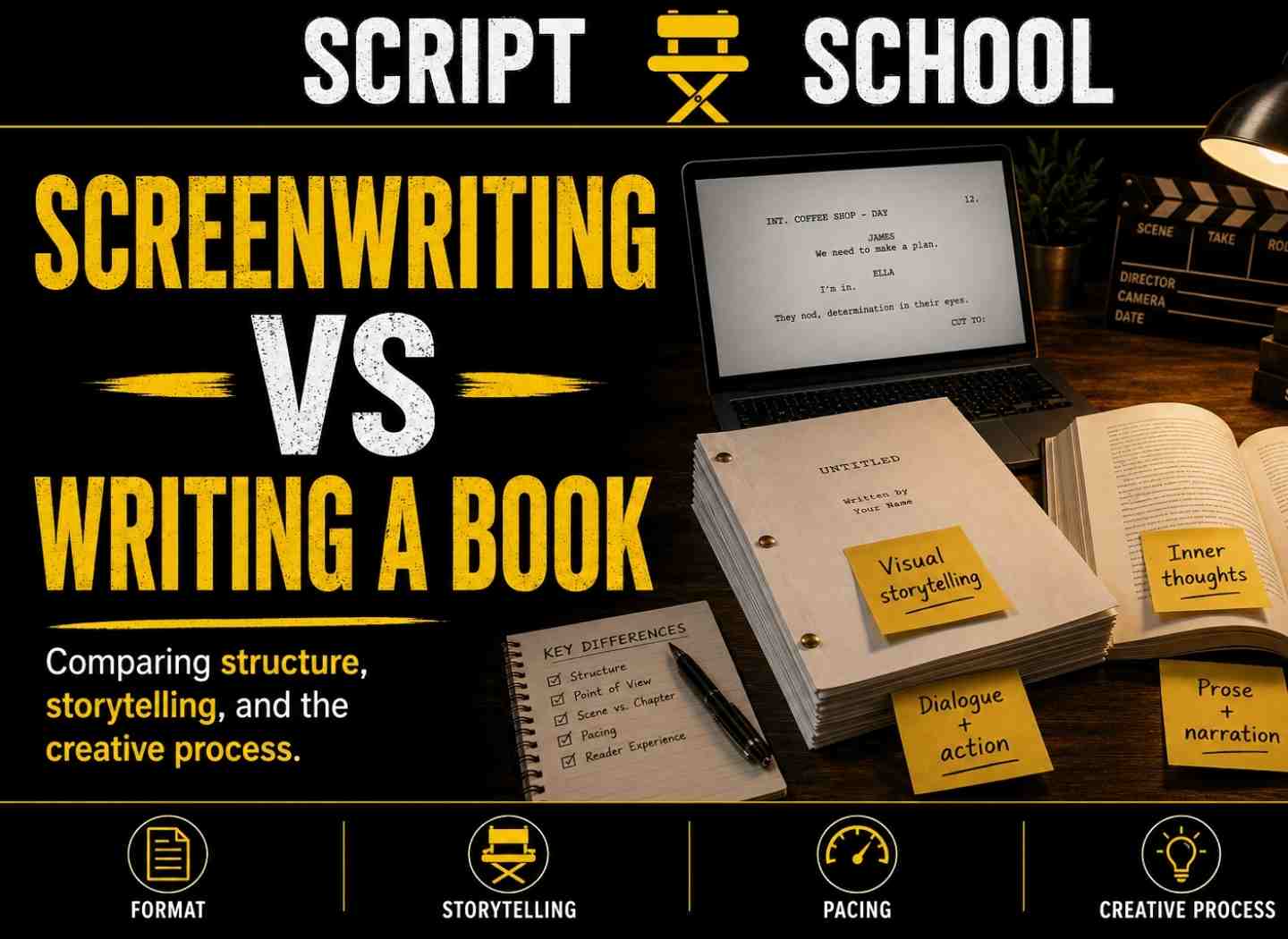
The core difference is simple. Screenwriting shows the story from the outside. Book writing tells the story from the inside. One uses images and action. The other uses prose and thought.
That single split shapes every choice you make. It changes your tools, your pacing, and even your sentences. The format should serve the story, not the market. Pick the one that gives your audience the strongest experience.
Screenwriting Is Visual and Production-Focused
A screenplay is built to be made. Every page points toward a camera, a set, and a crew. You write what can be seen, heard, and filmed.
This keeps screenwriting lean and external. You can’t tell us a character is sad. You show the tear, the slumped shoulders, the unanswered call. The story lives in front of the lens.
Book Writing Is Prose-Based and Reader-Focused
A book is built to be read. One mind reading the page builds the entire world. You write for that reader’s imagination, not a film set.
That freedom is huge. You can wander, reflect, and explain. You can describe a sunset for three sentences if it earns its place. The reader paints the picture you suggest.
The Key Differences Between a Screenplay and a Book
Here’s a quick side-by-side to lock it in.
| Element | Screenplay | Book |
|---|---|---|
| Main tool | Images and action | Prose and voice |
| Point of view | External, what we see | Internal, what we think |
| Length | Lean, around 90 to 120 pages | Long, 60,000 words and up |
| Inner thoughts | Shown through action | Stated directly |
| Final product | A film made by a team | A book read by one person |
| Control | Shared with the crew | Mostly the writer’s |
Bottom line: a screenplay is a plan for a team. A book is a direct gift to a reader.
A Book Is Read, a Screenplay Is Produced
The end product changes how you write. A book ends with a reader. A screenplay ends with a finished film. That difference reaches all the way back to page one.
Many first-time screenwriters trip here. They write for readers, not for production teams. Then their script reads like a novel in disguise. As the old saying goes, you can’t pour wine into the wrong bottle and expect it to age well.
Why This Difference Changes Everything
When you write a book, the page is the finish line. When you write a script, the page is the starting line. A crew still has to turn it into something real.
So a screenplay must leave room for others to work. Directors, actors, and editors all add their part. Your script invites them in. That mindset shift changes how every scene gets written.
Why Screenplays Are Leaner Than Books
Screenplays cut hard. There’s no room for long description or inner detours. One page roughly equals one minute of screen time.
That math forces discipline. You learn to say more with less. Think of it as storytelling minimalism. Every word fights for its spot, and weak words get cut first.
Why Screenwriters Have Less Direct Control Over the Final Product
A novelist controls almost everything. The screenwriter shares control with a whole team. That trade can feel strange at first.
But collaboration is the heart of film. Your script is the seed, not the tree. Actors find new meaning in your lines. Directors reframe your scenes. The final movie is a team sport, and your script kicks it off.
Why Screenwriting Is More Visual Than Writing a Book
Screenwriting forces you to think in pictures. If a camera can’t record it, it probably doesn’t belong in the script. That one rule explains most of the craft.
Books let you explain. Scripts make you show. So a screenwriter learns to turn feelings into visible behavior. This is the skill that separates strong scripts from flat ones. Master it, and your pages start to move.
Screenwriters Write What the Audience Can See and Hear
Your script is a list of sights and sounds. That’s the raw material of film. So you write only what the camera and mic can pick up.
Try the camera test on any line you write. Can a lens capture it? Can a mic record it? If yes, it can live in your action lines. If no, you need to rewrite it as something we can see.
Internal Emotion Must Become External Behavior
You can’t film a feeling. You can only film what a feeling makes someone do. So you turn emotion into action.
Look at the difference. Weak: “Sarah feels nervous.” Strong: “Sarah taps her foot and checks the door twice.” The second version shows us the nerves without naming them. That’s the move that brings a scene alive.
The Screenwriter’s Test: Can This Be Filmed?
Run every beat through one quick checklist.
- Can the audience see it?
- Can the audience hear it?
- Can an actor perform it?
- Can a camera capture it?
If a beat fails the test, rewrite it as action. This habit alone will sharpen your scripts fast. Want more practice turning ideas into scenes? Read our guide on 5 tips to turn your story ideas into a screenplay.
How Screenplay Format Changes the Way You Tell a Story
Format isn’t just a rulebook. It’s a storytelling tool. The way a screenplay sits on the page shapes pacing, mood, and readability. Smart formatting makes your story easier to feel.
Professional readers judge fast. They often sense within a few pages whether a script feels industry-ready. Clean format builds confidence before the story even unfolds. So treat format as part of your craft, not a chore.
Scene Headings Show Where and When We Are
A scene heading sets the stage in one line. It tells us the location and the time of day. Readers and crews lock in instantly.
Think of a scene heading as a GPS pin for the reader. It drops them right into the scene. Strong headings cut confusion and keep your script flowing.
Action Lines Describe What Happens on Screen
Action lines show visible behavior. They paint the picture the camera will capture. This is where your visual storytelling lives.
The strongest action lines use fewer words, not more. Compare these two. Weak: “He slowly and carefully walks across the messy, cluttered room toward the window.” Strong: “He picks his way to the window.” The lean version reads faster and hits harder.
Dialogue Is Formatted for Performance
Screenplay dialogue is built for actors. The format gives each line room to breathe. The actor then fills that space with life.
So you write the words and trust the performer. Don’t over-direct every line. Actors need room to interpret, not a leash. Light dialogue plus a skilled actor beats heavy dialogue every time.
White Space Helps the Script Move
White space matters more than beginners think. Readers see dense pages as slow pages before reading a word. Lots of white space signals speed and ease.
White space acts like breathing room for the story. Short action blocks pull the eye down the page. The reader feels momentum. The script moves, and so does the reader.
Format Is Not Decoration, It Is Communication
Format speaks to everyone who touches your script. Producers, actors, and crew all read your choices. Clean format tells them you know the craft.
So remember this one line. Format is not decoration. Format is communication. Get it right, and your story lands with the people who can make it real.
Dialogue in Screenwriting vs Dialogue in Books
Dialogue works under different rules in each form. Screen dialogue must be lean and loaded with subtext. Book dialogue can lean on prose for support. Same tool, very different jobs.
Most beginner screenplays fail for one reason. Characters explain information instead of creating tension. So let’s fix that. Does your dialogue reveal feeling, or just deliver facts? The best scenes do the first.
Screenplay Dialogue Has to Be Economical
Screen dialogue is tight. Every line earns its place or gets cut. There’s no room to ramble.
Here’s the strange part. Great screen dialogue often sounds shorter than real talk. Real conversation is messy and slow. Screen dialogue keeps the spark and drops the filler. Less really is more.
Book Dialogue Can Be Supported by Prose
Novelists get a helper that screenwriters don’t. Prose. You can wrap dialogue in description, thought, and tone.
So a novel can tell us how a line was said. It can pause to explain a glance. Screen dialogue stands alone, but book dialogue has prose holding its hand. That support changes how you write each one.
Screenplay Dialogue Depends on Subtext
Strong screen dialogue hides its real meaning. Characters say one thing and mean another. The gap creates tension.
Think of dialogue like an iceberg. The words are the tip above water. The real meaning sits below the surface. The best lines talk about one thing while pointing at something deeper. That’s subtext, and it’s the heart of great scenes.
Actors Complete the Dialogue
You don’t finish the dialogue alone. The actor finishes it for you. Their tone, pace, and pauses add a whole layer.
So writing for screen is a partnership. You leave space, and the actor fills it. A simple “okay” can mean love, anger, or defeat. The actor decides which. Trust that, and write lines that invite great performances.
Character Development: Inner Thoughts vs Visible Choices
Each form builds character a different way. Novels reveal character through inner thoughts. Screenplays reveal character through visible choices. Both create depth, just through different doors.
Here’s a truth worth taping to your desk. Audiences rarely remember what characters think. They remember what characters choose. So in a script, action is everything.
Novels Can Tell Us What a Character Thinks
A novel opens a window into the mind. We hear thoughts in real words. We follow doubt, hope, and fear from the inside.
This is the novel’s secret weapon. The reader knows the character better than the character’s own friends do. That deep access builds a bond prose handles better than any other form.
Screenplays Show Character Through Action
A screenplay can’t read minds. So it shows us who someone is through what they do. Choices become character.
Remember this contrast. Action creates evidence. Thoughts create explanation. A character who returns a lost wallet tells us more than a paragraph about their honesty ever could. Show the choice, and the audience draws the conclusion.
Every Scene Should Reveal Want, Conflict, or Change
Strong scenes pull their weight. Each one should reveal something about your character. Use this quick check on every scene.
- Want: What does the character want here?
- Conflict: What stands in the way?
- Change: How is the character different by the end?
If a scene shows none of these, ask a hard question. Why is it in the script? Scenes that reveal nothing usually need to go.
How to Know If Your Story Should Be a Book or a Screenplay
Pick the format where the audience experience actually lives. If your story lives in images and action, write a screenplay. If it lives in voice and thought, write a book. The story usually tells you which.
Don’t chase trends. Choose the format that delivers the strongest experience for your audience. Now let’s match your idea to the right path.
Choose a Screenplay If the Story Lives in Images, Scenes, and Action
Some stories play like a movie in your head. You see scenes, not sentences. You picture faces, places, and movement.
That’s a screenplay signal. If your best moments are visual, write for the screen. If you keep imagining how a scene would look on a movie screen, trust that instinct. Your story wants to be filmed.
Choose a Book If the Story Depends on Voice, Thought, or Prose
Other stories live in language and mind. The voice is the magic. The inner world carries the weight.
That’s a book signal. If your story leans on what a character thinks, write a novel. If readers need to live inside someone’s head, the page is your home. Don’t squeeze that depth onto a screen.
Choose a TV Pilot If the Story Has an Ongoing Engine
Some ideas don’t end after one story. They keep generating fresh conflict. New problems show up week after week.
That’s a series engine. If your premise spins out endless new conflicts, it may be a TV concept. Think of a setting or job that always creates drama. If that fits, explore our TV Pilot Lab to build it the right way.
Choose a Short Film If You Want to Learn by Producing
Short films are the best classroom. They’re small enough to actually finish. And you learn fast by making something real.
So if you want hands-on growth, write a short. You’ll write it, shoot it, and learn from every mistake. That loop builds real skill. See why we believe hands-on filmmaking experience is key to your growth.
Use This Quick Decision Checklist
Still unsure? Run your idea through this fast.
- Do you picture scenes or sentences? Scenes point to screen.
- Is the voice or the action the star? Voice points to book.
- Does the story end or keep going? Keeps going points to TV.
- Do you want to finish something soon? That points to a short film.
The right format usually becomes obvious fast. Just ask where the audience experience really lives. Then start there.
What Book Writers Must Unlearn When They Start Screenwriting
Novelists carry habits that slow down scripts. The page rewards depth and detail. The screen rewards action and restraint. So the switch takes some unlearning.
Here’s the fastest mindset fix. Stop asking, “What is my character thinking?” Start asking, “What is my character doing?” That one shift solves half the problem. Now let’s tackle the rest.
Stop Explaining What the Character Feels
On the page, you can name a feeling. On the screen, you can’t. You have to show it instead.
So turn emotion into behavior. Don’t write “Sarah feels nervous.” Show her tapping her foot or avoiding eye contact. The audience reads the body, not the label. That’s how feelings reach the screen.
Stop Over-Describing the Setting
Novelists love rich settings. Screenwriters trim them down. Long descriptions slow a script to a crawl.
So describe only what affects mood, story, or action. The art department handles the rest. Think like a camera. Show the one detail that matters, then move on.
Stop Depending on Inner Monologue
Inner monologue is a novel’s joy. It rarely fits a screenplay. The camera can’t see a thought.
So ask yourself one thing. How would a camera film that thought? If it can’t, find an external way to show it. A look. An action. A line of dialogue. The audience can’t read minds, so the screen must reveal it.
Stop Writing Dialogue That Sounds Like Prose
Book dialogue can be polished and full. Screen dialogue should sound like real speech. People rarely talk in neat paragraphs.
So use the read-aloud test. Read your dialogue out loud. If nobody talks that way, rewrite it. Your ear will catch what your eye misses every time.
Start Thinking in Scenes
Novelists think in chapters and flow. Screenwriters think in scenes. Each scene is a small unit with its own job.
Build every scene like a tiny blueprint. Give it a goal, an obstacle, and an outcome. The character wants something. Something blocks them. Something shifts by the end. Stack strong scenes, and you’ve got a strong script.
Can a Novelist Become a Screenwriter?
Yes, and many do. Storytelling fundamentals transfer surprisingly well. Character, conflict, and structure matter in both forms. You’re not starting from zero.
So if you write books and feel the pull of film, lean in. Your instincts are an asset. You just need to train a new muscle. Let’s break down what carries over and what’s new.
Yes, Story Skills Transfer
You already know how stories work. Character, conflict, stakes, and structure live in both forms. That foundation is gold.
So your years on the page weren’t wasted. You understand what makes readers care. That same instinct makes audiences care too. You’re further along than you think.
But the Craft Requires a Different Muscle
Screenwriting needs new skills. Visual thinking. Lean dialogue. Scene discipline. These take practice to build.
Think of it like cross-training. You’re a strong runner learning to swim. The fitness carries over. The technique is new. The shift is less about imagination and more about execution. Train the new muscle, and you’ll get there.
Why Feedback Helps Novelists Adapt Faster
Feedback is the shortcut. It reveals your blind spots early. You fix habits before they harden.
A novelist switching to scripts can’t always see the old habits. A fresh set of eyes can. Good notes shorten the learning curve by months. That’s why guided learning beats guessing alone.
Is Screenwriting Easier or Harder Than Writing a Book?
Neither is easier. They’re hard in different ways. Screenplays are shorter but demand ruthless cutting. Books are longer but demand prose endurance. The hard part depends on you.
Writers tend to underestimate whichever form they haven’t practiced. So be honest with yourself. Where do your strengths sit? Let’s compare the real challenges.
Screenplays Are Shorter, But Not Simpler
A screenplay looks easy because it’s short. That’s a trap. Reducing words often increases difficulty.
Remember the iceberg. A short script hides a deep structure underneath. Every line must do several jobs at once. Fewer words means each word carries more weight. Short is not the same as simple.
Books Offer More Freedom, But Require More Prose Endurance
Novels give you room to roam. That freedom comes with a cost. You have to write tens of thousands of words.
Writing a book is a marathon. You need stamina, not just sprints. You hold a whole world in your head for months. That endurance is its own kind of hard.
The Hard Part Depends on the Writer
There’s no single answer here. Some writers thrive on cutting. Others thrive on flow.
So match the form to your nature. Love trimming and structure? Screenwriting may feel natural. Love voice and depth? The novel may suit you better. Your strengths decide which path feels lighter.
Serious Writers Should Learn Both Forms
Here’s the pro move. Learn both. Each form teaches strengths the other often neglects.
Scripts train your discipline. Novels train your voice. Cross-training makes you a stronger writer overall. The best storytellers borrow tools from every form they know.
Should You Write the Book First or the Screenplay First?
Start with the form that serves your story best, with the least compromise. If the idea is cinematic, write the screenplay first. If the voice is the experience, write the book first. The story leads. You follow.
Don’t pick based on which sells easier. Market trends shift fast. Strong storytelling holds its value. So let’s find your right starting point.
Write the Screenplay First If the Idea Is Cinematic
Some ideas beg to be seen. The best moments are scenes, not thoughts. The story moves through images.
That’s your cue to write the script first. If you can describe your story’s peaks as shots on a movie screen, start there. Build it for the camera from the very first page.
Write the Book First If the Voice Is the Main Experience
Other stories live in the telling. The voice pulls readers along. The inner journey is the point.
That’s a book-first signal. If the reader’s journey happens inside a character’s mind, write the novel first. Give the voice the space it needs. The screen can wait.
Do Not Write a Book First Only Because Someone Said It Is Easier to Sell
You’ll hear this advice a lot. “Write the book first. It sells better.” Be careful with that myth.
The truth is simpler. Market trends change. Strong storytelling stays valuable. Don’t force your story into the wrong form to chase a sale. A great script can open doors too. Pick the form that fits the story.
A Better Question: What Form Best Serves the Story?
Here’s the question that cuts through the noise. What form best serves this story? Not what’s trendy. Not what’s easy. What serves the story.
Run a quick gut check. Where does the audience experience really live? In images, or in voice? In action, or in thought? The answer usually points straight to your starting format. When you focus on audience experience, the choice gets clear. Then you can finally start writing.
How Screenwriting Can Improve Your Book Writing Too
Screenwriting isn’t the enemy of your novel. It’s a training tool. The skills you build writing scripts make your prose sharper. Many published novelists use screenwriting exercises on purpose.
Why? Scripts expose weak scenes faster than prose. There’s nowhere to hide on a screenplay page. So even if you only want to write books, learning to write scripts pays off. Here’s how.
It Teaches Scene Discipline
Screenwriting makes every scene earn its place. There’s no room for filler. Each scene must push the story forward.
Think of it like architecture. Every beam holds weight or comes out. If a scene can be removed without affecting the story, it probably should be. That discipline tightens your novels too.
It Strengthens Dialogue
Script work trains you to cut. Screen dialogue has no fat. You learn to drop every wasted word.
Bring that habit back to your prose. Compare these. Wordy: “I was just thinking that maybe we could possibly go to the store later.” Tight: “Want to hit the store later?” Your book dialogue gets sharper, and readers feel it.
It Improves Pacing
Scripts live and die by pacing. One page equals one minute. That clock teaches rhythm fast.
Pacing is the heartbeat of a story. Learn it in scripts, and your prose finds its rhythm too. You start to feel when a scene drags. Then you fix it before the reader notices.
It Clarifies Character Goals
Screenwriting demands clear goals. Every character wants something specific. That want drives the scene.
Readers connect with characters who want something. Vague goals create flat stories. Sharp goals create pull. Carry that clarity into your novels, and your characters come alive on the page.
Learning Screenwriting in Austin
Austin is a real creative home for screenwriters. The city blends a thriving film scene with a strong writing community. So it’s a smart place to learn the craft.
Writers grow faster with three things working together. Instruction. Community. Regular feedback. Austin offers all three, whether you join in person or online. Here’s why that mix matters.
Why Austin Is a Strong Place to Learn Screenwriting
Austin has a deep film and writing culture. Festivals, filmmakers, and writers fill the city. That energy rubs off on you.
Creative communities speed up growth. You meet collaborators. You find readers. You build the network every working writer needs. In Austin, those connections are everywhere you look.
Why Adult Learners Need Structure and Feedback
Adult writers are busy. Life pulls in every direction. Without a system, scripts stall.
Many adults know they need practice. They simply need a system. Structure gives you deadlines. Feedback gives you direction. Together they turn a vague goal into finished pages.
How Table Reads Help Writers Improve
A table read is magic for a script. You hear your words spoken out loud. Problems jump out fast.
Writers often spot dialogue issues within minutes of a table read. A line that looked great on the page can fall flat in the room. Hearing it live shows you exactly what to fix. That’s growth you can’t get alone.
Why Local and Online Learning Can Work Together
You don’t have to choose one or the other. Local and online learning blend well. You can get the best of both.
Online classes give you flexible access and expert teachers. Local events give you face-to-face energy and table reads. Mix them, and you cover every angle. Script School runs live online cohorts, so location never holds you back.
How Script School Helps Serious Writers Build Screenwriting Skills
Script School turns curious writers into working screenwriters. We mix real instruction with real practice. You don’t just study screenwriting. You actually write.
Here’s our core belief. Students improve most when they create pages, not just consume theory. So our classes keep you writing from day one. Let’s walk through how it works.
Learn the Theory Without Getting Stuck in Theory
Theory matters. But too much theory traps writers. You can study forever and never finish a script.
So we balance learning and doing. You’ll grasp the fundamentals fast, then apply them right away. Knowing the rules is step one. Using them is where real growth happens. Our Screenwriting 101 course is built exactly this way.
Practice Through Real Pages and Projects
You learn screenwriting by writing screenplays. Simple as that. So our courses center on real projects.
Pages written create growth. Notes alone rarely do. You’ll build scenes, draft scripts, and finish real work. Like a builder, you learn by putting up walls, not by reading about them. Explore all our courses to find your project.
Get Feedback from Mentors
Feedback is the fastest path forward. Our mentors are working pros. They show you what’s working and what’s not.
Good notes are a shortcut. They reveal blind spots you’d never catch alone. You fix problems early, before they become habits. That guidance saves you months of trial and error.
Choose the Right Course for Your Goal
Every writer has a different goal. So we offer focused paths. You pick the one that fits your dream.
- New to it all? Start with Screenwriting 101.
- Love TV? Build a pilot in the TV Pilot Lab.
- Drawn to scares? Try horror screenplay writing.
- Ready to sell? Learn pitching and packaging.
- Want to direct talent? Join the casting director workshop.
- Need funding? See how to raise money for your first movie.
Not sure which fits? A quick chat can point you the right way. See how a consultation can help you choose the right course.
Move from Idea to Finished Script
The goal is always the same. A finished script in your hands. That’s the moment everything changes.
A completed imperfect script teaches more than an unfinished perfect idea. So we keep you moving toward the end. Page by page, scene by scene, you’ll get there. And finishing your first script feels incredible. Curious about the payoff? See what a screenwriter salary can look like.
Final Answer: Screenwriting vs Writing a Book
Neither format is better. The best format is the one that serves your story. Screenwriting shows a story through images, action, and performance. Book writing tells a story through prose, voice, and inner thought.
So stop asking which form is superior. Ask which form fits your idea. Match the story to the medium, and you’ll write with confidence. Here’s the quick recap.
Screenwriting Is Best for Stories Told Through Images, Action, Sound, and Performance
Choose screenwriting when your story lives on a movie screen. The best moments are visual. The audience watches the story unfold.
You write what can be seen and heard. A crew brings it to life. If that excites you, the screen is your home.
Book Writing Is Best for Stories Built Around Prose, Inner Thought, and Reader Imagination
Choose book writing when your story lives in the mind. The voice is the magic. The reader builds the world inside their head.
You write the words, and the reader takes the journey inside. If that feels right, the page is where you belong.
Ready to Turn Your Story into a Screenplay?
You know the difference now. The next step is action. The biggest gap between aspiring writers and working writers is consistent action. So let’s get your story moving.
You don’t have to figure it out alone. We’ll help you go from idea to finished script. Pick the path that fits you best.
Book a Consultation
Not sure where to start? Let’s talk it through. A quick consultation helps you find the right path for your story and your goals. Book a private consultation and get clear, friendly guidance.
Explore Screenwriting 101
New to screenwriting? Start here. Screenwriting 101 teaches the fundamentals while you write real pages. No experience needed. Just bring your story and your curiosity.
View All Courses
Want to see every option? Browse our full lineup and pick the path that fits your goal. From TV pilots to horror to pitching, there’s a course for you. View all courses and start your screenwriting journey today.
Your story deserves to be told. Now you know exactly how to tell it. Ready to begin? Get in touch and take the first step.