Can Anyone Write a Screenplay? A Beginner’s Guide to Starting Your First Script
You probably have a movie idea sitting in your head right now. Maybe it’s been there for years, playing on repeat like a trailer for a film nobody’s made yet. You’ve imagined the opening scene. You’ve cast it in your head. You’ve even thought about the title.
But every time you sit down to write it, something stops you.
Here’s the truth most people never hear: the real reason most beginners never finish a screenplay has nothing to do with talent. It has everything to do with fear, confusion, and bad advice from people who never wrote one themselves.
Starting a screenplay can feel like staring at a locked theater door. This guide hands you the key. Whether you’re sitting in a coffee shop on South Congress in Austin or scribbling notes on your phone at 2 a.m., you’re about to learn exactly how to start your screenwriting journey, even with zero experience.
Let’s open that door.
Can Anyone Write a Screenplay?
Short answer? Yes.
Long answer? Yes, but you need to stop believing the myth that screenwriters are born, not built. That’s Hollywood marketing, not reality. Every working screenwriter you admire was once a complete beginner who wrote something terrible.
Tarantino worked at a video store. Diablo Cody was a blogger. Greta Gerwig started as an actor scribbling scenes between auditions. None of them woke up brilliant.
What separates writers from wannabes isn’t talent. It’s the willingness to write a bad first draft and keep going.
Screenwriting is a skill, not a gift. Skills get built through reps. If you can text a friend, describe a scene from your favorite movie, or tell a story at a dinner table, you already have the raw material. The format is just a container. The instinct to tell stories? That’s already inside you.
Every writer starts ugly before they start strong. That’s not a flaw in the process. That is the process.
Trade secret: The screenwriters you envy didn’t have better first drafts than you. They just finished theirs.
Do You Need Experience to Write a Screenplay?
No. You need curiosity and a willingness to learn.
Think about it: you wouldn’t run a marathon before learning to jog, right? Same logic applies to screenwriting. You don’t need a résumé full of produced credits to start writing. You just need to start small and grow into bigger projects.
Here’s a smarter way to begin:
- Write a 1-page scene before attempting a feature film
- Try a 5-minute short script before tackling a 110-page screenplay
- Watch a movie you love and rewrite one scene in your own voice
- Read 3 produced screenplays in the genre you want to write
Most beginners try to climb Everest on day one. Then they quit when they can’t breathe. Start with the foothills.
You can also speed up the learning curve with structured guidance. Our Screenwriting 101 course was built exactly for writers who’ve never written a script before. No experience needed. No film school background required.
The blank page isn’t your enemy. Overthinking is.
Do You Need a Degree to Become a Screenwriter?
Nope. And anyone who tells you otherwise is selling you something.
Plenty of working screenwriters never set foot in a film school. Quentin Tarantino didn’t. Damon Lindelof skipped the MFA route. The Coen brothers studied film, sure, but their success came from writing, not from their diplomas.
Here’s the honest comparison:
Film School:
- Structured curriculum and deadlines
- Access to professors and peers
- Tuition costs that can hit six figures
- A degree most producers will never ask to see
Self-Taught Route:
- You set your own pace
- Cost stays low (books, online courses, reading scripts)
- You build a portfolio instead of a transcript
- You learn by doing, not just by listening
Producers don’t read your diploma. They read your script. If your pages crack, nobody cares where you went to school.
What you do need is real feedback from people who know the craft. That’s where targeted private consultations make a bigger difference than a four-year degree. One hour with a working pro can save you years of guessing.
Film school isn’t bad. It’s just not required.
What Makes Screenwriting Different From Regular Writing?
Novels live inside your head. Screenplays live on the screen.
That’s the core difference, and it changes everything about how you write.
In a novel, you can spend a page describing what a character is thinking. In a screenplay, you can only show what the camera sees and what the microphone hears. No interior monologue. No flowery prose. No “she felt a wave of nostalgia wash over her.” Instead, you write: She picks up the old photograph. Her hand trembles.
A screenplay is architecture for emotion. It’s a blueprint, not a building. Directors, actors, and crew members read your pages and turn them into something three-dimensional. Your job is to give them just enough to build from, and not a word more.
Here’s how the two styles compare:
Novel writing:
- Long descriptions
- Internal thoughts
- Past tense
- Flexible structure
- Reader-facing
Screenplay writing:
- Visual action only
- External behavior
- Present tense
- Strict 3-act or 5-act structure
- Industry-facing format
Screenplays also follow strict formatting rules. Sluglines. Action lines. Dialogue blocks. Parentheticals. They look weird at first. Then they start to feel like sheet music for movies.
Want to see how this works in practice? Our breakdown of screenwriting vs scriptwriting explains the format differences and where each one fits.
The shift from prose to script feels strange for about two weeks. Then it clicks, and you start seeing every story in scenes.
What Skills Do You Need to Write a Screenplay?
You don’t need every skill at once. You need to build them in the right order.
Here’s the toolkit every beginner should develop:
Visual thinking. Train your eyes to spot stories in motion. Watch a scene with the sound off. What can you tell from body language alone?
Dialogue that sounds real. Read your lines out loud. If you’d never say it, your character wouldn’t either. Listen to how people actually talk in line at Franklin BBQ or on the bus.
Story structure. Beginning, middle, end. Setup, conflict, payoff. Master the basics before you break them.
Character development. Your hero needs a want, a need, and a flaw. That’s the triangle every great character stands on.
Conflict design. No conflict, no movie. Every scene needs friction. Even the quiet ones.
Revision stamina. First drafts are clay. Rewrites are sculpture. Revision is what separates amateurs from professionals.
Reading other scripts. This one’s non-negotiable. You can’t write screenplays without reading screenplays. Download free PDFs of films you love. Study them like a chef studies recipes.
Receiving feedback without flinching. Notes sting at first. Then they save your script. Build a thick skin and a soft ego.
None of these skills require talent. They require time. Show up, write pages, learn from the mess, repeat.
If you want a faster way to build all of these in one place, our blog on turning story ideas into a screenplay gives you a starter framework.
What Does a Beginner Need Before Writing a Screenplay?
Before you write FADE IN, get these pieces in place. Five minutes of prep saves five weeks of rewrites.
Your beginner checklist:
- A clear logline. One sentence that captures your story. Hero + goal + obstacle. “A retired hitman seeks revenge after thieves steal his car and kill his puppy.” That’s John Wick in 15 words.
- A rough outline. Even a napkin sketch counts. Know your beginning, your midpoint, and your ending.
- Three to five core characters. Any more and you’ll lose track. Any fewer and your story flatlines.
- A genre choice. Comedy? Thriller? Horror? Drama? Pick one. Hybrids come later.
- A writing schedule. Even 30 minutes a day beats a heroic weekend binge.
- Screenwriting software (we’ll cover this in a sec).
- A few produced scripts to reference. Same genre as yours. Read them twice.
- A quiet writing spot. Library, coffee shop, parked car. Wherever your brain shuts up.
A strong logline prevents weak scripts. If you can’t pitch your idea in one sentence, the script isn’t ready. Go back to the idea stage.
Skip this prep work and you’ll get 30 pages in, lose the thread, and quit. Almost every abandoned screenplay died because the writer didn’t outline.
How to Start Writing Your First Screenplay
This is the part everyone wants and nobody plans for. Let’s break it into steps you can actually follow.
Step 1: Find Your Idea
Don’t wait for lightning. Steal from your own life. The fight with your sister. The weird neighbor. The job you hated. The trip that went sideways. Your best ideas are already in your head, hiding behind the assumption that they’re not “interesting enough.”
They are. Personal stories travel further than clever ones.
Step 2: Write Your Logline
One sentence. Hero + goal + obstacle + stakes. Test it on a friend. If their eyes light up, you’ve got something. If they look confused, rewrite it.
Step 3: Outline the Story
Skip this and pay later. Use a simple 3-act structure:
- Act 1: Setup the world, introduce the hero, hit them with an inciting incident
- Act 2: Pile on obstacles, raise the stakes, force the hero to change
- Act 3: Final confrontation, resolution, new normal
Sketch each act in 1-2 paragraphs. Then break it into 10-15 scenes. That’s your roadmap.
Step 4: Write the First Scene
Don’t start at FADE IN. Start with the scene that excites you most. Build momentum from a place of energy, not duty. You can rearrange later.
Step 5: Hit Your Daily Page Count
Two pages a day = a finished feature in about 7 weeks. One page a day = a finished feature in 3-4 months. Pick a pace and stick to it. Consistency beats intensity every time.
Step 6: Don’t Edit While You Draft
This is the killer of first scripts. You write a line, you hate it, you rewrite it, you hate that too, and you stall out by page 12. Resist. Bad first drafts are normal and necessary. Get to FADE OUT before you touch a single comma.
Step 7: Finish the Draft
This is the most important step in the entire process. Most people never finish. The ones who do? They become writers. The ones who don’t? They stay dreamers.
A finished bad screenplay beats a brilliant unfinished one every single time.
Step 8: Step Away
Put it in a drawer for two weeks. Don’t peek. Distance gives you fresh eyes.
Step 9: Read It Out Loud
Every line. Yes, even dialogue spoken by men if you’re a woman, or vice versa. You’ll catch problems your eyes missed.
Step 10: Rewrite With Purpose
Now you edit. Cut what doesn’t serve the story. Strengthen what does. Tighten dialogue. Sharpen scenes. Most pros rewrite 5-10 times before they show anyone.
Step 11: Get Real Feedback
Show it to writers, not just friends. Friends say “I loved it.” Writers say “Your second act sags.” You need the second response.
Step 12: Rewrite Again
Apply the notes that ring true. Ignore the ones that don’t. Trust your gut, but trust it after the feedback, not before.
That’s it. That’s the whole map. The work is hard, but the path is simple.
Stuck on which step is tripping you up? A focused private consultation can pinpoint exactly where your script needs help and save you months of trial and error.
Can You Write a Screenplay Without Screenwriting Software?
Technically? Yes. Practically? Please don’t.
You can write a screenplay in Microsoft Word, but you’ll spend more time formatting than writing. Tab here, indent there, all-caps for names, center the slugline. By page 10 you’ll want to throw your laptop into Lady Bird Lake.
Free options that handle formatting for you:
- WriterDuet (free version, browser-based, super clean)
- Trelby (free desktop app, simple and solid)
- Celtx (free tier available, popular with beginners)
- Fade In (free demo, paid full version, industry standard)
Paid options worth it later:
- Final Draft (the Hollywood standard, around $250)
- Highland 2 (Mac only, beloved by pros)
Start free. Upgrade when you sell something. The software doesn’t write the script. You do.
Is Screenwriting More About Talent or Practice?
Practice. Not even close.
Talent is overrated. Practice is undervalued. The screenwriters with long careers aren’t the most “gifted” ones. They’re the most consistent ones.
Think of it like sports. The kid who shoots 500 free throws a day beats the natural athlete who shoots 50. Same in writing. Pages on the calendar beat ideas in your head.
Here’s the math:
- Talent + zero practice = unfinished scripts
- Average ability + daily practice = working writer
- Talent + daily practice = exceptional career
The good news? You get to choose practice. You don’t get to choose talent.
Write every day. Read every week. Watch movies with intention. Get notes. Apply them. Repeat for a year and you’ll be unrecognizable as a writer.
Hard work hides in plain sight. That’s why nobody believes in it until they try it.
Common Myths About Writing a Screenplay
Time to bulldoze the lies that keep beginners stuck.
Myth #1: You need to live in LA. Reality: Austin has a booming film scene. So does Atlanta, Albuquerque, and your laptop. Writers write from everywhere now.
Myth #2: You need an MFA. Reality: Producers care about pages, not pedigrees. Your script is your credential.
Myth #3: Your first script needs to sell. Reality: Most pros write 5-10 scripts before they sell one. Your first script is tuition, not retirement.
Myth #4: You need an agent to get started. Reality: You need a great script to get an agent. The script comes first. Always.
Myth #5: Screenwriters make a fortune overnight. Reality: Some make great money. Most build careers slowly. Curious about actual numbers? Our breakdown of screenwriter salaries tells the real story.
Myth #6: You need to know everything before you start. Reality: You learn by writing. The first script teaches you how to write the second.
Myth #7: Good ideas are rare. Reality: Good execution is rare. Ideas are cheap. Finished scripts are gold.
Myth #8: Real writers don’t use templates or guides. Reality: Every working writer uses structure. Even Aaron Sorkin uses outlines.
Believe the myths, stay stuck. Drop them, start writing.
What Makes a Good Screenplay?
A good screenplay does three things: it grabs you fast, holds you tight, and leaves you changed.
That’s it. Everything else is technique.
Strong concept. A story that makes someone say “I’d watch that” before you finish pitching it. High concept ideas travel. Quiet character pieces travel too, but only if the character is unforgettable.
A hero worth following. Flawed, specific, active. Passive heroes kill scripts. Your protagonist needs a goal and the guts to chase it.
Clear stakes. What does the hero lose if they fail? If the answer is “nothing much,” your script is in trouble.
Tight structure. Beats land where they should. Setups pay off. The midpoint shifts everything. The climax delivers.
Dialogue that does double duty. Every line should reveal character AND advance plot. Lines that do neither get cut.
Emotional payoff. The audience should feel something at the end. Joy, heartbreak, hope, fear. Pick your emotion and deliver it.
A scene that makes them remember. The Wedding Crashers funeral scene. The Pulp Fiction dance scene. The Whiplash bus scene. Give your script one moment people will quote.
A satisfying ending. Doesn’t have to be happy. Just has to feel earned.
Watch your favorite movies again with these markers in mind. You’ll start to see why some scripts work and others fall flat.
Want to go deeper into story craft and watch yourself improve fast? The Screenwriting 101 course walks you through every one of these elements with real examples.
How Long Does It Take to Write a Screenplay?
Honest answer? Anywhere from 6 weeks to 6 years.
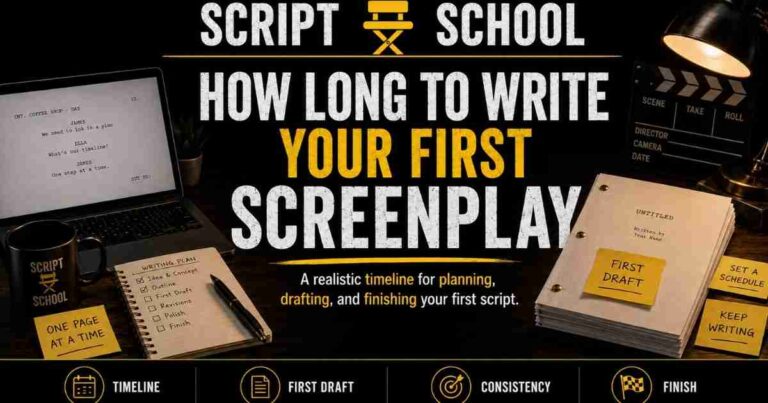
Most first-time writers take 3 to 6 months to finish a feature-length first draft. Add another 2-4 months for rewrites and you’re looking at roughly a year for a polished script.
Here’s a realistic timeline:
- Outline: 1-3 weeks
- First draft: 6-12 weeks
- Break before rewrite: 2 weeks
- Second draft: 4-6 weeks
- Feedback round: 2-4 weeks
- Third draft: 4-6 weeks
- Polish: 2 weeks
Pros write faster because they’ve done it a hundred times. You haven’t. Be patient with yourself. Your first script will take the longest. Your tenth will be the easiest.
Speed isn’t the goal. Finishing is.
Can You Become a Professional Screenwriter?
Yes. And Austin is a smart place to do it from.
The Austin film industry has exploded over the last decade. Major productions shoot here regularly. The Austin Film Festival is one of the most respected screenwriting events in the country. Local writers have broken into TV rooms, streaming series, and indie features without ever moving to LA.
The path looks like this:
- Write multiple scripts. Three minimum. Five is better. Your portfolio is your résumé.
- Enter competitions. Nicholl, Austin Film Festival, Page International. Placing opens doors.
- Build relationships. Local film events, writing groups, online communities. The industry runs on trust.
- Get representation. Once your work is strong, agents and managers find you. Or you find them through referrals.
- Take meetings. Pitch, listen, learn. Most jobs come from rooms, not cold submissions.
- Keep writing. Every working pro has the next script ready. Always.
The career path is real. It’s also slow. Most “overnight successes” wrote in obscurity for 5-10 years first.
Will it be hard? Yes. Is it possible? Absolutely. The only writers who fail for sure are the ones who quit.
Beginner Screenwriting Checklist
Print this. Tape it above your desk. Use it on every project.
- ✅ One-sentence logline written and tested
- ✅ Genre clearly chosen
- ✅ 3-act outline sketched
- ✅ Main character has a want, need, and flaw
- ✅ Inciting incident lands before page 15
- ✅ Midpoint twist planned
- ✅ Climax and ending mapped
- ✅ Screenwriting software installed
- ✅ Daily page goal set (1-3 pages)
- ✅ Writing schedule blocked on calendar
- ✅ Reference scripts downloaded and read
- ✅ First draft written without editing
- ✅ Draft rested for at least 2 weeks
- ✅ Read out loud during rewrite
- ✅ Notes gathered from at least 3 readers
- ✅ Rewrite completed with intention
- ✅ Polish pass for typos and formatting
- ✅ Logline and synopsis ready for sharing
If you check every box, you have a real screenplay. Not a draft. A script.
FAQs About Writing a Screenplay
How long should a screenplay be? Feature films run 90-120 pages. One page equals roughly one minute of screen time. TV pilots run 30 pages for half-hour shows and 60 pages for hour-longs.
Can I write a screenplay on my phone? Yes. Apps like WriterDuet and Final Draft Mobile work great for notes and scenes. For full drafts, a laptop is easier.
Do I need to copyright my screenplay? Register it with the WGA (Writers Guild of America) for around $25. It’s quick, easy, and gives you proof of authorship.
How do I get my screenplay read by producers? Through competitions, query letters, referrals, or agents. Cold submissions to studios usually go straight to the trash. Build relationships first.
What’s the difference between a screenplay and a script? “Screenplay” usually means a film script. “Script” is a broader term covering TV, theater, and film. We unpack this in detail in our post on screenwriting vs scriptwriting.
Should I write what I know or what sells? Write what you can’t stop thinking about. Authenticity sells better than calculation.
How many drafts before a script is “done”? Most pros do 5-10 drafts. Some do 30. A script is “done” when feedback stops uncovering big problems.
Can I write a screenplay with a co-writer? Absolutely. Some of the best films were co-written. Just agree on credit, process, and rights upfront.
What if my script is “weird” or doesn’t fit a genre? Lean into it. Unique voices stand out. The market has more room for weird than you think.
How do I know if my script is ready to send out? When trusted writers (not friends) tell you it’s working. When notes stop pointing to structural issues. When you’ve polished it to the bone.
Final Thoughts
Here’s what nobody tells beginners: the only thing separating you from a finished screenplay is the choice to start one.
Not talent. Not connections. Not a degree. Not living in LA. Not having “made it” yet. Just the simple, scary, beautiful act of opening a blank document and writing FADE IN.
You can’t edit a blank page, but you can shape a messy draft into something unforgettable. The writers you admire? They were all you, once. Sitting somewhere. Doubting themselves. Wondering if they had what it takes.
Then they wrote anyway.
Austin is full of writers doing exactly that right now. Some are in coffee shops. Some are in their cars on lunch breaks. Some are up at 5 a.m. before the kids wake up. The city doesn’t care who you were yesterday. Your script doesn’t either.
Writers become writers by finishing pages.
Ready to start your screenwriting journey with real guidance instead of guesswork? Explore our beginner courses, book a private consultation, or reach out to our team and tell us about your story.
The theater door is unlocked. Walk through it.