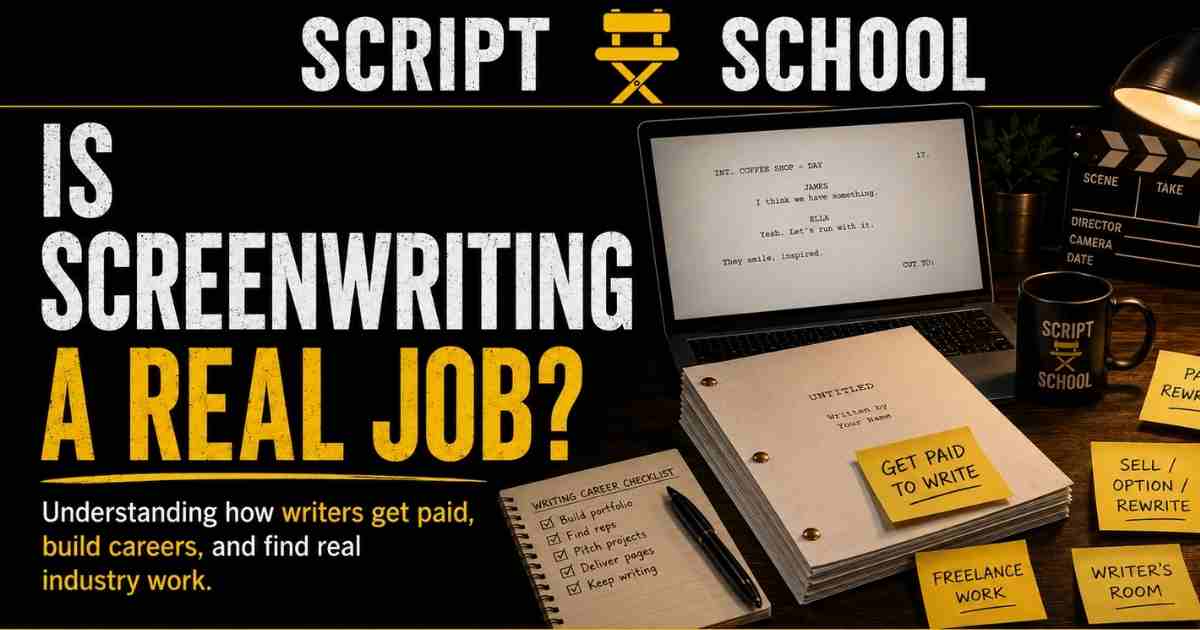
Is Screenwriting a Real Job You Can Make Money From?
Some people see screenwriting as a dream. Others build careers from it.
So here’s the honest answer up front. Yes, screenwriting is a real job. And yes, you can make money from it.
People earn from screenwriting every day. Studios pay them. Streaming platforms hire them. Brands and game studios need them too.
But the path isn’t a straight line. It rarely looks like one giant payday. It looks more like a craft you build over time.
Can you actually earn money doing this? That’s the real question. Keep reading, because the answer might surprise you.
Quick Answer
Screenwriting is a real, paid profession. Writers earn money selling scripts, taking assignments, and working in TV rooms. Many also earn from rewrites, branded content, and digital media.
Is screenwriting a stable nine-to-five salary? Usually not. It works more like freelance project work.
You get paid per project, not per paycheck. Some months are big. Others are quiet.
That’s the trade-off. The freedom is real. The income takes planning. Want to become a paid screenwriter? It starts with treating the craft like a job.
Yes, Screenwriting Is a Real Job
Professional screenwriters work across the entire film industry. Studios hire them. Production companies option their scripts. Streaming platforms staff whole writing teams.
A screenplay writer isn’t a hobbyist with a laptop. They’re a paid part of how stories get made.
Some chase the dream and stop there. Others turn the dream into invoices. The screenwriting industry runs on people who treat it like a profession, not a wish.
But It Is Usually Project-Based, Not Salary-Based
Here’s the part most people miss. Screenwriter income rarely arrives as a steady salary.
Think of a screenwriter like a freelance consultant, not a full-time employee. You’re hired to solve a problem. You deliver. You get paid.
Then you find the next project. A freelance screenwriter lives on a series of gigs, not one contract.
This isn’t bad news. It’s just a different model. Project-based income means more freedom and more responsibility at once.
Plan for the gaps, and the model works in your favor.
The Honest Answer for Beginners
Will your first script make you rich? Probably not. And that’s okay.
Most writers earn their first money from smaller projects. Think short films, indie scripts, or paid rewrites. The big screenplay sale usually comes later, if it comes at all.
Screenwriting for beginners is about building proof. Each small job adds skill and credibility.
You don’t leap straight to a studio deal. You climb there. Want to know how to become a paid screenwriter? Start small, stay consistent, and let the work compound.
Career growth here is slow and steady. That’s a feature, not a flaw.
What Makes Screenwriting a Real Job Instead of Just a Dream?
Anyone can write pages. Few people get paid for them. The difference comes down to one thing: solving story problems on demand.
A hobbyist writes when inspiration strikes. A professional writes when a deadline lands. That gap defines the entire screenwriting career.
Professional writing means showing up, hitting marks, and delivering on spec. It means screenplay development under real pressure.
“Writers write” is true. But pros also revise, pitch, and adapt. Writing discipline turns a creative habit into a paying job.
Want the short version? Focus on solving problems, not just filling pages.
Professional Screenwriters Solve Story Problems
Professional writers are architects of story. They don’t just type scenes. They fix what’s broken.
A producer says the second act drags. A pro reshapes it. Story development is the real product, not the page count.
Script doctors get paid well for exactly this. They diagnose weak structure and repair it fast.
Screenplay development is problem-solving with characters and stakes. Master that, and people pay for your brain, not just your keyboard.
Paid Screenwriting Requires Deadlines, Notes, and Rewrites
Writing is creative. Rewriting is professional.
Real paid work comes with production notes. A studio reads your draft and asks for changes. Sometimes a lot of changes.
You take those notes without ego. Then you do screenplay revisions on a deadline.
Script rewrites are the daily reality of the job. The first draft is just the start. Most paid hours go into making it better.
Miss a deadline and you lose trust. Hit it, and you get hired again. That’s how the work keeps coming.
The Difference Between Hobby Writing and Professional Writing
Do you write for yourself or for an audience? That question separates hobby from career.
Hobby writing answers to no one. Paid writing work answers to producers, deadlines, and notes.
A hobby vs professional writer gap isn’t about talent alone. It’s about standards.
Pros format correctly. They meet word counts. They deliver on time, every time.
You can love writing as a hobby. To go pro, you raise the bar and keep it there.
How Screenwriters Make Money
Here’s the freeing truth. Screenwriters earn money in lots of ways, not just one.
Don’t wait for one script to change your life when many skills can create income. The pros stack income streams.
One writer might sell a script, polish another, and write commercials on the side. How screenwriters make money is rarely a single source.
Below are the main paths. Some pay big and rare. Others pay steady and small. Together, they build a career.
Can you make money from screenwriting? Yes, often through several doors at once.
Selling a Screenplay
This is the dream deal. You write a script. A buyer loves it. They pay to own it.
A screenplay sale can be life-changing money. But it’s also the rarest path.
Spec sales happen, just not every day. When you sell a screenplay outright, the buyer controls it fully.
It’s the headline event most writers chase. Just don’t build your whole plan around it.
Optioning a Script
An option is like a rental with a purchase choice. A producer pays to control your script for a set time.
They don’t own it yet. They’re securing the right to try and make it.
A screenplay option agreement pays less than a sale. But it brings cash and momentum.
Think of a script option as a producer reserving your table. They pay to hold the seat while they line things up.
Writing Assignments
Here’s a steadier path. A company hires you to write something they need.
Maybe it’s an adaptation. Maybe it’s a rewrite of an existing draft. These screenwriting assignments pay real fees.
Paid script writing on assignment is how many pros earn most of their income. You’re not selling a dream. You’re delivering a service.
Assignments build relationships and a track record. Both lead to more work.
TV Writers’ Rooms
Television offers one of the most stable routes in the business. A TV writers room hires a team for a season.
You get a title, a schedule, and a steady check. A television writer collaborates daily on episodes.
This is career aspiration territory for many. The room teaches craft fast and pays consistently.
Want to learn how a room actually builds a series? Our TV Pilot Lab walks you through it. Strong pilots are how writers get staffed.
Rewrites and Script Polishing
Here’s a trade secret. Some of the steadiest money hides in rewrites.
Studios constantly need script polishing on existing drafts. A script doctor steps in to sharpen dialogue, fix pacing, or punch up jokes.
You don’t always get the credit. But you often get the check.
Script doctor services pay well because the need never stops. Every project wants a stronger draft before cameras roll.
Residuals and Union Benefits
Some screenwriting income arrives long after the work is done. That’s the magic of residuals.
When your produced work re-airs or streams, you can earn again. WGA residuals reward writers over time.
Writers Guild benefits also include health and pension support for qualifying members. This is real long-term security.
It’s one reason guild membership matters so much. The work you did years ago can still pay you today.
Indie Films, Shorts, and Low-Budget Projects
You don’t need a studio to start earning. Indie film writers find paid work everywhere.
Short film scripts, low-budget features, and passion projects all need writers. The pay is smaller, but the door is open.
These jobs are accessible early in your journey. They build credits, clips, and confidence.
Curious how indie projects even get funded? Our course on how to raise money for your first movie breaks it down. Many writers learn to finance their own work.
Commercials, Branded Content, and Corporate Video
Not every writer sells movies. Many build careers writing content businesses need.
Commercial script writing pays fast and often. A branded content writer crafts stories for companies, not cinemas.
Corporate video, ads, and brand films all need sharp scripts. This work is steady and surprisingly creative.
It also pays the bills between bigger projects. Plenty of pros fund their dream scripts with brand work.
Games, Podcasts, YouTube, and Digital Media
Where does modern storytelling actually live now? Increasingly, it lives online and in games.
Game writing needs strong narrative design. A YouTube script writer shapes videos that millions watch. Podcast script writing fuels audio drama and shows.
These fields are booming, especially for younger writers and Austin creators. The creator economy hires writers constantly.
Digital media moves fast and rewards fresh voices. If you grew up online, you already understand the audience.
This is one of the most exciting frontiers in paid writing today.
Average Salaries vs. Guild Minimums
Online salary numbers can fool you. An average salary may look impressive on paper. But does it reflect what most writers actually earn?
Here’s the issue. Many screenwriter salary figures mix beginners, mid-level writers, and top earners together. That creates a distorted picture.
To set real expectations, you need two views. One is the general market average. The other is official WGA minimum pay.
Together, they show the gap between hype and reality. Let’s break down both so your expectations match the truth.
| Pay Reference | What It Shows | What It Hides |
|---|---|---|
| Reported average salary | A blended national figure | Mixes top earners with beginners |
| WGA minimum (floor) | The least a guild project can pay | Doesn’t promise steady work |
| Actual take-home | What lands in your account | After taxes, fees, and commissions |
Want a deeper salary breakdown? Read our full guide on screenwriter salary for real numbers.
The General Market: Average Earnings
Reported screenwriter salary figures float around online constantly. They look clean and simple. They rarely are.
An average screenwriter income blends two extremes. A few writers earn huge sums. Many earn very little.
Mix them together and you get a misleading middle. That middle number describes almost no one’s real life.
So treat market averages with care. They’re a starting point for a screenwriting career, not a promise. Real earnings swing widely from writer to writer.
The Hollywood Reality: WGA Minimums
The Writers Guild of America sets minimum pay rates. These are called WGA minimums.
They cover guild projects like studio films and union TV. Screenwriter compensation on these projects can’t drop below the floor.
But here’s the key insight. Guild minimums protect writers, but they do not guarantee employment.
The minimum is a floor, not a ceiling. Top writers earn far above it. New writers must still get hired first. The number only matters once you have the job.
Why Salary Numbers Can Be Misleading
Looking at screenwriter salaries alone is like judging a movie by one scene. You miss the whole story.
Screenwriting behaves more like freelance consulting than a salaried career. Income comes in chunks, not even monthly slices.
A freelance screenwriter might earn a year’s pay in one deal. Then wait months for the next.
So project-based income breaks the salary model. Annual averages can’t capture that rhythm. Judge the career by the full picture, not one figure.
The Gross vs. Net Reality
Here’s a lesson every pro learns fast. What a screenwriter gets paid is not always what they keep.
A headline deal sounds huge. Then taxes, agents, and managers take their share. The net is smaller than the gross.
Don’t count your chickens before they hatch. Professionals track net earnings, not just the flashy number.
Understanding this gap protects you. It keeps your screenwriter income realistic and your planning sane.
What a Screenwriter Gets Paid Is Not Always What They Keep
Picture a deal as a pizza. You don’t eat the whole pie alone.
Taxes take a slice. Your agent takes a slice. A manager and lawyer may take slices too.
What’s left is your real net income. Screenwriter taxes alone can be a big bite, especially for freelancers.
So a six-figure deal isn’t six figures in your pocket. Smart writers plan around the slices, not the whole pizza.
Why a Big Deal May Not Mean Instant Wealth
A big screenplay deal sounds like instant money. Often, it isn’t.
Large contracts may be paid in stages over months or years. You might get part on signing and part on delivery.
More cash can arrive only if the film moves forward. A writer compensation package can stall if the project does.
So the announced number and your bank balance rarely match on day one. Wealth here builds slowly, not overnight.
Why Writers Need Financial Planning
Treat screenwriting as a business, not just an art form. That mindset changes everything.
Income planning matters more here than in a salaried job. Your pay arrives unevenly, so your budget can’t.
Set money aside for taxes. Build a cushion for slow months. Pay yourself a steady amount from lumpy income.
This is how writers turn bursts of cash into lasting financial stability. Plan like a business owner, because you are one.
The Current Job Market Reality
Let’s be straight about today’s market. Screenwriting jobs are competitive. The path is harder than it looks.
But hard isn’t the same as hopeless. The screenwriting job outlook has real bright spots.
Old doors narrowed. New ones opened wide. Streaming, gaming, and branded content all need writers now.
Opportunity often increases when writers develop multiple marketable samples. The market rewards range and readiness.
So here’s the balanced view of the screenwriting market, challenge and opportunity side by side.
Screenwriting Is Competitive
Let’s not sugarcoat it. The screenwriting market is crowded.
Competition is high because barriers to entry are low. Anyone with a laptop can write a script.
That means more writers chase the same paid spots. Standing out takes real skill, not just effort.
This isn’t meant to scare you. It’s meant to focus you. Respect the craft, sharpen your work, and rise above the noise.
Fewer Buyers Does Not Mean No Opportunity
Some markets have fewer traditional buyers than before. That’s real. But it’s only half the story.
Fewer buyers create challenges, but new platforms create opportunities. Streaming, gaming, podcasts, and branded content have expanded writing opportunities fast.
The screenplay opportunities of today look different from a decade ago. Digital media writing is now a serious paid field.
So don’t mourn the old map. Learn the new one. The work moved. It didn’t disappear.
Why New Writers Need More Than One Script
One great script is a nice start. It’s rarely enough.
Most professionals are judged by a body of work, not a single script. A real screenplay portfolio shows range and consistency.
Buyers want proof you can do it again. Several strong writing samples deliver that proof.
So don’t pour ten years into one screenplay. Build a small library instead. Two or three sharp scripts beat one polished outlier.
Why Relationships Matter
Here’s something film schools underplay. Relationships open doors before resumes do.
Sometimes who trusts your work matters as much as who reads it. People hire writers they know and like.
Industry connections grow from real human contact. Festivals, classes, and writing groups all build them.
Networking for writers isn’t slick or fake. It’s just showing up and being good to work with.
A warm referral often beats a cold submission. Relationships turn talent into opportunity.
Real Earning Examples
Theory only goes so far. Let’s make this concrete with real earning ranges.
One quick rule first. We’ll show ranges, not promises. Every writer’s path differs.
Screenwriter earnings depend on experience, project size, and union status. A beginner and a pro live in different worlds.
These examples clarify what paid screenwriting work can look like. Use them as a map, not a guarantee.
Beginner vs. Professional Screenwriter Earnings
The gap between stages is wide. Let’s compare.
| Stage | Typical Work | Earning Pattern |
|---|---|---|
| Beginner | Shorts, indie scripts, small rewrites | Low pay, infrequent, building credits |
| Mid-level | Assignments, options, polish jobs | Moderate pay, more regular |
| Professional | Sales, staffing, studio work | Higher pay, still project-based |
A beginner screenwriter salary often starts near zero. A professional writer income can reach serious figures. Perspective matters more than any single number.
WGA Screenwriting Pay Examples
Guild projects follow a set WGA pay scale. These rates carry real authority.
The Writers Guild publishes guild pay rates for screenplays, teleplays, and rewrites. They update over time.
These numbers act as the floor for union work. They signal what serious professional projects pay at minimum.
For exact current figures, the WGA’s own schedule is the trusted source. Treat it as your credibility benchmark.
Why Beginner Earnings Are Different
If your first checks feel small, that’s normal. Be patient.
An entry level screenwriter is still building proof. Your first paid screenplay is often a credit, not a windfall.
Early work pays in experience and relationships, plus some cash. That mix is the real investment.
Each small job raises your rate for the next one. Beginner earnings are a launchpad, not a ceiling. Give it time.
Why One Paid Job Does Not Equal a Stable Career
One paycheck can create excitement. Consistent work creates a career.
A single sale feels like you’ve arrived. Then the phone goes quiet, and reality returns.
A stable screenwriting career comes from repeated opportunities, not one win. Freelance writing income must keep flowing.
So celebrate the first job, then chase the second. Careers are built through many wins stacked over years. One hit is a start, not a finish.
The Hard Truth
Let’s get fully honest now. The road is hard, but hard roads often lead to strong careers.
Screenwriting can be deeply rewarding. It can also test your patience for years.
The writers who survive long term often treat screenwriting as both a creative craft and a business. They balance art with strategy.
This section won’t sugarcoat the screenwriting market. But it won’t crush your hope either. The goal is clear eyes and steady drive.
Know the hard parts, and you’ll handle them better than most.
Is Screenwriting Stable Income?
Honest answer? Screenwriting is usually not stable income, at least not early on.
It works like other project-based creative careers. Pay arrives per job, not per month.
Compare it to a freelance designer or contractor. Some seasons are busy. Others are slow.
Screenwriter earnings can swing hard year to year. Freelance income demands a cushion.
Stability comes later, once work repeats reliably. Until then, plan for the waves.
Why Screenwriting Is Competitive
Many talented people want the same jobs. That’s the simple reality.
In the screenwriting market, talent matters, but consistency often matters more. Showing up beats raw brilliance over time.
The entertainment industry careers pool is deep. Reliable writers who deliver clean drafts stand out.
So don’t just aim to be gifted. Aim to be dependable. The dependable writer keeps getting hired.
Why Many Writers Earn Irregular Income
Income can arrive in waves rather than a steady stream. That’s the rhythm of this work.
A project-based income means feast and famine cycles. One month overflows. The next runs dry.
That’s why many professionals build multiple income streams around writing. Teaching, consulting, and brand work fill the gaps.
Irregular income isn’t a failure. It’s the nature of the job. Smart writers smooth the waves with planning and side streams.
Why Most Writers Should Not Quit Their Day Job Too Early
Here’s some tough love. Don’t quit your day job too soon.
Wait until income becomes repeatable before making a major career shift. One big check isn’t a green light.
A safe full-time writing transition rests on proof, not hope. You want several paid jobs behind you first.
Keep the steady income while you build. Then become a paid screenwriter without panic. Patience here protects your dream, it doesn’t delay it.
Why Screenwriting Is Still Worth Pursuing
After all the hard truths, here’s the heart of it. Screenwriting is still worth it.
Many successful writers built careers slowly over years. Their stories started small and grew.
There’s deep creative fulfillment in shaping stories people feel. Your storytelling impact can reach millions.
Few careers let you turn imagination into income like this one. The climb is steep, but the view is worth it.
If the work calls you, that pull is worth following. Build the screenwriting career patiently, and it can pay off.
Can You Become a Paid Screenwriter as an Adult?
Worried you started too late? Breathe. You didn’t.
You can become a paid screenwriter at almost any age. Twenty-five or fifty-five, the door stays open.
Screenwriting after 30 is common. Screenwriting after 40 happens too. Plenty of working writers started as career changers.
Here’s the surprise. Life experience often strengthens storytelling ability. Your years are an asset, not a setback.
Let’s clear the age myth completely, then map a realistic path for adult writers.
Yes, Age Is Not the Main Barrier
Relax about your age. It’s rarely the real obstacle.
People become a screenwriter at every stage of life. Screenwriting later in life is a normal story, not a rare one.
What matters is your skill and your scripts, not your birth year. Buyers read pages, not ID cards.
So drop the “too old” worry. The craft cares about quality. Focus there, and age fades into the background.
Adult Writers Often Bring Stronger Life Experience
Here’s your secret advantage. You’ve lived more.
Many great stories come from lived experience. Jobs, heartbreaks, and family all feed authentic storytelling.
A younger writer guesses at adult life. You remember it. That depth shows on the page.
Life experience writing reads truer and hits harder. Your years gave you material a beginner can’t fake.
So bring your whole life to the keyboard. It’s your edge.
How to Build Screenwriting Around a Full-Time Job
You don’t need to quit work to start. Part-time screenwriting is a proven path.
Writing while working full-time takes structure, not magic. A few steady habits do the heavy lifting.
- Block small daily windows. Even thirty focused minutes adds up fast.
- Protect one weekend session. Use it for deeper drafting and rewrites.
- Set a script deadline. A finish date keeps momentum honest.
- Learn in short bursts. Take a class or course on your schedule.
Many pros wrote their first scripts before sunrise or after dinner. Build the habit now, and the career follows. Want a structured start? Our Screenwriting 101 course fits around a busy life.
How Long Does It Take to Become a Paid Screenwriter?
Everyone wants a timeline. Here’s the honest one. There isn’t a fixed clock.
Some writers earn within a year. Others take five or more. Both paths are normal.
Here’s what actually drives speed. Improvement speed often matters more than calendar time. Fast growth beats slow patience.
Let’s bust the timeline myths so you stay motivated. The goal isn’t speed. It’s steady progress toward paid work.
There Is No Fixed Timeline
Stop hunting for a magic number of years. It doesn’t exist.
The screenwriting timeline shifts for every writer. Talent, effort, luck, and timing all play a part.
One writing career path moves fast. Another winds slowly. Neither is wrong.
So measure progress, not the calendar. Are your scripts getting better? Are doors opening? That’s the real clock. Patience plus progress wins here.
Your First Script Is Usually Not the One That Sells
Brace yourself for this one. Your first script teaches. Your later scripts often sell.
Almost no one sells their very first screenplay. That draft is your training ground.
Professional writers often complete multiple scripts before landing paid work. Each one sharpens the craft.
So expect early screenplay rejection. It’s not failure. It’s tuition.
The first screenplay builds skill. The third or fourth might build a career. Keep writing past the first.
Feedback and Rewriting Speed Up Growth
Want to grow faster? Get real feedback and act on it.
Screenplay feedback shows you blind spots you can’t see alone. Then script revisions turn those notes into progress.
Writing in a vacuum slows you down. Honest critique speeds you up.
Smart writers seek feedback early and often. They rewrite with purpose, not pride.
Each round of notes plus revision compresses years into months. Feedback is the fastest shortcut you have.
How Do You Know If Your Script Is Ready for Paid Opportunities?
Big question. How do you know your script is actually ready?
Here’s the trade secret. Most scripts are submitted too early. Strong writers spend more time revising than drafting.
Readiness isn’t a feeling. It’s a checklist you can run honestly.
Below are the markers pros look for. Score your own script against each one. Be tough, because buyers will be.
If you hit most of these, you’re close to paid screenwriting opportunities.
Your Concept Is Clear
Can you pitch your story in one sentence? If yes, your concept is working.
A strong screenplay concept is easy to grasp and hard to forget. A high-concept script hooks people instantly.
If your idea takes five minutes to explain, it’s fuzzy. Sharpen it until it’s a single clean hook.
Clarity sells. A muddy concept stalls before page one.
Your Structure Works
Think of structure as the skeleton of your story. Without it, everything collapses.
Solid screenplay structure carries the audience smoothly from start to finish. Most pros lean on three-act structure as a backbone.
Does your story build, turn, and pay off? Do scenes earn their place?
If the middle sags or the ending feels rushed, the bones need work. Strong structure gives readers confidence in you.
Your Characters Drive the Story
Great scripts run on people, not plot tricks. Your characters should steer the wheel.
Strong character development means choices push the story forward. Compelling characters want something and chase it hard.
Readers connect through emotion, not events. We care because we care about someone.
If your plot could happen to anyone, the characters are too thin. Make us feel for them, and the script comes alive.
Your Dialogue Feels Intentional
Good dialogue sounds natural. Great dialogue reveals character.
Every line should do a job. Screenplay dialogue moves the scene or shows who someone is.
Cut the chit-chat that goes nowhere. Strong dialogue writing carries subtext and tension.
Read your lines aloud. If they sound stiff or pointless, rewrite them. Intentional dialogue marks a serious writer.
Your Formatting Is Professional
This one is simple but vital. Your script must look industry-ready.
Proper screenplay formatting signals you know the craft. Sloppy format gets you dismissed before the story even lands.
Use industry standard format for sluglines, action, and dialogue. Readers expect it instantly.
Clean formatting builds credibility. It tells a buyer you’re a professional, not a guesser.
You Have Rewritten More Than Once
Smooth seas never made skilled sailors. The same goes for first drafts.
A market-ready script has been through real screenplay editing. One pass is never enough.
Script rewrites are where good becomes great. Each version trims fat and sharpens focus.
If you’ve rewritten several times, you’re showing commitment. That discipline separates serious writers from hopeful ones.
You Have Received Serious Feedback
Here’s a final readiness check. Has anyone qualified actually read it?
Feedback from experienced readers is often the difference between a promising script and a market-ready script. Outside eyes catch what you can’t.
Get real script coverage or detailed screenplay notes. Professional feedback reveals the gaps you’re too close to see.
Friends and family are too kind to help. You need honest, expert input.
Want serious notes on your pages? Our private consultations give you exactly that.
Do You Need to Move to LA to Become a Screenwriter?
Time to bust a big myth. You do not need to live in LA to start.
Moving to LA does not create great scripts. Great scripts often create reasons to move to LA.
Most writers benefit more from improving their scripts than relocating too early. Talent travels. Pages cross any zip code.
Remote screenwriting is more possible than ever. Email, video calls, and digital tools shrink the distance.
So before you pack a U-Haul, let’s look at when location actually matters.
Not at the Beginning
At the start, where you live barely matters. Your scripts do.
Most writers need strong samples before location becomes important. A great script in Austin beats a weak one in Hollywood.
Remote screenwriting lets you build skill from anywhere. You can write, learn, and submit without moving.
So relax about geography early on. Focus your energy on the page. A real screenwriting career starts with the work, not the address.
When LA Can Help
That said, LA does offer real advantages later. Let’s be balanced.
LA becomes more valuable when meetings, representation, and staffing opportunities increase. Being close helps when the industry wants face time.
Hollywood networking happens fast in person. Rooms staff up, and proximity can matter.
So LA isn’t useless. It’s just better suited to a later stage. Many entertainment industry careers do cluster there once things heat up.
Why Moving Too Early Can Hurt Your Progress
Don’t build the house before you pour the foundation. Moving too soon can backfire.
Writers often underestimate living costs and overestimate immediate opportunities. LA is expensive and crowded with hopefuls.
Burn through savings before your scripts are ready, and you stall. Stress kills creativity fast.
A smarter screenwriting career path builds samples first, then relocates with leverage. Move when you have momentum, not just a dream. Timing protects your progress.
Is Austin a Good Place to Build a Screenwriting Career?
Short answer? Yes, Austin is a genuinely strong place to grow.
Austin screenwriters enjoy something special. The city blends a real film scene with a creative, welcoming culture.
Austin offers something many writers overlook: access to both writers and filmmakers. That mix accelerates learning.
A screenwriting career in Austin can start without massive overhead. The cost of living and the community both help.
Let’s look at why the Austin film industry deserves your attention.
Austin Has a Real Filmmaking Community
Austin isn’t just music and tacos. It’s a true film town.
Austin filmmakers gather around festivals, indie productions, and creator communities. The Austin film industry runs deep and active.
Major festivals draw talent and buyers to the city each year. Local crews shoot constantly.
That means you can find collaborators close to home. Belonging to a real scene fuels your growth and your network.
Austin Writers Can Build Craft and Community Locally
You don’t have to grow alone in Austin. The city makes connection easy.
Writers improve faster when surrounded by serious peers. The Austin writing community offers exactly that energy.
Screenwriting workshops Austin hosts bring writers together to learn and share. You sharpen your craft in good company.
Local groups, classes, and meetups keep you accountable. Community turns a solo grind into shared momentum. That support speeds everything up.
Why Austin Screenwriters Should Learn Filmmaking Too
Here’s a tip that pays off. Learn how films get made, not just written.
A screenplay is the blueprint, but filmmaking teaches you how the building gets made. Understanding production makes you a sharper writer.
Writers who understand production often write more producible scripts. You learn what’s realistic to shoot and budget.
Independent filmmaking Austin offers hands-on chances to learn. A solid filmmaking education rounds out your skills.
Know the whole process, and your scripts get easier to make. That makes you more hireable.
How Script School Supports Serious Austin Writers
So where does focused training fit in? That’s where Script School comes in.
Script School Austin helps serious writers build craft, community, and real skills. It’s a screenwriting school Austin writers can grow with.
You get mentorship, structured courses, and a network of peers. Screenwriting classes Austin students take here aim at real outcomes.
The focus is transformation, not just lectures. You leave with stronger scripts and clearer direction.
Curious what’s on offer? Explore our full course lineup and find your starting point. We also run youth programs for younger writers.
Do You Need a Manager, Agent, or Contest Win?
New writers obsess over reps and trophies. Let’s set the record straight.
Strong writing samples attract opportunities more consistently than aggressive networking alone. The work comes first.
Do you need a manager, agent, or contest win to start? Not yet. Those come after your craft is solid.
Chasing representation too early wastes energy. Reps want writers who already shine.
Let’s break down what actually matters and when. Spoiler: it starts with your pages.
Not Before You Have Strong Samples
Here’s the order that works. Craft first, gatekeepers second.
You don’t need an agent before you have great scripts. A manager won’t save weak writing.
A strong screenplay portfolio is your real calling card. Polished writing samples open more doors than cold pitches.
So focus your early energy on the work. Build undeniable scripts. Representation gets easy once your pages do the talking.
Contests Can Help, But They Are Not a Career Plan
Contests open doors. They rarely build entire careers.
A win in respected screenwriting contests can earn attention and credibility. Some screenplay competitions launch real opportunities.
But a contest is a boost, not a business plan. Few writers build a whole career on placements alone.
Enter selectively, then keep writing. Treat a contest as one tool among many. Don’t bet your future on a single trophy.
The Black List and Script Platforms Work Best for Polished Scripts
Online platforms can help, with one condition. Your script must be ready.
Black List scripts that get noticed are usually already strong. The platform amplifies quality. It can’t create it.
Screenplay platforms reward polished, professional work. A rough draft just buries you in the crowd.
So don’t rush onto these sites. Sharpen the script first. Then a platform like the Black List can actually move your career forward.
Relationships Often Matter More Than Cold Submissions
Here’s the quiet truth of the business. Who you know really does count.
Many opportunities start through trusted referrals. A warm intro beats a cold email almost every time.
Industry relationships grow through real connection, not spam. People hire writers they trust and enjoy.
Networking for writers isn’t about being pushy. It’s about being genuine and present.
Build real bonds, and doors open naturally. Relationships often do the work cold submissions can’t.
Ways to Make Money With Screenwriting Skills Before Selling a Feature
Waiting to sell a feature? You can earn long before that.
Most writers earn early income through adjacent writing services before major screenplay sales. Your skills are valuable right now.
The smart move is simple. Make money screenwriting through related work while you build toward the big sale.
These paid screenwriting opportunities keep cash flowing and skills sharp. They also build your network and credits.
Here are real ways to earn with the talent you already have.
Script Coverage
Companies need readers to evaluate scripts. That’s script coverage.
You read a screenplay and write a clear report. Production companies and contests pay for screenplay analysis.
It sharpens your own eye while paying you. Reading flaws in others’ work reveals your own.
Script coverage services are a smart early income source. You earn while learning what makes scripts work.
Script Consulting
Once you know story deeply, others will pay for your help. That’s consulting.
A script consultant guides writers through structure, character, and notes. You offer screenplay consulting based on real skill.
It positions you as an expert, which builds your reputation. Clients value clear, honest guidance.
This is steady professional growth and income at once. Helping others write better also makes you better.
Freelance Video Scripts
Plenty of clients need short, sharp scripts fast. You can write them.
A freelance script writer creates video scripts for businesses and creators. Explainers, ads, and brand clips all need words.
The pay is quick and the projects are short. You can juggle several at once.
Freelance video scripts are a reliable way to earn between bigger projects. Real money, real practice.
Commercial Scripts
Here’s an overlooked goldmine. Commercials need writers too.
Commercial script writing turns a brand message into a tiny story. Advertising scripts demand tight, punchy work.
The format is short, but the craft is real. Thirty seconds can carry a whole emotion.
Discover this lane and you unlock steady paid work. Brands always need fresh ad ideas.
Branded Content
Ever wonder who writes those slick brand films? Writers like you.
Branded content writing blends storytelling with marketing. Companies want branded storytelling that feels human, not salesy.
This is modern, creative, and well paid. You craft stories that quietly serve a brand.
It’s a fast-growing field full of opportunity. Curious writers thrive here, mixing art and strategy.
YouTube and Creator Scripts
The creator economy runs on words. Many creators hire writers.
A YouTube script writer shapes the hooks, beats, and payoffs of videos. Creator economy writing is in huge demand.
Top channels treat scripts seriously, and they pay for them. Good structure keeps viewers watching.
This is exciting, future-focused work. If you understand online audiences, you’re already ahead. The field keeps growing every year.
Podcast and Audio Drama Scripts
Audio storytelling is booming again. Writers fuel it.
Podcast script writing covers narrative shows, fiction, and structured episodes. Audio drama writing brings stories to life through sound alone.
It’s a fresh space to explore your voice. You learn to paint pictures with dialogue and audio cues.
This field rewards strong storytelling instincts. For writers who love voice and pacing, it’s a perfect playground.
Game Writing and Narrative Design
Games need stories more than ever. That means jobs for writers.
A game writer crafts dialogue, lore, and branching paths. Narrative design shapes how players experience the story.
The gaming industry is massive and still growing. It hires writers across every genre.
This is aspirational, well-paid, modern work. If you love interactive stories, narrative design is a thrilling lane to chase.
Short Film and Indie Film Writing
Everyone starts somewhere. Short and indie projects are great first stops.
An indie film writer creates work that’s actually achievable to shoot. Short film scripts are perfect for building early credits.
The budgets are small, but the access is wide open. Directors constantly seek fresh scripts.
These projects build your reel and your confidence. They’re a friendly on-ramp to paid screenwriting work.
Teaching, Coaching, or Workshop Support
Know the craft well? You can teach it.
A screenwriting coach guides newer writers toward stronger scripts. Leading writing workshops shares your skill and earns income.
Teaching also boosts your own authority in the field. Explaining craft sharpens your mastery.
It’s a credible, rewarding way to earn between projects. Your knowledge has value, so put it to work.
Good Resource Details for This Topic
Trust matters in research. So here are credible sources worth your time.
Official industry sources increase credibility and improve content quality signals. They give you real data, not guesses.
Use these for accurate screenwriting statistics and writer employment data. They anchor your expectations in fact.
Bookmark a few. They’ll serve you for years as your career grows.
U.S. Bureau of Labor Statistics
The BLS tracks writer employment data across the country. It offers reliable writing career statistics on pay and outlook. Use it for a grounded national view of the profession.
Writers Guild of America Minimum Basic Agreement
The WGA MBA sets the core terms for union writing work. This Writers Guild agreement defines minimum pay and protections. It’s the authoritative reference for guild standards.
WGA Screen Compensation Guide
The WGA pay guide lists current minimum rates clearly. It clarifies screenwriter compensation for films and TV. Check it for exact, up-to-date guild figures.
WGA Writer Employment Snapshot
This WGA employment report shows how many writers actually work. It adds credible writer employment data to your research. Use it to understand real hiring trends.
Austin Film Commission
The Austin Film Commission supports local productions and creatives. It’s a key source for Austin film resources and contacts. Lean on it for local confidence and connections.
City of Austin Film and Digital Media Resources
The city offers Austin digital media resources for creators. These Austin film programs support local writers and filmmakers. They reveal real opportunity in your own backyard.
Frequently Asked Questions
Is screenwriting a real job?
Yes, screenwriting is a real, paid job. Studios, production companies, and streaming platforms hire writers regularly. A professional screenwriter earns money through sales, assignments, and staff positions. It works like freelance project work, not a fixed salary, but the income is real.
Can you make money from screenwriting?
Yes, you can make money from screenwriting in many ways. Writers earn from script sales, options, rewrites, and TV rooms. Screenwriter income also flows from branded content, games, and digital media. Most pros combine several streams to build steady earnings over time.
Do screenwriters get a salary?
Usually not a traditional salary. Most screenwriters earn project-based income, paid per job. Staff TV writers get steadier checks during a season. But many writers work gig to gig, more like freelancers than salaried employees.
How much does a beginner screenwriter make?
A beginner screenwriter often earns little at first. Early pay comes from shorts, indie scripts, and small rewrites. Some first paid screenplay jobs pay only a few hundred dollars. Beginner earnings build slowly, then rise as your credits and skills grow.
Is screenwriting stable income?
Not usually, especially early on. Screenwriting offers project-based, irregular pay rather than steady monthly income. It resembles other freelance careers, with busy seasons and quiet ones. Stability grows once you land repeat work and build multiple income streams.
Do I need a degree to become a screenwriter?
No, you don’t need a degree to become a screenwriter. The industry cares about your scripts, not your diploma. A strong screenplay portfolio matters far more than formal screenwriting education. Targeted classes and real practice often beat a costly degree.
Do I need to live in LA to be a screenwriter?
Not at the start. You can build skills and write from anywhere. Remote screenwriting works fine while you develop strong samples. Los Angeles helps later, once meetings and staffing rise. Great scripts matter more than your zip code early on.
Is Austin good for screenwriters?
Yes, Austin is a strong city for screenwriters. It has a real Austin filmmaking community, festivals, and indie productions. Costs stay lower than LA, and the creative scene is welcoming. Austin screenwriters can build craft and connections close to home.
How many scripts should I have before looking for paid work?
Aim for at least two or three polished scripts. Buyers judge you on a body of work, not one sample. A small, strong screenplay portfolio shows range and consistency. Several solid writing samples open more doors than a single script.
Should I quit my job to become a screenwriter?
Not too early. Don’t build the house before you pour the foundation. Wait until paid screenwriting work becomes repeatable and reliable. Keep your day job while you build proof and savings. A safe full-time leap rests on steady income, not one big check.
Forum and UGC Questions to Answer in the Article
How do I get my script taken seriously?
Start with the basics nobody can ignore. Use correct screenplay formatting, every single time.
A messy script gets tossed before page two. Clean format signals you respect the craft.
Then get real screenplay feedback before you submit. Outside notes catch what you miss.
Pros also pitch clearly and act professionally. They hit deadlines and take notes without drama. Want to be taken seriously? Look and act like someone who’s done this before. Curious about the wider craft? Our blog digs deeper.
Should I write many scripts or keep rewriting one?
Classic beginner question. The honest answer is both.
More scripts build range. Better rewrites build quality. You need each one.
Rewrite a script until it’s genuinely strong. Endless screenplay revisions on one idea can trap you.
But also write new ones. A real screenplay portfolio shows you can repeat the magic.
Finish one, polish it, then start another. Range plus depth makes you hireable. Don’t get stuck rewriting forever.
Are screenwriting contests worth it?
Sometimes yes, sometimes no. It depends on the contest.
Respected screenwriting contests can boost your credibility and visibility. A win opens a few real doors.
But many screenplay competitions cost money and deliver little. Not every contest is worth your entry fee.
Pick the well-known ones with industry ties. Enter selectively, not constantly.
Treat contests as a small boost, not a master plan. They help. They don’t make a career alone.
Is the Black List worth paying for?
It can be, with one big caveat. Your script must be ready.
Black List scripts that score well can attract real industry eyes. The platform spotlights strong work.
But screenplay hosting fees add up fast. A weak script just burns money there.
So polish hard before you upload. Get feedback first. Then the Black List becomes a smart tool, not a gamble. Quality decides whether it pays off.
Should I move to LA or stay in Austin?
It depends on your stage. Both can be right.
Early on, stay put and build. Austin screenwriters can grow craft and credits without huge costs.
Los Angeles screenwriting helps later, when meetings and staffing ramp up. Proximity matters once the industry calls.
So don’t rush west with an empty portfolio. Build strength in Austin first.
Move when you have leverage and savings. Great scripts travel well. Let the work decide your zip code, not panic.
Can I become a screenwriter while working full-time?
Absolutely yes. Most writers start exactly this way.
Part-time screenwriting fits around a busy life. You don’t need to quit anything yet.
Writing while working full-time takes small, steady habits. Thirty minutes a day adds up fast.
Protect your weekends for deeper work. Set finish dates to stay honest.
Plenty of pros wrote their breakout script before dawn. Your day job funds the dream while you build it. Keep going.
Should I make my own short film?
Often, yes. It’s a powerful move.
A short film is often a business card in motion. It shows your voice better than a pitch.
Short film writing teaches you what actually works on screen. Indie filmmaking reveals how scripts become images.
You learn pacing, budget, and collaboration firsthand. That makes you a sharper writer.
A finished short proves you can deliver. It opens doors a script alone sometimes can’t.
How do I know if my script is good enough?
Tough but vital question. Honest answer: you need outside eyes.
You’re too close to judge your own work clearly. Real screenplay feedback reveals the truth.
Get professional script coverage from experienced readers. Their notes show what’s working and what isn’t.
Friends are too kind to help here. Strangers in the industry tell it straight.
If serious readers respond well, you’re close. Trust qualified feedback over your own gut. Self-awareness comes from outside input.
Can I sell my first screenplay?
It’s possible, but rare. Stay hopeful and realistic.
A first screenplay sale does happen for a lucky few. Most writers sell later scripts, not their first.
The screenplay market is competitive and selective. Your debut is usually a learning project.
So write your first script to grow, not to retire. Treat any early sale as a bonus.
Keep writing past script one. The one that sells is often still ahead.
Should I accept backend pay instead of upfront pay?
Be careful here. Backend pay carries real risk.
Treat backend promises carefully unless the project has proven financing and distribution. A share of profits means nothing if the film never ships.
Backend compensation sounds generous. Often it pays little or nothing.
Read screenplay contracts closely. Favor upfront pay when you can get it.
If you accept backend, treat it as a bonus, not your wage. Get real money for real work first.
Final Conclusion
Screenwriting Is a Real Career
Let’s land the plane. Screenwriting is a real career.
A professional screenwriter earns money across film, TV, and digital media. Studios, platforms, and brands all hire writers.
This isn’t a fantasy or a side hobby. It’s a legitimate screenwriting career with real paychecks. The job is as real as any other.
Screenwriting Is Not Easy Money
Here’s the honest balance. Screenwriting can pay well, but it rarely pays quickly.
Screenwriter income arrives in waves, not steady streams. Paid screenwriting work takes time to build.
You’ll write, revise, and pitch for years before it clicks. The reward is real. The shortcut isn’t. Patience is part of the price.
Screenwriting as a Long-Term Creative Business
Think bigger than one sale. Think long-term.
A writing career grows more like a tree than a lottery ticket. It builds slowly, then stands strong.
Treat your storytelling career as a creative business. Stack skills, relationships, and credits over time.
The writers who last play the long game. Plant now, and your career keeps growing for decades.
Final Call to Action for Script School
So here’s your next step. Stop wondering and start building.
Script School Austin helps serious writers turn talent into real skill. Our screenwriting classes Austin students join focus on growth and results.
You’ll get mentorship, structure, and a community that pushes you forward. This screenwriting school Austin trusts is built for transformation.
Explore our courses and find where you fit. New here? Start at our welcome page, learn our story on the about page, or reach out with questions.
Your screenwriting career starts with one bold step. Take it today.
Keep learning: Explore specialized craft with our horror screenplay course, master the deal with pitching and packaging, and understand the room from the other side in our casting director workshop. Confused about terms? Read screenwriting vs scriptwriting.