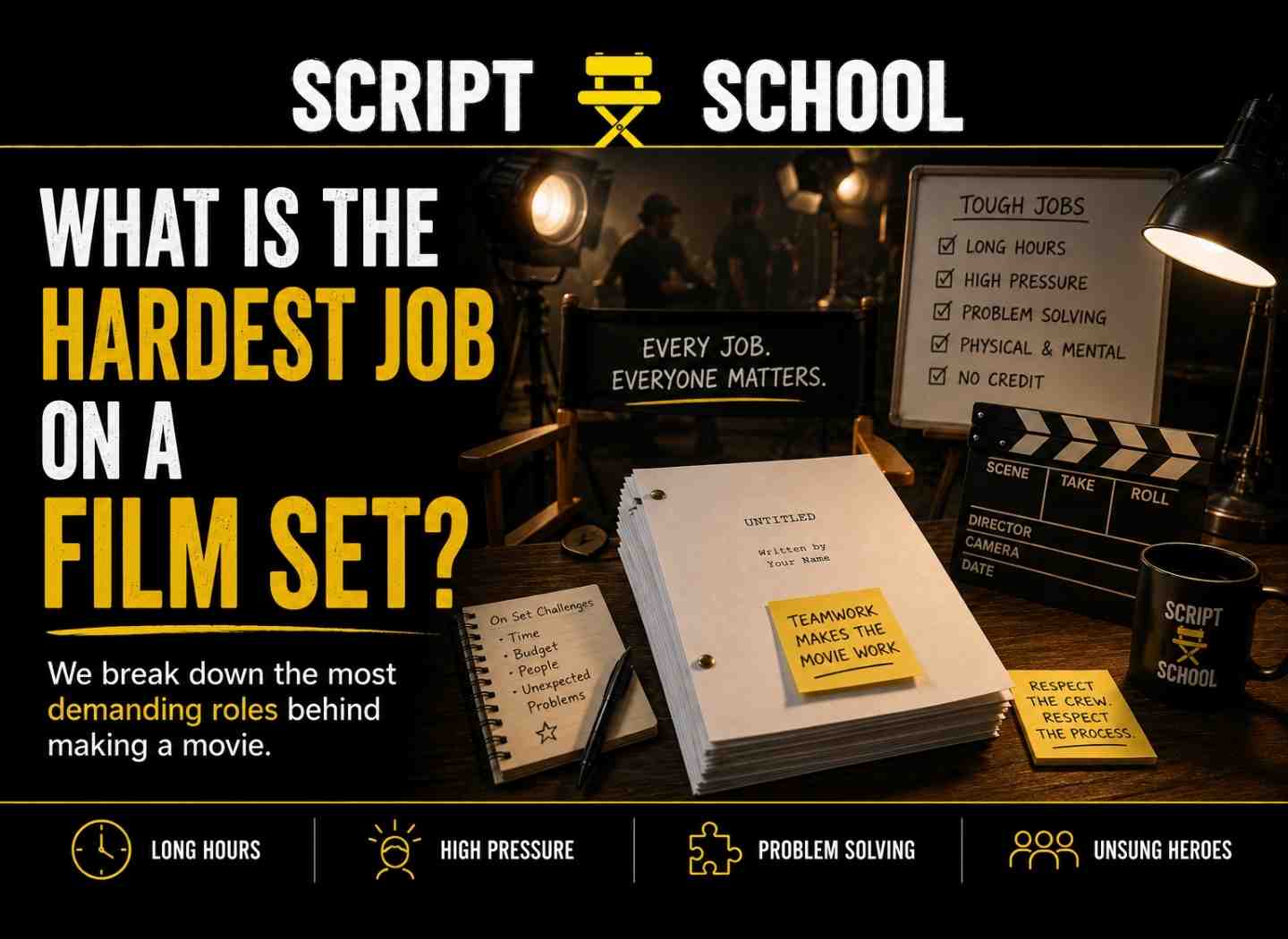
What Is the Hardest Job on a Film Set?
Most people think they already know the answer. They picture the director in a chair, calling the shots, carrying the whole movie on their back. But ask the crew who actually keeps a set running, and you’ll hear a different story.
Here’s the honest truth. The hardest job on a film set depends on the kind of pressure you’re talking about. Stick with me. By the end, you’ll see why the answer surprises almost everyone, and why one role keeps coming up when working crews talk about who really carries the weight.
Who actually carries the most pressure when a set starts falling behind schedule? Let’s find out.
Quick Answer: The Hardest Job on a Film Set Depends on the Kind of Pressure
The 1st Assistant Director usually has the hardest on-set job because they carry the schedule, safety, and daily operations all at once. But that’s not the whole picture. Different roles face different kinds of difficulty, and each one can feel like the hardest job on the day it goes wrong.
The producer carries the longest responsibility. The 1st AD carries the most immediate pressure. The director carries the creative vision. The cinematographer carries the look. Each role owns a different problem, and each problem can break a film.
So instead of crowning one winner, it helps to match the pressure type to the role that feels it most.
| Pressure Type | Hardest Role |
|---|---|
| On-Set Pressure | 1st Assistant Director |
| Business Pressure | Producer |
| Creative Pressure | Director |
| Technical Pressure | Cinematographer |
Read on and I’ll break down each one. We’ll start with the role most working filmmakers point to first.
Why Many Filmmakers Say the 1st Assistant Director Has the Hardest On-Set Job
Ask a seasoned crew member who has the toughest job, and many will name the 1st AD without hesitation. The reason is simple. The 1st AD runs the floor while everyone else focuses on one task.
The 1st AD tracks the schedule, manages the cast, coordinates every department, and protects safety. They do all of it at the same time, all day long. When the day slips behind, the pressure lands on them first.
Many crew members call the 1st AD the “air traffic controller” of the set. Planes keep landing. The schedule keeps moving. And the 1st AD keeps everything from crashing into each other.
Why Producers May Have the Hardest Overall Film Job
Now flip the view from one day to the whole journey. The 1st AD owns the day. The producer owns everything.
Producers handle money, contracts, hiring, scheduling, and risk. If the budget runs out, that’s their problem. If a location falls through, that’s their problem too. They carry the project before a single camera arrives and long after the last shot wraps.
Producers often stay attached to a project years longer than any crew member. That long-haul responsibility is why many people argue the producer has the hardest overall job in film.
Why Directors, Cinematographers, and Sound Teams Also Face Intense Pressure
It’s easy to oversimplify and pick one hero. Real sets don’t work that way. Let me widen the lens.
The director shapes the story and leads the creative vision. Every performance and every shot reflects their choices. That’s a heavy creative load.
The cinematographer turns ideas into images. They balance light, lens, and movement while the clock ticks. One wrong call changes how the whole scene feels.
The sound team protects something audiences rarely think about until it fails. One bad audio recording can cost more than a missed camera setup. A blurry shot might survive the edit. Unusable dialogue often does not.
So who has it worst? It depends on the moment.
The Simple Truth: Every Film Set Job Is Hard in a Different Way
Here’s where it all settles. There’s no single hardest job that wins every argument. There’s only the hardest job for that pressure, on that day, on that production.
A chain is only as strong as its weakest link. Film sets prove that every single day.
Film sets succeed because specialists solve different problems at the same time. The grip rigging a light, the script supervisor tracking continuity, the 1st AD watching the clock. Pull one link and the whole thing strains. That’s the real answer worth respecting.
What Makes a Film Set Job “Hard”?
Before we crown anyone, we need a fair way to measure difficulty. “Hard” is a feeling, but we can break it into parts. When I judge how tough a role is, I look at pressure, responsibility, consequences, and workload together.
A job can be physically brutal and low stakes. Another can be calm to watch but carry massive consequences. The hardest roles usually stack several of these on top of each other. That’s the trap. We see one stressful moment and assume that’s the whole job.
So let’s slow down and name the six kinds of pressure that show up on almost every set. Once you see them, you’ll judge film jobs in a smarter way. You’ll also understand why crews respect roles that look easy from the outside.
Real difficulty isn’t about who looks busiest. It’s about who carries the most when things go wrong. Keep that in mind as we go through each category below.
Time Pressure and Long Shooting Days
Film days are long and expensive. A crew can work twelve hours or more, and every minute costs money. Fall behind in the morning, and the whole day unravels by night.
What happens when you only have time for one more take? Someone has to decide, fast, and live with that choice. That clock never stops, and it pressures every role that touches the schedule.
Responsibility for Cast, Crew, Budget, and Safety
Some jobs carry lives, not just tasks. When you’re responsible for film set safety, a careless moment can hurt people. That weight is real.
Add the production budget, the cast, and the whole crew, and the load grows fast. The more people and money you protect, the harder the job becomes. Responsibility, not effort, is what makes these roles so demanding.
Creative Pressure vs Technical Pressure
Not all pressure feels the same. Creative pressure asks, “Does this feel right?” Technical pressure asks, “Did this work?”
Creative leadership lives with doubt. There’s no perfect answer to a performance or a story beat. Technical filmmaking lives with precision. The focus is sharp or it isn’t. Both kinds of pressure are hard. They just press on different nerves.
Physical Labor, Weather, Locations, and Set Conditions
Some film jobs punish the body. Crews haul gear up stairs, stand in the rain, and work through heat and cold. Location filming can mean mud, wind, and long walks with heavy equipment.
Picture a grip carrying a sandbag across a wet field at 5 a.m. Filming conditions can turn brutal fast. The toughest physical roles rarely get the spotlight, but they earn every bit of respect.
Communication Between Multiple Departments
A film set works like an orchestra. Camera, lighting, sound, art, and wardrobe all play different parts. If they don’t stay in sync, the whole performance falls apart.
Good crew communication keeps everyone on the same beat. Department coordination sounds simple, but it’s one of the hardest skills on set. One missed message can stall a hundred people at once.
Problem-Solving When Something Goes Wrong
Plans break. They always do. The real test is what happens next.
What happens when the lead actor gets stuck in traffic and a hundred crew members are waiting? Someone has to solve it without panic. Production problem solving under pressure is a rare skill. The best crews handle on-set challenges so smoothly that you’d never know anything went wrong.
Why the 1st Assistant Director Is Often Considered the Hardest On-Set Job
Now we get to the heart of it. When working crews argue about the hardest on-set job, the 1st AD keeps winning the debate. Here’s why that happens.
The 1st AD sits at the center of every kind of pressure we just covered. Time, responsibility, communication, and problem-solving all run through this one role. The director dreams the day. The 1st AD makes the day happen.
Think about what that means. The 1st AD turns a creative vision into a minute-by-minute plan. Then they protect that plan against every delay, every surprise, and every change. They keep cast and crew moving while staying calm enough to make fast calls.
Many productions rise or fall based on the effectiveness of the 1st AD. A strong one saves hours and protects the budget. A weak one lets the day drift, and the cost piles up.
Here’s the part outsiders miss. The 1st AD absorbs stress so the director can focus on the work. They take the heat from every department at once. That’s a lonely kind of pressure, and it’s exactly why so many filmmakers call this the hardest job on the floor.
The 1st AD Runs the Set
The 1st AD is the engine of set operations. They set the pace, call the moves, and keep the day flowing from one shot to the next.
Picture an air traffic controller. Planes keep arriving. Each one needs a clear path. The 1st AD guides every department in and out without a single collision. First AD leadership is what keeps a busy set from turning into chaos.
The 1st AD Protects the Shooting Schedule
The shooting schedule is the day’s promise. Hit it, and the production stays healthy. Miss it, and the cost climbs by the hour.
The 1st AD guards that production timeline like a hawk. They watch the clock, push the pace, and make hard calls about what stays and what gets cut. Every minute they save protects the budget and the people relying on it.
The 1st AD Coordinates Every Department
Every department plays a different instrument. Camera, lights, sound, art, and wardrobe each have their own rhythm. The 1st AD keeps them all on the same beat.
That’s real department coordination. The 1st AD knows what each team needs and when they need it. They build the production workflow so nobody waits and nobody clashes. It’s a constant balancing act.
The 1st AD Handles Safety and Set Discipline
Set safety is not optional. The 1st AD watches for risk before it becomes a problem. They run safety briefings and keep dangerous moments under control.
They also hold crew discipline. A busy set needs focus and order. The 1st AD sets the tone, keeps people sharp, and makes sure everyone trusts the process. That trust keeps the whole crew safe.
The 1st AD Balances the Director’s Vision With Production Reality
Here’s the tightrope. The director wants the perfect shot. The schedule says there’s time for one more setup. The 1st AD lives in that gap.
The director chases the dream. The 1st AD protects the reality. They handle production logistics while keeping the director’s collaboration strong. Good ones do it without crushing the creative spark. That balance is one of the hardest parts of the job.
The 1st AD Must Stay Calm When Everyone Else Is Under Pressure
Ever notice how the calmest person on set is often carrying the most pressure? That’s usually the 1st AD.
Leadership under pressure means staying steady when the day is on fire. Crisis management is part of the job, every single day. The 1st AD makes fast calls, keeps their voice level, and helps the crew breathe. Calm is contagious, and it starts with them.
What Does a 1st Assistant Director Actually Do?
Let’s clear up the biggest myth first. The 1st AD does far more than yell “Action” and “Cut.” In fact, on most sets the director calls those. The 1st AD’s real work happens around and between every take.
Think of it this way. The director points toward the destination. The 1st AD builds the road that gets everyone there. That road starts weeks before filming and runs through every shooting day.
The job splits into two big phases. In pre-production, the 1st AD studies the script and builds the plan. During production, they run the floor and keep that plan alive. Both phases demand sharp organization and serious people skills.
Here’s a trade secret. Professional productions often build their schedules from the script breakdown. A strong breakdown can save days of production time later. That early, invisible work is where a lot of the real difficulty lives.
So let me walk you through what a 1st AD actually does, step by step. You’ll see why this role earns its tough reputation.
Break Down the Script Before Filming
Before a single camera arrives on set, the hardest work may already be happening behind the scenes.
The 1st AD reads the script and breaks down every scene. They note the cast, props, locations, stunts, and special needs. This script breakdown becomes the backbone of all production planning.
Skip this step or rush it, and the trouble shows up later. Many scheduling problems start with a weak breakdown. Strong pre-production planning here makes filming logistics far smoother down the line.
Build the Shooting Schedule
Next, the 1st AD turns that breakdown into a real plan. The shooting schedule decides what gets filmed, when, and in what order.
Here’s the surprise for beginners. Movies are rarely filmed in story order. They’re filmed in production order. A smart filming schedule groups scenes by location and resources, not by the plot.
That choice saves time and money. A strong production calendar keeps the crew efficient. Schedule management like this is one of the most respected skills in the business.
Prepare the Set for Each Shot
A film set is like a stage performance that must be rebuilt dozens of times each day. Before each shot, a lot has to fall into place.
The 1st AD makes sure the set preparation runs on time. Actors get ready. Camera and lights get set. The production setup needs to click together so the team can roll.
Good shot planning here protects the day. Solid preparation often decides whether a production gains time or loses it. Lost setups are lost hours.
Call the Roll Before Each Take
When it’s time to film, the 1st AD runs the procedure. They call for quiet, then cue camera and sound to roll. This “calling the roll” keeps every take clean and organized.
It sounds small, but it matters. Consistent roll procedures reduce mistakes during filming and in post-production. These film set procedures keep the production workflow tight and the footage usable.
Keep Cast and Crew Moving
Momentum is everything on set. The 1st AD keeps cast and crew moving from one shot to the next without dead time.
Here’s the math that scares producers. Lost minutes often become lost hours by the end of the day. Don’t wait until the roof leaks to fix the shingles.
Good crew management and cast coordination protect the schedule in real time. Production efficiency isn’t about rushing. It’s about removing the gaps that quietly eat the day.
Communicate With Department Heads
The 1st AD talks to everyone. They check in with camera, lighting, sound, art, and wardrobe all day long. Clear contact with department heads keeps the whole set aligned.
Every department plays a different instrument, but the 1st AD keeps everyone on the same beat. Strong crew communication is the core of production leadership. Communication failures create more delays than equipment failures on many productions.
Solve Problems Without Slowing Down Production
Have you ever watched someone solve five problems before breakfast and still look completely calm? That’s a great 1st AD.
Problems hit all day. An actor runs late. The weather turns. A location falls through. The 1st AD handles production problem solving on the fly. They manage filming delays and on-set challenges before they spread.
The best 1st ADs solve problems before most crew members even know they exist. That quiet skill is the heart of the job.
Why Producing May Be the Hardest Job in Film Overall
Now let’s zoom all the way out. The 1st AD owns the hardest day. The producer owns the hardest journey. If we measure difficulty across the entire life of a film, the producer often wins.
Here’s why. The 1st AD manages the day. The producer protects the entire journey. Most crew members show up for the shoot and go home when it wraps. The producer started years earlier and stays on long after the last shot.
The producer’s job spans development, financing, hiring, production, and distribution. They carry the money, the contracts, the people, and the risk. When something breaks at any stage, it lands on them.
That’s a different kind of pressure than a tough day on set. It’s slow, heavy, and constant. Unlike most crew members, producers remain responsible before production begins and long after filming ends.
So let me break down what makes producing so demanding. You’ll see why this role carries the broadest weight in the entire business.
Producers Secure the Money
Nothing happens without funding. The producer’s first job is to find the money that makes the film possible. No financing means no schedule, no crew, and no equipment.
What happens to a production when the funding disappears? Everything stops. That’s why producers chase film financing so hard, and why production funding keeps them up at night.
This pressure never fully ends. Even with a movie budget locked, producers must protect every dollar. Want to understand this side of film? Our course on how to raise money for your first movie walks you through it.
Producers Build the Team
A film is only as good as the people who make it. Producers handle crew hiring, casting decisions, and production staffing. They assemble the right team for the job.
Here’s a quiet truth. Great productions are often built through relationships rather than resumes. The best producers know who works well together and who to call when the pressure rises.
Casting is its own art. If you want to learn how that side works, our casting director workshop shows you the process from the inside.
Producers Manage Budget, Schedule, and Risk
Producers hold three things in balance at once. Budget management. Schedule management. Production risk. Drop any one of them, and the project can collapse.
Every delay has a financial consequence. A rained-out day, a sick actor, a broken camera. Each one costs money the producer has to find or save somewhere else.
Creative decisions create opportunities. Budget decisions determine whether those opportunities survive. That tension sits on the producer’s desk every single day of the shoot.
Producers Balance Creative, Legal, and Business Decisions
Producers wear a lot of hats. One hour they’re discussing a creative idea. The next they’re reading a contract or solving a business problem. Legal film production work, creative decision making, and the business side of film all collide on their plate.
Most of these choices have no perfect answer. Many producer decisions involve competing priorities rather than clean solutions. They protect the art and the money at the same time.
Producers often walk a tightrope between art and business. Lean too far either way, and the film suffers.
Producers Stay Responsible From Development to Distribution
This is the part that makes producing so heavy. The job runs from film development all the way through film distribution. That’s the full production lifecycle, start to finish.
A producer’s job often lasts years longer than principal photography. They nurture a project from idea to script, through the shoot, and into the marketplace. The crew goes home. The producer keeps going.
The best time to plant a tree was twenty years ago. The second-best time is now. Producers think in those long timelines, and they carry the project the whole way.
Why Directing Is One of the Hardest Creative Jobs on a Film Set
Let’s give the director their due. Even when the 1st AD runs the floor and the producer holds the money, the director carries something no one else can. The creative vision.
Directing is hard in a way that’s tough to measure. There’s no checklist for a great performance. There’s no formula for the right emotional beat. The director makes hundreds of creative decisions every day, and many of them with incomplete information.
Think about that. A director chooses how a moment feels, how an actor plays a line, and how a story lands. They make those calls fast, under a ticking clock, with a whole crew waiting. And once the production moves on, many of those choices are locked forever.
On top of the creative load, the director leads people. Actors need one kind of guidance. The crew needs another. The director switches between both all day long.
So let me break down why this creative role carries such intense pressure. It’s a different weight than the 1st AD or the producer, but it’s just as real.
The Director Carries the Creative Vision
The director owns the artistic direction. Every choice points back to their vision for the film. That’s a huge creative responsibility to hold.
The director holds the compass while the crew builds the map. They know where the story should go and how it should feel. Strong visual storytelling starts with a clear vision in the director’s head.
Here’s the skill that separates the great ones. Strong directors communicate ideas clearly without controlling every detail. That kind of filmmaking leadership lets the whole crew do their best work.
Directors Must Lead Actors and Crew at the Same Time
Directing is two leadership jobs in one. Actors need emotional guidance. Crew members need operational clarity. The director gives both, often within the same minute.
One moment, they coach an actor through a vulnerable scene. The next, they tell the camera team exactly what they need. Directing actors takes patience and empathy. Crew leadership takes precision and speed.
Switching between those modes all day is exhausting. Few jobs ask for that range. That constant shift is part of what makes actor direction and crew leadership so demanding.
Directors Make High-Stakes Decisions Under Time Pressure
What would you do if you had five minutes to solve a problem that could affect the entire film? Directors face that all the time.
Directing decisions come fast and carry weight. Light is fading. The schedule is tight. The crew is waiting. The director has to choose, and choose well, under real film set pressure.
Here’s the scary part. Many directing decisions become permanent once the production moves on. Production deadlines don’t pause for second-guessing. That permanence raises the stakes on every single call.
Directors Must Communicate Clearly Across Every Department
A director may not play every instrument, but they must help the entire orchestra perform the same song. That’s the job in one line.
Director communication touches every team. Camera needs to know the framing. Lighting needs to know the mood. Sound, art, and wardrobe all need clear direction too. Strong department collaboration depends on the director being clear.
When the message gets fuzzy, the cost is real. Miscommunication often costs more time than technical mistakes. Good production teamwork starts with a director who can explain the vision in plain words. Our TV Pilot Lab dives into how strong storytelling shapes that kind of clear creative direction.
Why Cinematography Can Be One of the Hardest Technical-Creative Jobs
Here’s a role that lives in two worlds at once. Cinematography sits right where art meets engineering. The Director of Photography, or DP, has to be a creative and a technician in the same breath.
The director imagines the world. The cinematographer makes the audience see it. That sounds simple, but it hides a mountain of hard choices. The DP turns a feeling into light, lens, and movement, all while the clock runs.
Think about everything they juggle. They design the look of the film, then make it real with cameras and lighting. They solve technical limits without losing the emotion. They manage a whole camera department while staying true to the story.
And here’s a trade secret most people miss. Many people think great cinematography starts with cameras. Experienced DPs know it starts with lighting and story intent. The gear is the easy part. The vision is the hard part.
So let me break down why this technical-creative role demands so much. It’s one of the most respected jobs on any set, and for good reason.
The Cinematographer Designs the Visual Language
Before any gear comes out, the DP decides how the film will look. They shape the cinematic style and plan the shot design. This is the film’s visual language.
Visual language is the film’s accent. It tells audiences how to feel before anyone speaks. A dark, tight frame feels different than a bright, wide one. The DP chooses that feeling on purpose.
That’s why visual storytelling matters so much. Good visual language often communicates emotion faster than dialogue. The DP makes the audience feel before they think.
The DP Balances Lighting, Camera, Lens, Movement, and Mood
The DP holds a lot of levers at once. Film lighting. Camera movement. Lens selection. Mood. Each one shapes how the scene lands.
The camera captures reality. The lens shapes perception. Small lens changes can dramatically alter emotional impact. A different focal length can make a room feel warm or cold, safe or tense.
That’s the hard part of cinematography techniques. The DP balances all of it in real time, under pressure, without losing the story. One wrong choice changes the whole feel of a scene.
The DP Works Closely With the Director and Gaffer
The DP never works alone. They sit between the director and the lighting team. The director shares the vision. The DP turns it into a plan. The gaffer brings the light to life.
The director creates the melody. The DP and gaffer help the audience hear it through images. Strong gaffer collaboration is a huge part of the job.
Here’s the payoff. Strong DP and gaffer relationships often improve production speed and visual consistency. Good production teamwork here makes the whole set faster and the look more reliable.
A Cinematographer Must Be Both Artist and Technician
This is the core challenge. A cinematographer must be both artist and technician. They need an eye for beauty and a brain for machines.
Art creates emotion. Technology delivers it consistently. Creative cinematography sets the goal. Technical cinematography hits it on every take. The DP has to master both sides.
But here’s the order that matters. The best cinematographers understand storytelling before technology. Filmmaking technology is a tool. The story is the point. The greatest DPs never forget that.
Why Production Sound Is One of the Most Underrated Hard Jobs
Now let’s talk about the role people forget. The camera department gets the glory. The sound team gets the blame when something goes wrong. That’s the unfair life of production sound.
Here’s the reality. A shaky shot may survive the edit. Unusable audio often cannot. The production sound mixer carries a heavy responsibility, and most viewers never even notice.
Think about why. Audiences often forgive imperfect visuals. They rarely forgive bad sound. A blurry frame can feel artistic. Muffled dialogue just feels broken. So the sound department fights hard to protect something invisible.
The job is tougher than it looks. The film sound recording team battles noise, location problems, and tight schedules. The movie sound crew has to capture clean dialogue in a world full of distractions. Location sound is rarely quiet.
So let me show you why production sound is one of the most demanding film crew roles on set. These pros deserve a lot more credit than they get.
Bad Sound Can Ruin a Great Scene
Would you keep watching a movie if you could not understand the dialogue? Probably not. That’s why sound quality matters so much.
A perfect scene can fall apart with bad audio. The acting can be brilliant and the framing beautiful. If the film audio is unusable, the moment is gone. Production sound protects the whole performance.
Here’s the editing truth. Many editors can fix visuals more easily than dialogue. That’s why clean sound on set is so valuable. Get it wrong, and the fix is expensive or impossible.
Sound Recordists Fight Noise, Location Problems, and Time Limits
Ever notice how the loudest problem on set is often the one nobody planned for? A passing plane. A buzzing fridge. Wind on a microphone.
Location sound is a constant battle. Recordists fight filming noise from traffic, weather, and equipment. They handle audio challenges that change scene to scene. And they do it all on a tight clock.
The best ones stay ahead of trouble. The best sound professionals listen for problems before they become audible. That early ear saves takes and protects the day.
Boom Operators Need Focus, Strength, and Precision
The boom operator has one of the most physical jobs in sound. They hold a long pole with a microphone just out of frame, take after take, for hours.
Boom operators perform a balancing act that most viewers never notice. They keep the mic close to the actor but out of the shot. They follow movement without making a sound. That takes focus, strength, and real precision.
It’s harder than it looks. A boom operator often works for hours while keeping perfect microphone placement. The sound crew roles ask a lot of the body and the brain at once.
Sound Teams Are Often Overlooked Until Something Goes Wrong
The well never seems important until the water stops flowing. That’s the sound department in one line.
When the audio is clean, no one thinks about the sound team. When it fails, everyone does. The sound department lives with that quiet pressure every day.
Here’s the truth I want you to remember. Invisible success is often the sign of excellent sound work. Great production audio means you never noticed it. That’s the goal, and it’s a hard one to reach.
Why the Script Supervisor Has One of the Most Mentally Demanding Jobs
Let’s talk about the quiet genius of the set. The script supervisor doesn’t run the floor or carry the budget. Instead, they track everything, and I mean everything.
The audience notices the story. The script supervisor notices everything else. They protect continuity, the invisible thread that keeps a film from falling apart in the edit.
Here’s why this is so mentally demanding. Movies are shot out of order, often over many days. A scene filmed on Monday might cut right next to one filmed three weeks later. The script supervisor makes sure those pieces match.
That means tracking dialogue, action, props, wardrobe, and timing across hundreds of takes. One missed detail, like a cup that moves between shots, can break the illusion. And fixing it later is expensive.
Editors often rely heavily on script supervisor notes when assembling scenes. So this role doesn’t just protect the shoot. It protects post-production too. Let me show you why it takes such fierce attention to detail.
The Script Supervisor Protects Continuity
What happens when a character’s jacket changes between camera angles? The audience notices, and the spell breaks. That’s the problem the script supervisor solves.
Continuity management means keeping every detail consistent across takes and days. The script supervisor tracks how things look, sound, and move from one shot to the next. They catch continuity errors before they reach the screen.
Here’s the key insight. Continuity begins during production, not editing. Catch the mismatch on set, and it’s a quick fix. Miss it, and scene consistency falls apart later.
They Track Dialogue, Action, Props, Wardrobe, and Timing
The workload here is huge. The script supervisor watches and records a long list of details for every take. Here’s a taste:
- Dialogue tracking. Did the actor say the lines as written, or change them?
- Action. Which hand picked up the glass, and when?
- Prop continuity. Where was every object placed in the frame?
- Wardrobe continuity. Was the shirt buttoned or open, sleeves up or down?
- Timing. How long did the scene run, and does it fit the schedule?
The audience notices the story. The script supervisor notices everything else. Small details create major editing advantages later.
Their Notes Help the Editor Build the Final Film
The script supervisor builds a bridge between production and post-production. Their notes travel from the set straight to the editing room.
Those production notes tell the editor which takes were best, what changed, and how the pieces fit. A clear set of notes makes the editor’s job far smoother. The editor workflow depends on this handoff.
Here’s the payoff. Detailed notes can significantly reduce editing time. Good post production starts with good notes from set. The script supervisor sets the editor up to win.
A Small Continuity Mistake Can Create Big Post-Production Problems
An ounce of prevention is worth a pound of cure. Nowhere is that truer than continuity.
Continuity mistakes look tiny on set. A moved prop. A different hairstyle. A glass that’s full in one shot and empty in the next. But those small misses become big editing challenges later.
Fixing continuity problems in post-production is often expensive. Sometimes it means a costly reshoot. Sometimes it means cutting a great take. That’s why catching post production issues early is so valuable, and why this job carries real mental weight.
Why the 1st Assistant Camera or Focus Puller Has a High-Pressure Job
Here’s a job most people have never heard of, yet it can make or break a shot. The 1st Assistant Camera, also called the focus puller, keeps the image sharp while everything moves.
The audience watches the actor. The focus puller watches the distance. As actors move and the camera glides, the focus puller adjusts the lens in real time. Get it right, and no one notices. Get it wrong, and the shot is ruined.
That’s the brutal part. Even expensive cameras cannot save a shot if focus is missed. A perfect performance can become unusable over one soft frame. The pressure is enormous, and it never lets up during a take.
This is one of the most demanding technical roles in the camera department. It takes skill, timing, and nerves of steel. Let me show you why focus pulling earns so much respect from crews.
The Focus Puller Keeps the Image Sharp During a Take
The core job sounds simple. Keep the camera focus sharp on the right subject during every take. In practice, it’s incredibly hard.
A focus puller works like a surgeon operating in real time. Actors move. The camera moves. The focus puller adjusts the lens by tiny amounts to hold image sharpness through it all.
There’s no autopilot here. Focus control often relies on measurements and instinct at the same time. The focus puller marks distances, then feels the moment to make the move. It’s part science, part art.
Focus Mistakes Can Ruin Otherwise Great Performances
What if the best performance of the day turns out to be slightly out of focus? That’s a focus puller’s nightmare.
Focus errors are unforgiving. A soft frame on a key line can make the whole take unusable. The acting might be perfect. The camera precision still has to match it.
That’s why focus mistakes often lead to production retakes. Reshooting costs time and money. The pressure to nail it on the first try sits heavy on the focus puller all day.
The Role Requires Technical Skill, Timing, and Calm Concentration
Have you ever tried staying perfectly calm while one tiny mistake could ruin an entire take? That’s the daily reality of focus pulling.
The role demands technical camera skills, sharp timing, and deep concentration. The focus puller has to read the scene and react before it happens. Great focus pullers often anticipate movement before it starts.
That blend of filmmaking precision and calm focus is rare. The best ones make a brutal job look effortless. Camera operations at this level take years to master.
Why Production Assistants Often Have the Hardest Entry-Level Job
Let’s give the newcomers their respect. The production assistant, or PA, holds the most junior title on set. But don’t mistake junior for easy. The PA job is often the toughest entry-level role in film.
Here’s why. PAs work long hours, run nonstop, and rarely get credit. They handle whatever no one else has time for. They learn under pressure with very little authority. That’s a hard combo for anyone starting out.
But here’s the part that should give you hope. Many producers, directors, assistant directors, and cinematographers started as PAs. The role often works like an unofficial film school. You see every department up close and learn how a real set runs.
Every expert was once a beginner who refused to quit. That’s the spirit a great PA brings. The work is hard, but it’s also the start of so many film careers.
So let me break down the real life of a PA. I want you to feel prepared, not scared. Because if you can handle this role well, you can build a future in film.
PAs Do the Work No One Else Has Time to Do
PAs are often the connective tissue that helps a production keep moving. They fill the gaps no one else can reach.
They lock up the set. They guide traffic. They run paperwork, fetch gear, and help any department that’s slammed. This production support keeps the whole machine running smoothly.
Here’s the upside. The more reliable a PA becomes, the more opportunities they usually receive. Strong set assistance gets noticed. Crew support is how you earn trust and bigger roles.
The Job Can Mean Long Hours, Low Pay, and Little Recognition
Let me be honest with you. The PA job is hard. Long production hours. Low pay. Little recognition. That’s the reality of many film industry entry-level roles.
Ever feel like you’re working harder than anyone notices? Many successful filmmakers started right there. Those tough days are real, and they test your commitment.
But here’s the reframe. The toughest days often become the most valuable learning experiences. Every production assistant challenge teaches you something money can’t buy. The grind builds the skills that carry your career.
A Great PA Learns Every Department From the Ground Up
What if your next task teaches a lesson that shapes your entire film career? For a curious PA, it often does.
A great PA pays attention. They watch how camera, lighting, sound, and art all work. Learning filmmaking this way, from the ground up, is a huge advantage. You see the whole film career path laid out in front of you.
Soak it in. Observing experienced department heads can speed up your growth fast. This production experience is some of the best education you’ll ever get, and it happens on the job.
Why PA Experience Can Be a Strong First Step Into Film
A PA position may be small in authority, but it can be enormous in opportunity. That’s the secret hiding inside the hardest entry-level job.
The connections you build matter. Relationships often create future opportunities faster than resumes. The crews you impress remember you. Industry networking on set leads to your next gig, and the one after that.
So treat the PA role as your launch pad. Real filmmaking experience plus strong relationships fuel film career growth. Want a head start before your first day? Our guide to hands-on filmmaking experience shows you why doing the work matters so much.
Hardest Film Set Jobs Ranked by Type of Difficulty
Let’s pull it all together. There’s no single hardest job that wins every argument. Professional crews usually define difficulty by the type of responsibility. So here’s a clean way to compare the toughest roles, sorted by the kind of pressure each one carries.
| Difficulty Category | Hardest Role |
|---|---|
| Overall Pressure | 1st Assistant Director |
| Business Responsibility | Producer |
| Creative Leadership | Director |
| Technical Visual Pressure | Cinematographer |
| Audio Precision | Production Sound Mixer |
| Continuity | Script Supervisor |
| Entry-Level Challenge | Production Assistant |
| Camera Precision | Focus Puller |
Each role below owns a different problem. Read them as a quick map of where the pressure lives on a real set.
Hardest Job for Overall Set Pressure: 1st Assistant Director
The 1st AD carries the most pressure on the floor. They run the schedule, the safety, and the daily flow all at once. Most departments ultimately depend on the 1st AD’s schedule. They’re the air traffic controller of the set, keeping everything moving without a crash.
Hardest Job for Business Responsibility: Producer
The producer carries the heaviest business load. Money, contracts, hiring, and risk all sit on their desk. The 1st AD protects the day. The producer protects the project. The producer owns the risk when everyone else goes home. That’s why this role tops the business pressure list.
Hardest Job for Creative Leadership: Director
The director carries the creative vision. Every performance and shot reflects their choices. They hold the compass while the crew builds the map. Creative clarity often decides production efficiency. When the director is clear, the whole set moves faster and better.
Hardest Job for Technical and Visual Pressure: Cinematographer
The cinematographer carries the look of the film. They balance light, lens, and movement under the clock. Visual decisions influence audience emotion more than most viewers realize. The DP makes you feel the scene before anyone speaks a word.
Hardest Job for Audio Precision: Production Sound Mixer
The production sound mixer protects the audio. Clean dialogue is fragile, and the pressure is constant. Would you keep watching a film you couldn’t understand? Audio mistakes often reveal themselves only after filming ends. That’s why this role demands such precision on set.
Hardest Job for Continuity and Detail: Script Supervisor
The script supervisor protects continuity. They track every detail across out-of-order takes. The audience watches the story. The script supervisor watches everything else. Tiny details can become major editing issues. This is precision work for a sharp mind.
Hardest Entry-Level Job: Production Assistant
The PA carries the toughest starting role. Long hours, low pay, and little credit. But many industry leaders started here. Every expert was once a beginner who refused to quit. The PA job is hard, and it’s also where great careers begin.
Hardest Camera Department Job: Focus Puller
The focus puller carries camera precision. They keep the image sharp as everything moves. A focus puller works like a surgeon operating in real time. Focus cannot always be fixed later. One soft frame can sink a perfect take.
Above-the-Line vs Below-the-Line: Where the Hardest Jobs Fit
Now that you know the hardest roles, let me show you where they sit in the film world. The industry splits jobs into two groups. Above-the-line and below-the-line. Knowing the difference helps you understand how productions are built.
Here’s the simple version. One group guides the vision. The other group turns the vision into reality. Both carry pressure. Both are essential. Neither one wins without the other.
| Above-the-Line | Below-the-Line |
|---|---|
| Director | 1st AD |
| Producer | Script Supervisor |
| Writer | Focus Puller |
| Executive Producer | Sound Mixer |
Here’s a tip newcomers often miss. Many people chase only above-the-line careers. But some of the most stable and respected film careers exist below the line. Let me break down both sides.
Above-the-Line Jobs: Creative and Business Leadership
Above-the-line jobs lead the big picture. These are the creative leadership and business leadership roles. The director, producer, writer, and executive producer all live here.
These roles help determine where the production is going. They make the strategic calls about story, money, and vision. They shape the film before a single frame is shot.
Above-the-line roles often influence the largest decisions. They set the direction. The whole crew then works to bring that direction to life. If you dream big, our Screenwriting 101 course is a strong place to start that journey.
Below-the-Line Jobs: Practical, Technical, and On-Set Execution
Below-the-line jobs make it real. These are the technical film careers and hands-on roles. The 1st AD, script supervisor, focus puller, and sound mixer all work here.
If above-the-line creates the score, below-the-line performs the music. These production departments turn the plan into footage, day after day. They execute under pressure with skill and speed.
Here’s the truth that surprises beginners. Most day-to-day filmmaking happens below the line. These are the people on set solving real problems in real time. They’re the backbone of every production.
Why Both Categories Face Different Kinds of Pressure
One side carries vision. The other side carries execution. Neither succeeds without the other. That’s the heart of the film crew hierarchy.
Above-the-line roles live with creative and financial pressure. The film’s success rides on their big decisions. Below-the-line roles live with on-set and technical pressure. The day’s success rides on their hands-on work.
Different responsibilities create different stress. But both categories are essential to a finished film. Strong filmmaking teamwork connects the two. Respect both sides, and you’ll understand how movies really get made.
What Beginners Should Learn From the Hardest Film Set Jobs
Let’s turn all this knowledge into action. You don’t need to run a set tomorrow. But you can start building the right skills today. The hardest jobs in film teach lessons every beginner can use.
Here’s the big one. Most successful filmmakers master communication and organization before they master expensive equipment. The gear matters less than you think. The mindset matters more.
The best time to learn how a set works is before you’re responsible for running one. So let me give you a simple roadmap. These are the lessons I’d want every new filmmaker to take from this guide.
Read each one as a skill to practice, not a box to check. Build these habits now, and you’ll walk onto your first set with real confidence.
Learn How a Set Actually Runs
What separates experienced crew members from beginners often has nothing to do with equipment. It’s understanding how a film set actually works.
Study the production workflow. Watch how a day flows from setup to wrap. Learn how the film crew roles fit together. The more you understand the rhythm, the more useful you become.
Here’s my advice. Observe how departments interact, not just what they do alone. The magic is in the handoffs. That’s where smooth sets are made.
Respect Every Department
If you want to go far, go together. That proverb is built for film sets.
Every department faces its own challenges. Camera, lighting, sound, art, and grip all carry real weight. Respect the work each one does. Strong filmmaking teamwork starts with that respect.
Here’s a warning. The fastest way to lose credibility is to underestimate another department’s challenges. Treat crew collaboration as sacred. People remember how you treated them, and it shapes your reputation.
Practice Clear Communication
Communication is a survival skill on set. Most production mistakes start as communication mistakes. A missed message can stall a hundred people.
Good communication prevents confusion. Great communication prevents crises. Learn to speak clearly, listen well, and confirm what you heard. These leadership skills matter more than any tool in your bag.
Practice it everywhere. Crew communication and production teamwork are habits you can build long before your first set. Start now, and it’ll feel natural when it counts.
Understand Scheduling, Script Breakdowns, and Call Sheets
Three documents run a film set. Learn them early, and you’ll stand out fast.
- Script breakdowns. These list every element in a scene, like cast, props, and locations. They’re the base of all planning.
- Production scheduling. This decides what gets filmed and when. It groups scenes by location and resources, not by story order.
- Call sheets. This is the daily plan. It tells everyone where to be, when, and what to bring.
Here’s the insider tip. Many new crew members struggle because they don’t understand call sheets. Learn to read one, and you’ll never feel lost on your first day.
Build Both Creative and Practical Skills
Ideas start projects. Execution finishes them. You need both to thrive in film.
Build your creative side. Study story, visuals, and emotion. Then build your practical side. Learn the tools, the schedules, and the workflows. Balanced filmmaking skills make you valuable on any set.
Here’s a truth that surprises people. Employers often value reliability as much as creativity. Practical filmmaking and creative production roles both matter. Be the person who has ideas and gets things done.
Start Small Before Leading a Full Production
Ever notice how the strongest leaders usually spent years learning the basics first? That’s the path I want you to trust.
You don’t lead a production on day one. You start small, learn the ropes, and grow. Leadership skills develop through repetition, not titles. Every role you take builds your foundation.
So be patient with your filmmaking experience. Take the small gigs. Learn from every set. That steady film career growth leads to real production leadership down the road. Want to compare paths? Our screenwriter salary guide gives an honest look at one creative career.
How Script School Helps Emerging Filmmakers Understand Real Film Set Work
Here’s where I get to share what we do. At Script School, we bridge the gap between learning filmmaking and actually working on a real production. That gap is where most beginners get stuck.
Learning filmmaking is valuable. Learning how productions actually operate can be career-changing. That’s the difference we focus on.
Here’s the biggest problem in film education. Most programs teach skills in isolation. The biggest gap is often understanding how departments work together during production. We close that gap with practical, hands-on teaching.
We connect the dots between story and set. You learn how a script becomes a schedule, how a schedule becomes a shoot, and how a shoot becomes a finished film. That whole-picture view is what helps you walk onto a set ready to contribute.
Let me show you how our approach prepares emerging filmmakers for real-world work. This is the practical training that builds confidence.
Learn Screenwriting and Filmmaking From Working Mentors
The best lessons come from people who’ve done the work. Our filmmaking mentors are working professionals, not just teachers. They share what really happens on set, not just theory.
Industry mentors often teach lessons that never appear in textbooks. Real stories. Real mistakes. Real fixes. That kind of screenwriting education sticks with you.
Our filmmaking classes are built around mentorship. You get guidance from people who’ve lived the work and want to pass it on.
Understand How Scripts Become Real Productions
A script is not the destination. It is the blueprint. We teach you the full script-to-screen journey.
You’ll see how the film production process turns words into images. How a scene on the page becomes a setup on set. Understanding this filmmaking workflow makes you a stronger creator at every stage.
Here’s the payoff. Strong scripts become stronger when writers understand production realities. Want a head start on that craft? Our guide on turning story ideas into a screenplay is a great first read.
Build Practical Skills Before Stepping Onto a Set
Ever wish you could arrive on set already knowing how things work? That’s exactly what we help you do.
We focus on practical filmmaking, not just lectures. You build real production training and real filmmaking skills before your first professional gig. That preparation changes everything.
Here’s why it matters. Prepared beginners often gain trust faster on professional productions. When you know the basics cold, crews notice. You move from nervous newcomer to reliable team member.
Turn a Story Idea Into a Film Project With Guidance
What happens when a simple idea receives the right guidance and production plan? It becomes a real project.
We help you do film project development from the ground up. With screenwriting mentorship and clear filmmaking guidance, your idea takes shape into something you can actually make.
Projects teach filmmaking faster than theory alone. So we get you making things, not just studying them. Curious which path fits you? A private consultation can point you in the right direction.
Frequently Asked Questions About the Hardest Job on a Film Set
What Is the Hardest Job on a Film Set?
The 1st Assistant Director usually has the hardest on-set job. They carry the schedule, safety, and daily operations all at once. The producer carries the hardest overall responsibility across the whole project. The truth is the hardest job depends on the kind of pressure you mean.
Is the 1st Assistant Director the Hardest Film Set Job?
For day-to-day set pressure, yes, many crews say the 1st AD has it hardest. The 1st AD runs the floor. The producer runs the project. One carries the day. The other carries the journey. Both are brutally demanding in different ways.
Is the Producer’s Job Harder Than the Director’s Job?
It depends on the kind of difficulty. The producer carries broader, longer responsibility, from financing to distribution. The director carries deeper creative pressure during the shoot. The producer’s job lasts years. The director’s job runs hot and fast. Neither is easy.
Is Being a Production Assistant Hard?
Yes, the PA job is one of the hardest entry-level roles in film. Long hours, low pay, and little credit. Ever feel like you work harder than anyone notices? Many top filmmakers started right there. The grind is real, and it builds real skills.
What Is the Most Stressful Job on a Movie Set?
The 1st Assistant Director often holds the most stressful on-set job. They absorb pressure from every department at the same time. The schedule, the safety, and the surprises all land on them. That constant load is why the role earns so much respect.
What Is the Most Physically Demanding Film Crew Job?
The grip department and boom operators face the most physical demands. Grips haul heavy gear and rig equipment all day. Boom operators hold a mic pole for hours while staying perfectly still. These jobs test the body as much as the mind.
What Is the Most Technical Job on a Film Set?
Cinematography and focus pulling are among the most technical jobs. The cinematographer balances light, lens, and movement. The focus puller keeps the image sharp in real time. Both blend deep technical skill with creative instinct under pressure.
What Film Set Job Has the Most Responsibility?
The producer carries the most responsibility overall. They own the money, the team, the schedule, and the risk. Film leadership at this level spans the entire project. When everyone else goes home, the producer still carries the weight.
What Is the Best First Film Set Job for Beginners?
The production assistant role is the best first job for most beginners. It’s tough, but it teaches you how a set really works. You see every department up close. Many producers and directors started as PAs. It’s a proven first step.
Do You Need Film School to Work on a Film Set?
No, you don’t need film school to work on a set. Many crew members learn on the job and through focused training. What matters most is skill, reliability, and a willingness to learn. The right filmmaking education can speed up your path, though.
What Skills Help You Survive a Film Set?
Communication, organization, and reliability help you survive a film set. Here’s the short list:
- Clear communication to prevent confusion and delays.
- Strong organization to track tasks and timing.
- Reliability so crews trust you with more.
- Problem-solving to handle the surprises that always come.
How Can I Learn Filmmaking Before Working on Set?
You can learn filmmaking through hands-on courses, mentorship, and real projects. Study how sets run, practice clear communication, and build small projects. At Script School, our filmmaking classes and mentorship help you arrive on set ready to contribute. A quick message to our team is a great place to start.
Conclusion: The Hardest Job on a Film Set Is the One That Carries the Most Pressure for That Moment
So where does this leave us? After breaking down every major role, the honest answer holds up. There’s no single hardest job that wins every debate. There’s only the role that carries the most pressure for that moment.
Professionals rarely agree on one hardest role. Difficulty changes with the day’s challenge, the budget, the schedule, and the scale of the production. That’s not a dodge. That’s the reality of how film sets work.
Different jobs carry different burdens. But every great film succeeds because hundreds of people solve problems together. Let me leave you with the key takeaways and a clear next step.
The 1st AD Is Usually the Hardest On-Set Role
For pure on-set pressure, the 1st Assistant Director usually wins. The 1st AD often functions as the air traffic controller of the entire production. They absorb pressure from every department at once. They run the schedule, protect safety, and keep the day moving. That’s a heavy load to carry every single shooting day.
Producers Carry the Hardest Overall Responsibility
For overall responsibility, the producer carries the most. The 1st AD protects the day. The producer protects the entire project. A producer stays accountable long before and long after filming. From financing to distribution, the risk is theirs. That’s the broadest weight in the business.
Every Crew Member Helps the Film Survive
Every role matters, and every film proves it. A chain is only as strong as its weakest link. Productions succeed because specialists solve different problems at the same time. The grip, the script supervisor, the sound team, the PA. Pull one link, and the whole thing strains. Respect them all.
Start Learning the Craft Before You Step Onto a Professional Set
The best time to learn is now, before your first big day. Imagine stepping onto your first professional set already understanding how the day works. That confidence is real, and it’s learnable. Learning production workflows early can dramatically improve how you perform. Ready to build that foundation? Explore our filmmaking courses and start your journey today.
Sources, Review Method, and Trust Information
We built this guide to be genuinely useful and trustworthy. Here’s who wrote it, who reviewed it, how we researched it, and where the information comes from. Transparency matters, especially for career and education content.
Written By: Script School Filmmaking Education Team
This guide was written by the Script School filmmaking education team. We teach screenwriting and filmmaking to emerging creators and draw on real production experience.
Reviewed By: Working Film Instructor or Production Mentor
A working film instructor and production mentor reviewed this guide for accuracy. Our reviewers bring hands-on set experience to make sure the advice reflects real-world filmmaking.
Methodology: How This Guide Was Researched
We researched this guide by combining industry knowledge with multiple role perspectives. We did not rely on a single job to define difficulty. Instead, we compared how working crews describe pressure across departments. This balanced approach reflects how real productions operate.
Sources Cited: Film Crew Role Guides, Assistant Director Job Profiles, Film Education Resources, Production Career Sources
Our sources include film crew role guides, assistant director job profiles, film education resources, and production career sources. We blend educational material with industry insight to keep the guidance practical and accurate.
Last Updated: June 2026
This guide was last updated in June 2026. We review career content regularly as industry practices evolve.
Contact Script School
Ready to learn how real productions work? Connect with Script School and keep building your filmmaking skills. We’re here to help you take the next step in your creative journey.