What Does a Screenplay Look Like? A Beginner’s Guide to Format, Structure, and Style
A screenplay looks like a clean, formatted blueprint for a movie. It uses Courier 12 font, single spacing, and clear sections for scene headings, action, and dialogue. Every page reads top to bottom, left to right, with lots of white space. One page roughly equals one minute of screen time.
Maybe you’ve had a movie idea for years but never knew how professional writers put those ideas on the page. That’s normal. Most new writers freeze the moment they open a blank document.
What separates a screenplay from a story idea? A screenplay is the format that turns your idea into something a film crew can shoot. It’s clear, simple, and surprisingly professional once you see the pattern.
In this guide, you’ll see real screenplay examples. You’ll learn the main parts. You’ll find the format rules that matter. And you’ll walk away ready to write your first scene with confidence.
What Is a Screenplay?
A screenplay is the architectural blueprint of a film. It’s not the movie itself. It’s the plan that helps create the movie. Every scene, every line, and every character action lives on the page first.
Writers use screenplays to share their vision with directors, actors, producers, and crew. Without one, a film has no shape. With one, hundreds of people can work toward the same story.
Simple Definition of a Screenplay
Screenplay (noun): A written document that describes a film’s scenes, action, dialogue, and characters in a standard industry format. It’s used to plan and produce movies and TV shows.
Some people call it a script. Some call it a screenplay. Both terms get used in the film world. We’ll cover that difference later in this guide.
What a Screenplay Is Used For
A screenplay does a lot of jobs at once. Directors read it to plan shots. Actors read it to understand their characters. Producers read it to estimate budgets and runtime.
The screenplay also guides the production designer, costume team, sound crew, and editors. Every department starts with the page. The screenplay is the single source of truth on a film set.
So when you write a screenplay, you’re not just telling a story. You’re handing over a working document that dozens of people will use to bring it to life.
Why a Screenplay Is Not Just a Story Idea
Many new writers think a great idea is enough. The hard part is turning that idea into scenes.
A story idea sounds like: “A retired hitman comes back for one last job.” That’s a concept. A screenplay turns that into 100 pages of action, dialogue, and structure. It shows the hitman’s morning routine. It builds the moment he picks up the gun again. It writes the fight scene shot by shot.
Ideas are easy. Execution is the craft. Learning what a screenplay looks like is the first step toward writing one.
What Does a Screenplay Look Like?
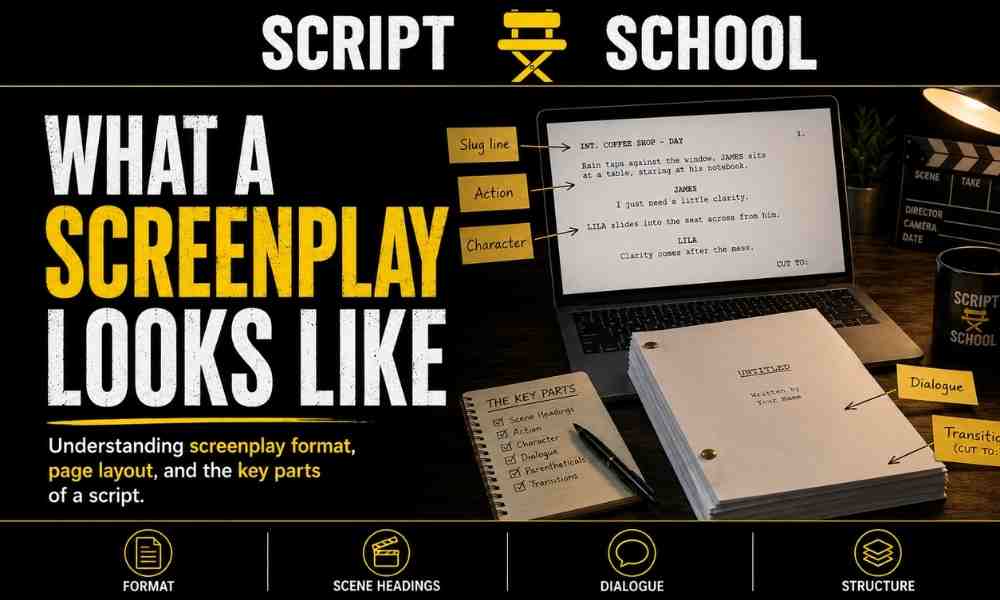
A screenplay page has a clean, almost minimal look. Plenty of white space. Short paragraphs. Centered character names. Dialogue tucked into a narrow column. At first glance, screenplay pages look strange. After a few examples, they become surprisingly easy to read.
We’ll break down every part of this sample page in a moment. First, let’s see what makes the layout work.
A Screenplay Page Has White Space and Clear Sections
Open any professional screenplay and the first thing you’ll notice is the breathing room. Scenes don’t run as huge blocks of text. They sit in chunks separated by blank lines.
White space matters because film readers move fast. They scan pages by the dozen. Cluttered pages slow them down. Clean pages keep them reading. If your page looks busy, your script feels harder than it is.
Simple Screenplay Example
INT. KITCHEN – NIGHT
Rain taps the window. MAYA, 32, stands at the sink, washing the same plate over and over.
The front door creaks open. She freezes.
MAYA
Hello?
Silence. She grips the plate tighter.
MAYA (CONT’D)
Sam? Is that you?
A shadow stretches across the floor.
That’s a real screenplay layout. Notice how short the lines are. Notice the rhythm. Now let’s break down every element.
Annotated Breakdown of the Example
- INT. KITCHEN – NIGHT is the slug line. It tells us we’re inside, in the kitchen, at night.
- The block under it is action. It describes what we see and hear.
- MAYA, 32 is the character introduction. Name in caps, age right after.
- MAYA centered is the character name above her dialogue.
- “Hello?” is dialogue. It sits in its own narrow column.
- (CONT’D) means the same character keeps speaking after a beat.
Six elements. That’s most of a screenplay page. Once you spot them, every script starts to make sense.
The Main Parts of a Screenplay
Every screenplay uses the same building blocks. Learn these once, and you can read or write any script in the world. Action lines describe. Dialogue reveals. Slug lines anchor. Each part has a job, and each one follows the industry standard.
Let’s walk through them in the order you’ll see them on a real page.
Title Page
The title page is the first thing a reader sees. It’s simple. Centered title in caps. “Written by” line below it. Author name under that. Contact info in the bottom corner.
No fancy fonts. No images. No taglines. A clean title page signals you know the rules. A messy one signals the opposite before anyone reads page one.
Scene Heading or Slug Line
The slug line opens every scene. It tells the reader three things in one short line.
- INT. or EXT. means interior or exterior
- LOCATION tells us where we are
- TIME OF DAY tells us when, usually DAY or NIGHT
Example: EXT. COFFEE SHOP - DAY
That’s it. No backstory. No mood. Just the facts the crew needs to plan the shot.
Action Lines
Action lines sit under the slug line. They describe what the audience sees and hears. Keep them short. Keep them visual. Write only what can be filmed.
Bad action: “Maya feels lonely and remembers her childhood.”
Good action: “Maya stares at the silent phone. She sets it face down.”
The second version shows feeling through behavior. That’s how screenplays work.
Character Introductions
The first time a character appears, write their name in ALL CAPS. Add an age and one or two visual details. Keep it brief.
Example: “SAM (40s), tall, wears a wrinkled suit and yesterday’s tie.”
You don’t need their full life story. You need a snapshot. Let the actor and director fill in the rest.
Character Names
Above every line of dialogue, the character’s name appears centered and in caps. This signals who’s speaking. The name stays consistent through the whole script. If you call her MAYA on page two, don’t call her MARY on page fifty.
Dialogue
Dialogue is the spoken part. It sits in a narrow column under the character’s name. Short lines work best. Real people don’t give speeches. They interrupt, hesitate, and trail off.
Dialogue is the heartbeat of a scene. It’s where characters connect, fight, lie, and break down. Think of dialogue like music. It needs rhythm, pauses, and surprise.
Read your dialogue out loud. If it sounds like a real human saying it, you’re close. If it sounds like a TED talk, rewrite it.
Parentheticals
A parenthetical is a small note in parentheses between a character name and their dialogue. It gives a hint about how the line is delivered.
Example:
SAM
(whispering)
Don’t move.
Use parentheticals sparingly. If your dialogue needs a note every line, the dialogue itself probably needs work.
Transitions
Transitions sit at the right edge of the page and mark a shift between scenes. The most common ones are CUT TO:, FADE OUT., and FADE IN:.
Modern scripts use fewer transitions than older ones. Most scenes cut straight to the next slug line without a label. Save transitions for moments that need extra weight.
Shots and Camera Directions
Shots and camera notes tell the reader what the camera is doing. Things like CLOSE ON, POV, or ANGLE ON. They guide the visual focus of a moment.
Here’s the trade secret: directors usually decide shots. New writers often overuse camera directions. The strongest scripts use them only when the story really depends on it. Write the moment. Let the camera capture it.
Screenplay Format Rules Beginners Should Know
The format rules are easier than you think. They exist for one reason: to make scripts readable across the industry. Good formatting helps readers stay focused. Great storytelling keeps them turning pages.
Many first-time writers spend more time adjusting margins than finishing scenes. Don’t be that writer. Learn the basics once. Then write.
Do you really need expensive software to write a screenplay? No. You need to know the rules. Here are the ones that matter.
What Font Is Used in a Screenplay?
Screenplays use Courier 12-point font. Always. It’s the industry standard and has been for decades.
Why Courier? Because it’s monospaced. Every letter takes the same width. That makes page count predictable. One page in Courier 12 equals roughly one minute of screen time.
Producers use this to estimate runtime before a frame is shot. A 110-page script means a roughly 110-minute movie. That’s why the font matters.
How Long Should a Screenplay Be?
Page count depends on the format you’re writing. Here’s a quick reference.
| Format | Page Count |
|---|---|
| Feature Film | 90 to 120 pages |
| Half-Hour TV Pilot | 28 to 32 pages |
| One-Hour TV Pilot | 55 to 65 pages |
| Short Film | 5 to 40 pages |
If one page equals about one minute of screen time, how long should your story really be? Long enough to tell it well. Short enough to keep readers turning the page.
Why Margins and Spacing Matter
Margins are the road markings that help readers move smoothly through the story. Standard screenplay margins look like this:
- Left margin: 1.5 inches
- Right margin: 1 inch
- Top margin: 1 inch
- Bottom margin: 1 inch
- Dialogue: indented and narrower
- Character names: centered above dialogue
These aren’t random. They exist because producers estimate runtime from page count. Mess with margins and you mess with the math.
Do You Need Screenwriting Software?
Software makes formatting easy. It handles margins, indents, and spacing for you. The most common tools are Final Draft, WriterDuet, Fade In, and Celtx.
Pros of using software:
- Automatic formatting
- Industry-standard output
- Built-in templates
Cons:
- Some tools cost real money
- Can become a procrastination tool
- Doesn’t make your story better
Software can format the page. Only you can write the story. If you’re just starting out, free tools work fine.
Can You Write a Screenplay in Google Docs?
Yes. You can write a screenplay in Google Docs. It’s a great option for early drafts, especially when you’re learning. Free templates exist that mimic standard screenplay format.
The catch? Google Docs gets clunky once your script grows past 30 or 40 pages. Page breaks shift. Character names go out of sync. Revising becomes painful.
Start in Google Docs if you want. Just plan to switch to real screenwriting software once you commit to longer projects. Don’t let software stop you from writing your first screenplay.
Screenplay vs Script: What Is the Difference?
The difference is smaller than most beginners think. Every screenplay is a script, but not every script is a screenplay.
Here’s the short version. A script is any written plan for a performance. A screenplay is one specific kind of script, written for screen media like film or TV. Many professionals use “script” casually even when they mean “screenplay.”
Script Is the Broader Term
A script is the umbrella category. It covers anything written to be performed. Plays have scripts. Radio shows have scripts. Podcasts have scripts. Stage musicals have scripts.
A screenplay is one branch of the larger script family tree. So when someone says “I’m writing a script,” they could mean almost anything. Always ask what kind.
Screenplay Is for Screen Media
A screenplay is written specifically for things shown on a screen. That includes feature films, TV shows, streaming series, short films, and digital content. The format is built around visuals, scene structure, and runtime.
Stage plays don’t use slug lines the same way. Radio scripts don’t need action lines for visuals. A screenplay assumes a camera and an audience watching.
Quick Comparison Table
| Feature | Script | Screenplay |
|---|---|---|
| Use | Any performance | Screen only |
| Format | Varies by medium | Strict industry standard |
| Includes | Plays, podcasts, films | Films, TV, streaming |
| Length | Depends on form | 90 to 120 pages typical |
Want a deeper breakdown? Read our full guide on screenwriting vs scriptwriting.
Screenplay vs Novel: Why Screenwriting Feels Different
If you’ve written fiction before, screenplay pages can feel strangely empty at first. That’s normal. A novel lives inside the reader’s mind. A screenplay lives on the screen.
The biggest adjustment for novelists is learning to write behavior instead of thoughts. It’s a different muscle. Once you build it, your storytelling gets sharper across every format.
Novels Can Describe Thoughts Directly
In a novel, you can write what a character thinks, feels, remembers, or fears. The reader hears it directly. You can spend a full paragraph inside someone’s head.
Example from a novel: “Maya stood at the sink, her mind drifting to the summer she lost her father, the smell of pine still sharp in her memory.”
Beautiful on the page. Impossible on a screen. The camera can’t film a memory unless you show it.
Screenplays Must Show What Can Be Seen and Heard
A screenplay can only describe what the audience will see or hear. No internal thoughts. No hidden memories. No silent feelings.
You convert emotions into actions. Instead of “she feels lonely,” you write “she stares at her silent phone.” Instead of “he’s angry,” you write “he slams the drawer shut.”
You know the feeling. The emotion is obvious on screen even though nobody says it.
Show what can be filmed. Skip what can’t. That single rule turns prose writers into screenwriters faster than any other.
Example: Novel Version vs Screenplay Version
Watch how the same moment changes when translated from prose to screenplay.
Novel version:
“Maya felt her stomach tighten as the door creaked open. She knew it wasn’t Sam. Sam never came home this early. Her hand tightened around the wet plate, and for a second, she considered running.”
Screenplay version:
INT. KITCHEN – NIGHT
The door creaks open. Maya’s shoulders lock. She doesn’t turn.
Her grip tightens on the plate. Water drips. She glances at the back door.
Same beat. Same fear. No internal narration. Just visual, cinematic, professional storytelling. The reader fills in the feeling because the behavior makes it obvious.
What Should Not Go in a Screenplay?
Most new writers make these mistakes because they care more about explaining the story than showing it. Readers want to see the story unfold, not read a report about it. Cleaner pages tell stronger stories.
Here are the most common things to leave out of your screenplay.
Long Backstory Paragraphs
Backstory should season the scene, not bury it. Big chunks of history slow scripts down and pull readers out of the present moment.
Instead of writing a paragraph about a character’s childhood, reveal that history through behavior. A photo on the wall. A scar she touches. A name she avoids saying. Show the past inside the present.
Unfilmable Thoughts
You know a character feels nervous long before they say they’re nervous. So don’t write the thought. Write the visible sign of it.
Bad: “Tom thinks about his ex-wife and wonders if he made the right choice.”
Good: “Tom stares at his wedding ring on the dresser. He picks it up. Puts it down. Walks out.”
Every emotion should have a visible behavior attached to it. That’s the screenwriter’s job.
Too Many Camera Directions
New writers often try to direct the film from the page. They write CLOSE ON, PAN LEFT, and WIDE SHOT on every other line. It looks busy. It feels amateur.
Directors generally decide shots. Writers focus on story. Write the moment. Let the camera capture it.
Overused Parentheticals
If your dialogue needs a note like (angry), (sad), or (loud) on every line, the line itself may need rewriting. Strong dialogue makes the emotion clear without help.
Natural, believable, and authentic dialogue carries itself. Use parentheticals only when the meaning would be unclear otherwise. Trust your words.
Dialogue That Explains Too Much
Characters rarely say exactly what they feel. Real conversation hides as much as it reveals. Subtext makes scenes stronger.
Bad: “I’m sad because you forgot our anniversary, and now I feel unloved.”
Better: “It’s fine. I already ate.”
Would a real person actually say the first line out loud? Probably not. Readers remember tension, not explanations.
Common Beginner Screenplay Mistakes
Many writers spend months preparing and only days actually writing. You can’t edit a blank page. Finished beats perfect. Progress beats preparation.
Here are the most common mistakes beginners make, and how to fix each one.
Worrying About Format Instead of Finishing Pages
Have you spent an hour adjusting margins instead of writing a scene? You’re not alone. Format is easy to obsess over because it feels like progress.
It’s not. Draft first. Format later. Even a messy first draft beats a perfectly formatted blank page. Finish your story. Then clean it up.
Starting Scenes Too Early
Many beginners open scenes with small talk, walking into rooms, or setting up situations. That’s the warm-up. The story usually starts later.
Enter scenes late and leave early. Drop the audience into the middle of the action. Cut before the scene fully resolves. The result feels sharper, tighter, and faster.
Writing Description Like a Novel
A screenplay is a spotlight, not a history book. Long, prose-heavy paragraphs slow the page. Action lines should feel quick and visual.
Aim for three to five lines per action block. Break longer blocks into smaller ones. Readers scan in chunks. Give them chunks that move.
Making Dialogue Too Direct
People hide what matters most. Strong dialogue lets characters dance around the truth instead of stating it. Conflict often lives beneath the words.
Two people fighting about dirty dishes might really be fighting about respect. A breakup conversation might never use the word “breakup.” That’s subtext, and it’s where great scenes live.
Overusing “We See” and “We Hear”
“We see Maya enter the kitchen” is weaker than “Maya enters the kitchen.” The audience already sees what’s on the page. You don’t need to announce it.
Show the action. Skip the announcement. Your pages will feel cleaner and more professional.
Ignoring Story Structure
What keeps readers turning pages after page ten? The answer has less to do with format than most writers think. It’s structure.
Strong screenplays build momentum through turning points, escalating stakes, and clear character goals. Without structure, even great scenes feel random. With it, even simple ideas feel epic.
Learn the basics of three-act structure, then break the rules with purpose. Our Screenwriting 101 course walks you through it scene by scene.
How Important Is Screenplay Format Really?
Writers often fear formatting mistakes more than weak scenes. They shouldn’t. Formatting gets the script opened. Story keeps it open.
Most professional readers forgive minor formatting flaws in a compelling script. They rarely forgive a boring story. Here’s how to think about the balance.
Format Matters Because It Makes the Script Readable
Good formatting acts like road signs on a long journey. It tells readers where they are and what’s happening without effort. Readers process hundreds of scripts each year. Anything that adds friction loses them.
That’s why standard format exists. It’s not a creative choice. It’s a shared language. When you follow it, your script feels professional from page one. Format buys you the first ten pages of attention.
Story Still Matters More Than Perfect Margins
The best time to write the story is before you worry about polishing the page. A great scene survives minor formatting flaws. A boring scene with perfect margins still gets rejected.
Readers remember characters, not margins. They remember the twist on page sixty, not the spacing on page one. So write the story first. Format it second. Story wins every time.
When Formatting Mistakes Become a Problem
If a reader struggles to understand the page, how likely are they to keep reading? Not very. Repeated formatting mistakes signal that the writer hasn’t learned the basics.
Warning signs that hurt credibility:
- Wrong font or font size
- No slug lines or inconsistent ones
- Action paragraphs ten lines long
- Dialogue spread across the full page width
- Random capitalization of characters
- Missing scene transitions or page numbers
One or two of these? Fine. A page full of them? You’ve lost the reader. Aim for polished, professional, industry-standard, and credible work.
Where Can You Find Good Screenplay Examples?
Many writers want to write screenplays before they’ve read enough of them. You learn to build a house by studying houses that stand. Read to learn format. Read again to learn storytelling.
Reading ten professional screenplays often teaches more than reading ten screenwriting books. Here’s where to start and how to make the most of each read.
Read Produced Screenplays in Your Genre
Why study horror scripts if you’re trying to write a romantic comedy? Match your reading to your goal. Comedy writers should read comedy. Thriller writers should read thrillers.
Free sources for produced screenplays:
- The Internet Movie Script Database (IMSDB): Hundreds of free scripts
- Simply Scripts: Wide library across genres
- Studio award sites: Studios release “For Your Consideration” scripts during awards season
- BBC Writers Room: UK-focused but excellent for TV
Pick three scripts from films you love. Read them slowly. You’ll start to spot patterns that show up in nearly every great screenplay.
What to Look For When Reading a Screenplay
First read like a fan. Then read like a writer. The second read is where the learning happens.
Use this checklist on your second pass:
- Scene openings: How does each scene start? Where does the action begin?
- Dialogue length: How short are the lines? How often do characters interrupt each other?
- Character introductions: How does the writer describe a person in one sentence?
- Pacing: How long does each scene last? When does the writer cut?
- Action lines: How visual are they? How short?
You’ll start noticing patterns that almost every professional screenplay shares.
Do Not Only Read Your Favorite Movies
The script that teaches you the most may not come from your favorite movie. A flawed script can show you what to avoid. A great one can show you what to chase.
Read across genres. Read a comedy if you write drama. Read a war film if you write rom-coms. Read short films and feature scripts side by side.
A writer’s education grows wider every time another script is opened. So open more of them.
How to Start Writing Your First Screenplay
Staring at a blank page is one of the most frustrating parts of writing. A journey of a thousand miles begins with a single step. Start small. Finish big.
Writers who outline before drafting usually finish scripts faster than writers who discover everything while writing. Here’s a six-step path from idea to first draft.
Start With a Logline
A logline is one or two sentences that describe your whole movie. It names the main character, the goal, the obstacle, and the stakes.
Example: “A retired hitman returns for one final job to protect his estranged daughter, but the target is the only friend he has left.”
If you can’t explain the story in one sentence, can you explain it in 100 pages? A weak logline often signals a weak story concept. Write five drafts of yours before moving on.
Write a Short Treatment
A treatment is a one-to-three page summary of your screenplay. It walks through the story in prose, beat by beat. No dialogue. Just the events.
Treatments are powerful because they reveal problems early. If your story falls apart on page two of the treatment, it’ll fall apart on page sixty of the screenplay. Better to find that out now. Organized, focused, efficient.
Build a Simple Outline
An outline is the roadmap before the road trip. List your major scenes in order. Note the turning points. Mark the opening, midpoint, and ending.
Start with the big moments before details. You’re not writing dialogue yet. You’re mapping the shape. A good outline keeps you from getting lost on page forty.
Write One Scene First
One finished scene beats ten unfinished plans. Pick the scene you’re most excited to write. Maybe it’s the opening. Maybe it’s the climax. Doesn’t matter.
Write it. Make it about two pages. Don’t worry if it’s perfect. The goal is momentum. Once you’ve written one real scene, the rest feel possible.
Read the Scene Out Loud
Dialogue that looks good on paper may sound wrong out loud. Reading aloud is the fastest way to catch stiff lines, weird rhythms, and dialogue that no human would actually say.
Read every character’s lines yourself. Notice where you stumble. Those are the spots that need work. Your ear is smarter than your eye.
Get Feedback Before Rewriting
It is hard to see weaknesses in a script you’ve read a hundred times. Outside eyes catch what you can’t.
Ask two or three trusted readers for honest notes. Look for patterns. If three people flag the same scene, fix that scene. If only one person flags it, weigh the feedback carefully.
Objective, useful, actionable notes shorten the learning curve by months. That’s why our private consultations exist. Sometimes one good note saves you ten rewrites.
Screenwriting in Austin: Why Local Context Matters
Writing alone is hard. Growing alone is even harder. If you want to go fast, go alone. If you want to go far, go together.
Austin happens to be one of the best places in the country to grow as a screenwriter. It has a real film community, real industry events, and real working writers nearby.
Austin Has a Serious Screenwriting and Film Culture
Austin isn’t just a music city. It’s a film city. Major productions shoot here every year. The Austin Film Festival draws screenwriters from around the world. SXSW puts new filmmakers on the map.
Local workshops, indie crews, and writing groups meet every week. Great stories often grow faster when surrounded by other storytellers. You’ll write better when you write near other writers.
Whether you’re a teenager dreaming of your first short film or a working adult planning a feature, Austin gives you the room to grow.
Local Writers Need More Than Format Rules
Learning format is important. Learning storytelling is essential. Most beginners can learn margins in an afternoon. Learning to build a compelling character takes years.
That’s where coaching, feedback, and accountability matter most. A working mentor can spot story problems faster than any book. They can save you from a year of bad drafts in a single afternoon.
Austin writers have access to teachers who’ve actually sold scripts and run rooms. Use that. Don’t write in a vacuum.
How Script School Helps Austin Screenwriters
Most writers don’t need more information. They need guidance and accountability. That’s exactly what Script School was built for.
We run practical, supportive, experienced classes for writers at every level. Whether you’re trying to finish your first draft or pitch your first pilot, we’ve got a path for you.
- Screenwriting 101 for beginners writing their first feature
- TV Pilot Lab for writers building a pilot to sell
- Horror Movie Screenplay Writing for genre fans ready to write scary
- Youth Programs for young writers under 18
Looking for one-on-one help? Our private consultations match you with an experienced screenwriter who reads your pages and gives real notes. Proven, practical, and built for working writers.
Next Steps After Learning What a Screenplay Looks Like
The best time to plant a tree was twenty years ago. The second best time is today. Learning matters. Doing matters more.
Many writers stay in research mode because writing feels risky. You’ve already done the hard part. You know what a screenplay looks like. Now turn that knowledge into pages. Here’s your action plan.
Download a Screenplay Format Checklist
Keep a simple format checklist next to your laptop. A useful, practical, quick-reference list catches the most common formatting mistakes without slowing your writing.
Include: font, margins, slug line format, character name placement, and dialogue indentation. Five items. One page. That’s all you need.
Read Three Produced Scripts
Pick three scripts from films you respect. Read for enjoyment first. Read for technique second. Choose different genres if you can.
You’ll absorb format and storytelling at the same time. The patterns you spot will guide your own writing instincts. Free scripts live on IMSDB and Simply Scripts. Start tonight.
Write a One-Page Scene
One page today is more valuable than a screenplay you’ll start someday. Pick a single scene. Two characters. One location. One conflict.
Write it in Courier 12. Use one slug line, a few action lines, and some dialogue. That’s it. You’ve just written your first piece of a screenplay. Momentum starts here.
Take a Screenwriting Class or Get Notes
You can spend months solving a problem that an experienced reader spots in minutes. Feedback shortens the learning curve dramatically.
If you’re in Austin or learning online, check out our screenwriting classes built for writers at every level. Even one round of professional notes can change the way you write forever.
Build a Writing Routine
Little by little, a little becomes a lot. Write a little every day rather than a lot once a month. Consistency beats intensity.
Pick a time. Pick a place. Show up. Even 30 minutes a day builds a finished draft in three to four months. The screenplay you’ll finish is the one you actually write.
Frequently Asked Questions About Screenplays
What is a screenplay in simple terms?
A screenplay is a written plan for a movie or TV show. It describes scenes, action, and dialogue using a standard industry format. Writers use it to share their story with directors, actors, and crew.
What does a screenplay look like?
A screenplay looks like a clean, formatted document in Courier 12 font. Each page has slug lines, action paragraphs, and centered character names with dialogue underneath. Pages use lots of white space and run about one minute of screen time per page.
What are the main parts of a screenplay?
The main parts of a screenplay are the title page, scene headings (slug lines), action lines, character introductions, character names, dialogue, parentheticals, and transitions. Each part has a specific format and job. Together they tell the full story.
Is a screenplay the same as a script?
Not exactly. A script is any written plan for a performance, including plays and podcasts. A screenplay is a specific kind of script written for screen media like film and TV. Every screenplay is a script, but not every script is a screenplay.
What is the difference between a screenplay and a story?
A story is an idea or concept. A screenplay is the written, formatted version of that idea built for film. The story tells you what happens. The screenplay shows how it happens, scene by scene, in industry format.
What is the difference between a screenplay and a teleplay?
A screenplay is written for movies. A teleplay is written for television, including TV episodes and pilots. The format is almost identical, but teleplays often include act breaks for commercial slots and follow show-specific length rules.
What is a slug line in a screenplay?
A slug line is the heading that starts every scene. It tells the reader if the scene is interior or exterior, where it takes place, and when. Example: INT. KITCHEN – NIGHT.
How long should a screenplay be?
A feature film screenplay should be 90 to 120 pages. A half-hour TV pilot runs 28 to 32 pages. A one-hour TV pilot runs 55 to 65 pages. Short film scripts vary from 5 to 40 pages depending on the project.
What font do screenplays use?
Screenplays use Courier 12-point font. It’s monospaced, which keeps page count consistent. One page in Courier 12 equals roughly one minute of screen time.
Do I need screenwriting software?
No, but it helps. Software like Final Draft or WriterDuet handles formatting automatically. Free tools like Google Docs and Celtx work fine for beginners. Story matters more than software.
Can I write a screenplay in Google Docs?
Yes. Google Docs is a free, easy way to start. Free screenplay templates exist online. Just plan to switch to real screenwriting software once your script grows past 30 or 40 pages.
Should I use a screenplay template?
Yes, especially when starting out. A template handles margins, indents, and spacing so you can focus on the story. Most screenwriting software includes built-in templates, and free ones exist for Google Docs and Word.
How important is screenplay format?
Format matters because it makes your script readable and professional. But story matters more. Most readers forgive minor format flaws in a great story. They rarely forgive a boring story with perfect margins.
What are the biggest beginner screenplay mistakes?
The biggest beginner mistakes are obsessing over format instead of finishing, writing description like a novel, starting scenes too early, overusing camera directions, making dialogue too direct, and skipping story structure. Focus on finishing first. Polish later.
Where can I find good screenplay examples?
You can find produced screenplays on the Internet Movie Script Database (IMSDB), Simply Scripts, BBC Writers Room, and studio award sites during awards season. Read scripts in your genre first, then expand to other styles.
Should I outline before writing a screenplay?
Yes, most working writers do. An outline maps your major scenes and turning points before you write dialogue. Writers who outline before drafting usually finish faster than writers who discover everything while writing.
What should I write before the screenplay?
Most writers start with a logline (one-sentence story summary), then a treatment (one to three pages of prose), then an outline (scene-by-scene map). This pre-writing reveals story problems before you spend months on a full draft.
Can a novelist learn screenwriting?
Absolutely. Many successful screenwriters started as novelists. The main shift is learning to write behavior instead of thoughts. Once you adjust to visual storytelling, the discipline of fiction becomes a major advantage in screenwriting.
How do I know if my screenplay idea is strong enough?
Test it with a logline. Can you explain the idea clearly in one sentence? Does it include a character, a goal, and stakes? If yes, it’s likely strong enough to develop. If you struggle to summarize it, the idea may need more work.
When should I get feedback on my screenplay?
Get feedback after completing a full first draft, not after every scene. Finish first. Revise second. Constant feedback during the first draft can stall your momentum and confuse your voice.
Ready to write your first screenplay? Explore our screenwriting courses, book a private consultation, or check out the Script School blog for more writing guides.