What Are the Three Types of Film?
Most people think horror, comedy, and drama are film types. They aren’t. Those are genres.
The three true types of film are narrative, documentary, and experimental. Each one shapes how a story gets built, shot, and felt. Understanding this changes how you approach a project from day one.
Have you ever wondered why a documentary feels so different from a Hollywood drama, even when both move you deeply? The answer lives in the film type. Let’s break all three down, fast.
Quick Answer: The Three Main Types of Film
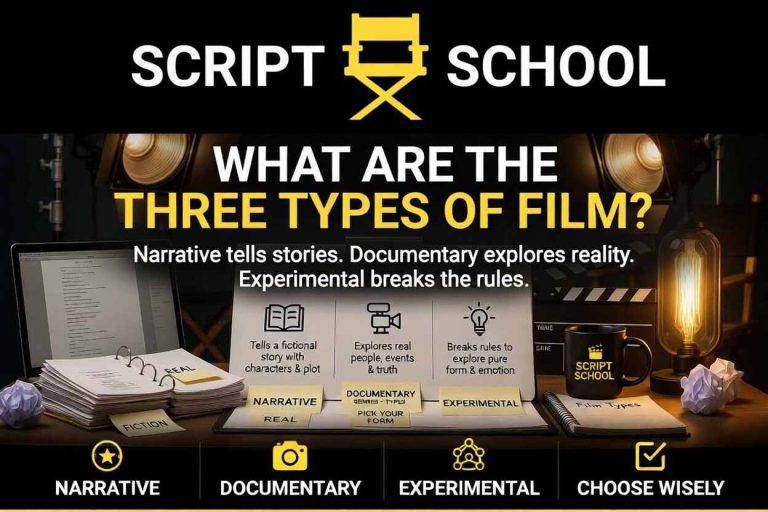
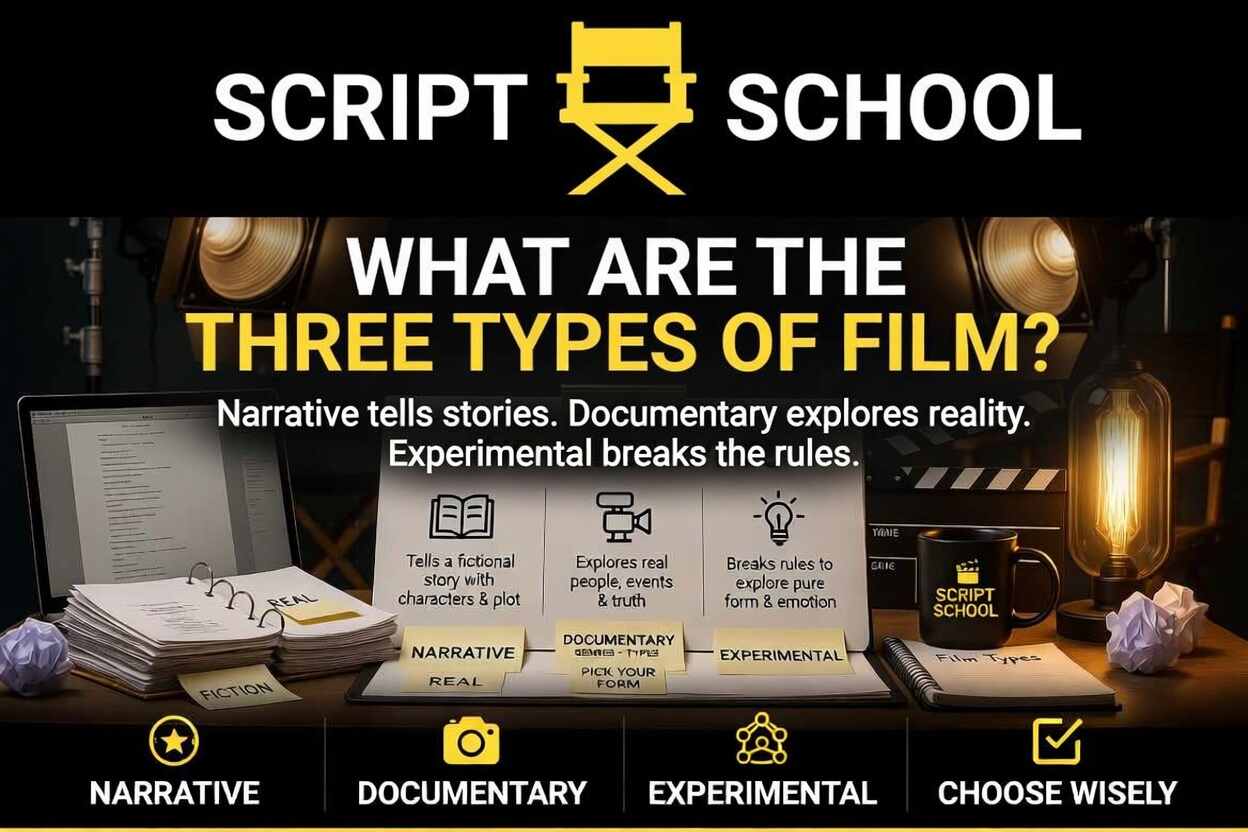
The three main types of film are narrative, documentary, and experimental. Narrative film tells a fictional story. Documentary film explores real people and events. Experimental film breaks traditional rules to play with form, image, and sound.
Here’s the simple version:
- Narrative film tells a story.
- Documentary film explores reality.
- Experimental film experiments with form.
One type tells stories. One explores the real world. One bends the rules. Every movie you’ve ever loved fits inside one of these three, or blends them on purpose.
Narrative Film
Narrative film tells a fictional, story-driven experience. It uses characters, conflict, and plot to pull you through a beginning, middle, and end. Think of any blockbuster or indie drama. That’s narrative film, and it rules commercial cinema worldwide.
Documentary Film
Documentary film captures real people, real events, and real stakes. It uses nonfiction footage, interviews, and true stories as its raw material. But strong documentaries still shape that reality into a story you can feel.
Experimental Film
Experimental film throws out the rulebook. It explores image, rhythm, and emotion over plot. Think avant-garde cinema and visual poetry. Experimental film treats storytelling like a playground instead of a map.
Why Understanding Film Types Matters
Have you ever started a film idea and felt unsure how to tell it? That uncertainty usually comes from skipping one step. You picked a story before you picked a form.
Professional filmmakers choose the form first. They decide whether an idea wants to be narrative, documentary, or experimental. Then production begins. This single habit saves time, money, and heartbreak.
Knowing your film type gives you confidence. It tells you how to write, how to shoot, and what your audience will expect. It turns a vague idea into a clear plan. And clarity is what separates finished films from abandoned ones.
Film Type Shapes the Story
Your film type decides how your story gets built. A narrative film leans on plot points and character arcs. A documentary follows real events as they unfold. An experimental film may have no plot at all.
Same idea, three very different blueprints. The form you choose shapes every scene that follows.
Film Type Shapes the Audience Experience
Viewers walk in with expectations. A narrative crowd wants to escape into a story. A documentary crowd wants truth and insight. An experimental crowd wants to feel something new.
Match the form to the expectation, and your film lands. Miss it, and even great footage falls flat. The type sets the contract with your audience.
Film Type Shapes the Screenwriting Process
Scripts change a lot based on film type. A narrative script maps scenes, dialogue, and structure in detail. A documentary uses a flexible outline that bends to reality. An experimental piece may script mood and image instead of words.
Each form asks for a different kind of writing. Learning all three makes you a sharper, more flexible writer. Our Screenwriting 101 course starts you with the narrative foundation.
Film Type Shapes Production Choices
Form drives every production decision. Narrative needs actors, sets, and a shot list. Documentary needs access, real subjects, and patience. Experimental needs room to test and fail.
Think of film type as the engine under the hood. It quietly powers your budget, your crew, and your schedule.
The Three Types of Film at a Glance
Sometimes you just want the whole picture in one view. So here’s a clean comparison of all three film types side by side. Use it as your quick reference whenever an idea sparks.
Narrative vs. Documentary vs. Experimental Film
Narrative film invents a story and performs it. Documentary film records reality and shapes it. Experimental film abandons plot to chase pure expression.
Narrative chases emotion through character. Documentary chases truth through evidence. Experimental chases feeling through form. Three roads, one destination, which is connection with an audience.
Simple Comparison Table
Scan this table to lock the differences into memory.
Film TypePurposeStory SourceAudience ExpectationCommon UseNarrativeTell a storyFiction and imaginationEmotional escapeFilms, series, shortsDocumentaryExplore realityReal people and eventsTruth and insightNonfiction features, seriesExperimentalExplore formImage, sound, ideaNew sensationsArt films, visual essays
Which Type Is Most Common for Screenwriters?
Most screenwriters start with narrative film. It’s where the core craft lives. You learn structure, character, conflict, and dialogue, and those skills carry into every other form.
You learn to walk before you run. Narrative gives you that foundation. Once it feels natural, documentary and experimental open up fast. Beginners feel right at home starting here.
1. Narrative Film: The Story-Driven Type
Narrative film is the heart of storytelling cinema. It’s the form most of us picture when we hear the word “movie.” It invents characters, drops them into conflict, and carries us to a resolution that means something.
Why does narrative film grip us so tightly? Because it mirrors how we already make sense of life, through story. Most screenwriting frameworks trace straight back to narrative film principles. Master this, and you hold the keys to the craft.
What Is a Narrative Film?
A narrative film is a fictional, story-driven movie that uses characters, conflict, and plot to deliver a beginning, middle, and end. It performs an invented story for an audience, whether scripted from scratch or adapted from a book.
Narrative film is the most common type in commercial cinema. From silent classics to modern epics, it shares one goal. It wants to move you through a story.
Key Features of Narrative Film
Narrative films share a clear set of building blocks:
- Characters with goals and flaws
- Conflict that creates tension
- Plot that moves cause to effect
- Structure with a clear arc
- Theme that gives the story meaning
Mix these well, and you get a story people remember. Each piece supports the others.
How Narrative Films Use Characters
Characters are the soul of narrative film. We follow people, not plots. A strong character wants something badly and struggles to get it. That struggle is what hooks us.
We connect through their fears, choices, and growth. When a character changes, we feel it. Good characters turn strangers in the dark into people we care about.
How Narrative Films Use Conflict
What keeps you glued to a screen for two hours? Conflict. Narrative film runs on tension between what a character wants and what stands in the way.
That obstacle can be a villain, a flaw, or the world itself. Remove the conflict and the story stalls. Conflict is the engine that drives every scene forward.
How Narrative Films Use Plot Structure
Plot is the order of events that builds your story. Most narrative films follow a three-act arc. Setup, confrontation, resolution. Tension rises, peaks, and resolves.
Structure gives the audience a sense of momentum. It promises that the journey is going somewhere. A clear arc keeps viewers leaning forward.
How Narrative Films Use Theme
Theme is the deeper meaning under the surface. It’s what your story is really about. Love, freedom, loss, or courage. Plot is what happens. Theme is why it matters.
Great narrative films say something true about being human. Theme is the part that lingers long after the credits roll.
Common Narrative Film Genres
Genres live inside narrative film. They flavor the story. Common narrative genres include:
- Drama
- Comedy
- Action
- Horror
- Thriller
- Romance
- Science fiction
- Fantasy
Remember, these are genres, not film types. A horror movie is still a narrative film at its core.
Examples of Narrative Films
Narrative films fill cinemas and streaming queues. A coming-of-age drama follows a teen finding their voice. An action film chases a hero through danger. A romance tracks two people falling in love.
Series like prestige dramas are narrative too. So are most animated features. If a movie invents characters and performs a story, it’s a narrative film. That covers the vast majority of what we watch.
Why Screenwriters Usually Start With Narrative Film
Narrative film is the natural starting point for writers. It teaches the core craft in its purest form. You learn structure, dialogue, and character before anything else.
Don’t worry about mastering every form at once. You learn to walk before you run. Build your narrative skills first, and the rest follows. Our guide on turning story ideas into a screenplay is a great next step.
Narrative Film Exercise for Screenwriters
Ready to practice? Try this simple three-act drill. It builds your structure instinct fast.
- Act One: Introduce a character who wants something. Give them one clear goal.
- Act Two: Throw a big obstacle in their way. Raise the stakes.
- Act Three: Force a choice that resolves the conflict. Show how they change.
Write it in one page. Keep it tight. Do this once a week and your storytelling muscle will grow fast. Want feedback on your pages? Book a private consultation and get expert eyes on your work.
2. Documentary Film: The Reality-Based Type
Documentary film is one of the three core film types. It builds stories from the real world instead of invented ones. But here’s the twist most beginners miss.
A documentary does not simply collect facts. It shapes meaning. Many people believe documentaries just record reality. The truth is richer. Documentary filmmakers actively craft a story from what they capture.
Strong documentaries rarely succeed because of access alone. They succeed because the filmmaker finds a clear question, conflict, or transformation. That’s what gives an audience a reason to keep watching. Reality provides the ingredients. The filmmaker creates the meal.
What Is a Documentary Film?
A documentary film is a nonfiction movie that explores real people, events, and issues. It uses footage, interviews, and true stories as source material. Strong documentaries don’t just capture reality. They interpret it into a clear, emotional story.
Do documentaries show pure, untouched reality? Not quite. Every documentary involves choices about what to film and what to cut. That selection is where the storytelling begins.
Key Features of Documentary Film
Documentaries share recognizable traits. Narrative film performs a story. Documentary film discovers one. Core features include:
- Real subjects instead of actors
- Interviews with people involved
- Archival footage and photos
- Real locations and events
- A guiding question or point of view
These pieces ground the film in truth. Together they build trust with the viewer.
How Documentaries Use Real People and Events
Documentaries pull their power from real life. The people on screen are not playing roles. They are living their actual stories. That authenticity hits differently.
People connect with documentaries because they recognize real struggles, real victories, and real uncertainty. With that power comes responsibility. Filmmakers owe their subjects honesty and care. Real lives deserve respect, not just good footage.
How Documentaries Still Create Story
Here’s the secret. Even without a script, documentaries build story. Filmmakers find arcs hidden inside real events. A subject changes. A mystery unfolds. A conflict resolves.
Many documentaries use character arcs without ever writing one. The editor shapes hours of footage into a journey. Reality provides the ingredients. The filmmaker creates the meal. That craft is what turns raw clips into a film worth watching.
The Filmmaker’s Point of View in Documentary Film
Is any documentary truly neutral? No. Every choice reflects a point of view. What to include, what to cut, and how to frame it all shape the message.
No documentary is completely objective. That’s not a flaw. It’s the nature of the form. The best documentary makers own their perspective and use it with honesty. Awareness of bias makes a film stronger, not weaker.
Common Documentary Structures
Documentaries organize reality in different ways. Common structures include:
- Chronological: events unfold in time order
- Investigative: the film hunts for an answer
- Character-driven: one person carries the story
- Thematic: ideas link the scenes together
One structure tracks time. One chases truth. One follows a person. One explores an idea. The right choice depends on your story.
Types of Documentary Films
Documentary is not one single style. It splits into six classic modes. Each one handles reality in its own way. Curious which fits your idea? Let’s walk through them.
Expository Documentary
Expository documentaries lead with a narrator. A clear voice guides you through facts and arguments. Think classic nature documentaries with a calm voice-over. This mode teaches directly and builds authority fast.
Observational Documentary
Observational documentaries play fly on the wall. The camera watches without interfering. There’s no narrator and no staged setup. You feel like an invisible guest in someone’s real life. This style is also called direct cinema.
Participatory Documentary
In participatory documentaries, the filmmaker steps into the frame. They interview, react, and become part of the story. The camera stops hiding. The maker is a participant, not just a witness, and that presence shapes the truth on screen.
Poetic Documentary
Poetic documentaries chase mood over facts. They favor images, rhythm, and feeling. Plot takes a back seat to atmosphere. These films wash over you like a visual poem and leave an emotion rather than a lesson.
Reflexive Documentary
Reflexive documentaries turn the lens on themselves. They explore how documentaries get made. The film reminds you it’s a film. This sparks curiosity about truth, editing, and the choices behind every frame.
Performative Documentary
Performative documentaries lean personal. The filmmaker’s own experience drives the story. They blend emotion, memory, and viewpoint. You feel the maker’s heart in every scene, and that empathy pulls you close.
Examples of Documentary Films
Documentaries cover every corner of life. A nature film follows wildlife across a season. A true crime series digs into an unsolved case. A music documentary tracks an artist’s rise and fall.
Some explore social issues with hard data. Others paint quiet portraits of one person’s life. The styles vary wildly, from sweeping expository epics to intimate observational films. Each one proves the same point. Real life holds endless stories. The filmmaker just has to find the shape inside them.
Documentary Film Exercise for Filmmakers
Want to feel documentary craft firsthand? Try this challenge.
- Pick one real person you can film or interview.
- Find the question their story answers.
- Capture three moments that show change or tension.
- Edit them into a two-minute story with a clear arc.
Tell a complete story using just one real person. You’ll learn more from this than from a dozen articles. Reality will surprise you every time.
3. Experimental Film: The Form-Breaking Type
Experimental film is the rebel of the three types. It tosses out plot, structure, and rules. Instead it plays with image, sound, time, and feeling.
Experimental film treats cinema less like a roadmap and more like a sketchbook. It asks a bold question. What if a film didn’t tell a story at all? What if it just made you feel?
Here’s a fact that surprises new filmmakers. Many techniques now considered mainstream began in experimental cinema. Jump cuts, dream sequences, and bold editing all started as experiments. Today’s wild idea can become tomorrow’s standard.
What Is an Experimental Film?
An experimental film is a movie that breaks traditional storytelling rules to explore form, image, and emotion. Also called avant-garde cinema, it values mood, rhythm, and visual ideas over plot, characters, or clear narrative.
Experimental film is where cinema tests its own limits. It treats the screen as a canvas. The goal is expression, not explanation.
Key Features of Experimental Film
Experimental films share a daring spirit. Common features include:
- No traditional plot or arc
- Nonlinear time and structure
- Abstract imagery over realism
- Bold sound and silence
- Visual rhythm as the main language
These films chase feeling first. Rules come second, if at all.
How Experimental Films Break Traditional Rules
What happens when you ignore every film rule on purpose? You get experimental cinema. These films skip plot, scramble time, and reject clear meaning.
They might repeat a single image for minutes. They might cut with no logic. The point is discovery. By breaking rules, experimental film finds new ways to move an audience.
Nonlinear Storytelling in Experimental Film
Experimental film loves nonlinear time. Scenes don’t follow A to B to C. They loop, jump, and repeat. The past, present, and future can blur together.
This freedom lets the film mirror memory, dreams, or emotion. Time becomes a tool, not a track. The viewer pieces the meaning together.
Abstract Imagery and Visual Rhythm
Experimental film speaks in images, not plot. Shapes, colors, and motion carry the meaning. A film might pulse with light or float through textures.
Think of it like music for the eyes. Visual rhythm sets the mood and pace. The image is the message, with no story required.
Sound, Silence, and Mood in Experimental Film
Sound is a powerful tool in experimental film. It can clash, repeat, or vanish completely. Silence can speak as loudly as noise.
Silence can be narrative. A long quiet stretch builds tension or peace. Experimental filmmakers use sound to shape feeling, not just to support a scene.
Experimental Film vs. Avant-Garde Film
Are experimental and avant-garde the same thing? Mostly, yes. People often use the terms interchangeably. Both reject mainstream rules and chase fresh forms.
If there’s a shade of difference, it’s this. Avant-garde often points to a historical art movement. Experimental is the broader, modern label. For most filmmakers, the spirit is identical.
Examples of Experimental Film Techniques
Experimental filmmakers use a wild toolbox. Common techniques include:
- Repetition of images or sounds
- Collage editing of mixed footage
- Distorted color and exposure
- Found footage reworked into new meaning
- Long takes with no cuts
- Abstract animation and visual texture
Each tool bends reality in a new direction. The only limit is imagination.
Why Experimental Film Matters for Serious Filmmakers
Should serious filmmakers care about experimental film? Absolutely. It builds creative courage. It teaches you to see beyond the rules you take for granted.
The bravest art opens the doors that everyone else walks through later. Experimental film stretches your visual instincts. Even if you make narrative films, this practice makes your work bolder and more original.
Experimental Film Exercise for Filmmakers
Want to free your creative mind? Try this.
- Shoot 60 seconds of footage with no plot in mind.
- Focus on color, texture, or motion.
- Edit it to a piece of music or pure silence.
- Aim for a feeling, not a story.
Don’t judge it. Just experiment. This single exercise can unlock ideas you never knew you had. Play, and see what happens.
Film Type vs. Film Genre vs. Film Style
Here’s where most beginners get tangled. They mix up type, genre, style, and format. These words are not the same thing. Sorting them out is a huge relief.
This one distinction solves the most common beginner confusion in filmmaking. Once it clicks, everything else makes more sense. Let’s clear it up for good.
What Is a Film Type?
A film type is the broadest category of all. It describes what a film fundamentally is. There are three. Narrative, documentary, and experimental.
Film type is the foundation. Everything else sits on top of it. It answers one question. Is this story invented, real, or pure form?
What Is a Film Genre?
A genre describes the flavor of a story. Horror, comedy, drama, and action are genres. They tell you the mood and the kind of experience to expect.
Genres live inside film types, mostly inside narrative film. Genre answers a different question. What kind of story is this?
What Is a Film Style?
Style is the visual and tonal signature of a film. It covers look, pacing, color, and camera work. Two directors can shoot the same story in totally different styles.
Style is the how, not the what. It’s the fingerprint a filmmaker leaves on every frame.
What Is a Film Format?
Format describes the shape and length of a film. Short film and feature film are formats. So are web series and commercials.
Format answers a practical question. How long is it and how is it delivered? It has nothing to do with the film type itself.
Why Horror, Comedy, and Drama Are Genres, Not Film Types
This trips up almost everyone. Horror, comedy, and drama feel like types. They’re not. They’re genres that live inside narrative film.
Here’s the proof. A horror movie still uses characters, conflict, and plot. So does a comedy. They share the narrative DNA. The scary or funny flavor is the genre. The narrative form is the type.
Why Short Film and Feature Film Are Formats, Not Film Types
Length is not a type. A short film can be narrative, documentary, or experimental. A feature film can be any of the three too.
Think of it like clothing. The type is the fabric. The format is the size. A small shirt and a large shirt are still the same fabric. Length describes packaging, not the film’s nature.
Where Do Short Films, Feature Films, and Commercial Films Fit?
So if these aren’t film types, what are they? Great question. Short films, features, and commercials are formats and production models. They describe how a film is made and delivered, not what it is.
A film type is what the film is. A format is how the film is packaged. Many new filmmakers think “short film” and “documentary” belong in the same category. One describes length. The other describes type. Let’s place each one clearly so you never mix them up again.
Short Film
A short film is any film under about 40 minutes. That’s a format, not a type. A short can be narrative, documentary, or experimental. Many filmmakers start with shorts because they’re cheaper and faster to finish. They’re the perfect training ground for new talent.
Feature Film
A feature film runs roughly 70 minutes or longer. It’s the full-length format you see in theaters. Like shorts, a feature can be any of the three types. The length defines it, not the content. Features give a story room to breathe and grow.
Commercial Film
A commercial film sells something. It’s branded or advertising-driven work made for a product or service. Commercials can use narrative, documentary, or hybrid approaches. A 30-second ad might tell a tiny story or capture a real moment. The goal is persuasion, packaged as film.
Independent Film
An independent film is made outside the major studio system. It’s a production model, not a type. Indie filmmakers often have smaller budgets and bigger creative freedom. That freedom is where bold, original voices break through. If you dream of telling your own story your way, indie is your home.
Studio Film
A studio film is backed by a major film studio. It carries bigger budgets, wider reach, and more oversight. This is a production model too, not a type. Studio films are usually narrative, but the studio system can fund any form. Scale is the defining trait here.
Art House Film
An art house film prioritizes artistic vision over mass appeal. It’s a distribution and audience category. These films often feel personal, slow, or daring. Think of art house cinema as a gallery rather than a mall. It rewards viewers who want depth over spectacle.
Student Film
A student film is made while learning the craft. It’s defined by its purpose, growth, not commerce. Student films can be any type or format. Mistakes are welcome here. That’s the whole point. Every great filmmaker started with rough early work. Yours counts too.
Web Series or Digital Film
A web series is built for digital platforms first. It’s a format shaped by how people watch online. Episodes are often short and bingeable. Digital distribution lowers the entry barrier for new filmmakers. A phone, an idea, and an internet connection can launch a career.
Can a Film Belong to More Than One Type?
Yes, and this is where filmmaking gets exciting. Films don’t have to stay in one box. Many of the best ones blend types on purpose.
Why stay in one lane when filmmaking gives you an entire highway? Many award-winning films blur the boundaries instead of obeying them. Hybrid filmmaking is creative freedom in action. Let’s explore the most common blends.
Narrative Documentary Hybrids
Narrative documentary hybrids mix real and staged elements. A filmmaker might recreate true events with actors. Or weave real interviews into a scripted story. The result feels both true and cinematic. These hybrids let you tell real stories with the emotional punch of fiction.
Docudrama
A docudrama dramatizes real events using scripted scenes. It’s based on true stories but performed by actors. Think of historical retellings or biopics built from real records. The facts are real. The delivery is narrative. It’s a powerful way to bring history to life.
Mockumentary
A mockumentary is fiction dressed as documentary. It uses the documentary style to tell a made-up story, often for comedy. The fake interviews and shaky cameras sell the joke. It looks real, but every word is scripted. The form itself becomes the punchline.
Experimental Documentary
An experimental documentary blends real footage with bold, abstract form. It explores true subjects through poetic or nonlinear editing. Facts meet visual art. These films challenge how we think about truth on screen. They prove reality can be presented in wildly creative ways.
Essay Film
An essay film mixes personal reflection with image and idea. The filmmaker thinks out loud through footage and narration. It blends documentary truth with experimental freedom. The result feels like a written essay brought to the screen. It’s thoughtful, personal, and quietly powerful.
Animated Documentary
An animated documentary tells true stories through animation. It uses drawings instead of live footage. This works great for memories, trauma, or events with no cameras present. Animation can show what reality can’t capture. It’s nonfiction with a creative, hand-drawn heart.
Hybrid Genre Films
Hybrid genre films mix multiple storytelling traditions at once. A film might blend horror with comedy, or sci-fi with romance. These blends create fresh, surprising experiences. When done well, they feel like nothing you’ve seen before. Mixing traditions is how new genres are born.
How Genres Fit Inside the Three Types of Film
Now let’s connect the dots. Genres are not types. They live inside types. And they can appear inside narrative films, documentaries, and even experimental films.
A war story can be a narrative drama or a documentary. A love story can be fiction or real. Genres are flavors that any film type can serve. Here’s how the most common genres fit.
Action
Action films thrive on movement and high stakes. Chases, fights, and danger drive the story. Action usually lives in narrative film. But documentaries about real rescues capture the same thrill.
Comedy
Comedy aims to make you laugh. It plays with timing, surprise, and human flaws. Comedy mostly lives in narrative film. Yet a witty documentary can be just as funny.
Drama
Drama digs into real emotion and conflict. It explores relationships and hard choices. Drama is the heart of narrative film. Documentaries deliver powerful drama too, straight from real life.
Horror
Horror is built to scare and unsettle. It uses tension, dread, and shock. Horror is a narrative favorite. Some documentaries about real crimes feel just as chilling.
Thriller
Thrillers keep you on the edge of your seat. Suspense and tension never let go. Thrillers shine in narrative film. Investigative documentaries can carry the same gripping pull.
Science Fiction
Science fiction imagines future worlds and new technology. It asks big “what if” questions. Sci-fi is almost always narrative. Experimental films also use sci-fi imagery to explore wild ideas.
Fantasy
Fantasy builds magical worlds and impossible rules. It invites pure imagination. Fantasy lives in narrative film. Experimental films borrow its dreamlike, otherworldly feel.
Romance
Romance centers on love and connection. It explores attraction, longing, and heartbreak. Romance is a narrative staple. Documentaries about real couples capture genuine love too.
Crime
Crime stories explore wrongdoing and consequence. They dig into motive and justice. Crime is huge in narrative film. True crime documentaries are one of the most popular forms today.
Western
Westerns live in the rugged frontier. They mix adventure, honor, and conflict. Westerns are classic narrative films. Documentaries about the real West share the same wide-open spirit.
Historical Film
Historical films revisit the past. They recreate real eras and events. As narrative, they become period dramas. As documentary, they preserve true history with footage and facts.
Biographical Film
Biographical films tell a real person’s life story. The narrative version is the biopic, performed by actors. The documentary version uses real footage and interviews. Both inspire us with a single human journey.
How to Choose the Right Type of Film for Your Idea
Have you ever had a great idea but no idea how to tell it? You’re not alone. Choosing the right film type is the bridge from theory to action.
Here’s the pro secret. Great filmmakers choose the form that best serves the idea. Not the form they personally prefer. Let your story tell you what it wants to be. Use the checklists below to decide with confidence.
Choose Narrative Film If…
Narrative film fits when you want to invent and perform a story. Pick it if:
- You have characters and a plot in mind.
- You want full creative control.
- You enjoy writing dialogue and scenes.
- Emotional escape is your goal.
If your idea lives in your imagination, narrative is your form.
Choose Documentary Film If…
Documentary fits when reality is your raw material. Pick it if:
- A real person or event fascinates you.
- You want to explore truth and uncover answers.
- You have access to real subjects.
- Authenticity matters more than control.
If the real world holds your story, documentary is the way.
Choose Experimental Film If…
Experimental film fits when you want to chase feeling and form. Pick it if:
- Plot feels less important than mood.
- You love images, sound, and rhythm.
- You want to break the rules on purpose.
- Creative freedom excites you most.
If your idea is a feeling, not a plot, go experimental.
Choose a Hybrid Film If…
A hybrid fits when one form isn’t enough. Pick it if:
- Your idea mixes real and invented elements.
- You want truth with cinematic style.
- You like blending genres and forms.
- You want to surprise your audience.
If your idea lives between the lines, a hybrid sets it free.
Questions to Ask Before Choosing a Film Type
Stuck between forms? Ask yourself these questions:
- Is my story invented or real?
- Do I care more about plot or feeling?
- What does my audience expect?
- What resources do I actually have?
- Which form serves the idea best?
Your honest answers will point you straight to the right type.
How Budget Affects Your Choice
Budget shapes what’s possible. Narrative films often cost more, with actors, sets, and crew. Documentaries can run lean with a small team. Experimental films can be made for almost nothing.
Here’s the upside. Budget limits can inspire stronger storytelling. A tight budget forces creative choices. Constraints often spark your best ideas.
How Cast and Crew Affect Your Choice
Your people shape your options. Narrative film needs actors and a coordinated crew. Documentary needs trust with real subjects. Experimental film can be a solo mission.
Look at who’s around you. The talent you can access often points to the right form. Build to your team’s strengths.
How Audience Goals Affect Your Choice
Who are you making this for? A festival crowd may love experimental work. A streaming audience may want narrative escape. A community may crave a real documentary.
Narrative pulls people into a story. Documentary teaches and reveals. Experimental challenges and inspires. Match the form to the audience you want to reach.
What Screenwriters Can Learn From Each Film Type
Here’s a truth that levels up writers fast. The best screenwriters study filmmaking broadly, not just screenplays. Each film type teaches a different lesson.
The wider your creative toolbox becomes, the more stories you can tell. Narrative, documentary, and experimental each sharpen a different skill. Let’s see what each one offers your writing.
What Narrative Films Teach About Structure
Narrative film is your structure school. It teaches setup, conflict, and resolution. You learn how scenes connect and how tension builds.
This structural sense is the backbone of every screenplay. Master it once, and it serves every script you ever write. Our Screenwriting 101 course builds this foundation step by step.
What Documentaries Teach About Truth and Perspective
Documentaries teach you to find truth in a story. They sharpen your eye for real human behavior. You learn how perspective shapes meaning.
That skill makes your fiction feel more honest. Real observation feeds great character writing. Truth makes invented stories believable.
What Experimental Films Teach About Visual Storytelling
Experimental film frees your visual imagination. It teaches you to tell stories through image and sound. You stop leaning only on dialogue.
This makes your scripts more cinematic. You start writing what the audience sees and feels. Visual thinking turns good pages into great films.
How Studying All Three Types Makes You a Better Filmmaker
Put it all together and something powerful happens. Narrative gives you structure. Documentary gives you truth. Experimental gives you vision. Each one fills a gap the others leave open.
Filmmakers who study all three become flexible, fearless storytellers. They can shape any idea into the right form. Your creative future gets bigger with every type you explore. The more tools you have, the more stories you can tell. So keep learning, and keep making.
Austin Filmmaking Context: Why This Matters Locally
Film theory is great. But opportunity is even better. If you’re near Austin, you’re in one of the most creative film cities in the country.
Local stories often stand out because they offer perspectives audiences haven’t seen before. Austin gives you the community, the events, and the energy to make your film real. Here’s why this matters for you right now.
Austin as a Film and Storytelling City
Austin has a deep, proud film culture. It’s home to major festivals, indie filmmakers, and a tight creative community. The city celebrates bold, original voices.
That makes it a perfect place to learn and create. You’re surrounded by people who love telling stories. The scene welcomes newcomers with open arms.
Opportunities for Austin Screenwriters
Austin screenwriters have real chances to grow. The city offers workshops, meetups, and collaboration everywhere you look. You can find writing partners and feedback fast.
Want structured guidance? Script School’s screenwriting classes give Austin writers a clear path forward. Opportunity is everywhere when you plug into the community.
Opportunities for Austin Documentary Filmmakers
Austin is rich with real stories. Its music, history, and people offer endless documentary material. Real subjects are all around you.
Local documentary makers find inspiration on every corner. The city’s character makes authentic, meaningful films possible. Your next true story might be a few blocks away.
Opportunities for Austin Independent Filmmakers
Austin loves independent film. The indie scene here is active and supportive. You’ll find gear, crews, and collaborators ready to create.
Independent filmmaking thrives on community, and Austin has plenty. With the right skills and connections, your indie project becomes possible. The door is open.
How Local Stories Can Become Narrative, Documentary, or Experimental Films
Take one Austin story. Say, a beloved old music venue closing down. That single idea can become all three film types.
As narrative, it’s a drama about the people who love the place. As documentary, it captures the real closing and real voices. As experimental, it becomes a moody collage of light, sound, and memory.
One local story is like seed in good soil. It can grow in three directions. The form you choose decides which one blooms.
How Script School Helps You Develop the Right Type of Film
Learning the theory is step one. Turning your idea into a real film is step two. That’s where guidance changes everything.
Students progress faster when feedback comes early. It stops small mistakes from becoming bad habits. Script School helps you move from idea to finished, producible project. Here’s how we support you at every stage.
Clarify Your Film Idea
We help you find the right type for your idea. Together we ask the key questions. Is it narrative, documentary, or experimental? That clarity sets your whole project on the right track from day one.
Build a Strong Story Foundation
Every great film starts with a solid story. We help you build that foundation first. Strong bones make everything else easier. With a clear core, your confidence grows and your project gains real momentum.
Learn Screenwriting Structure
Structure is a skill you can learn. Our screenwriting classes teach you how stories are built. You’ll master setup, conflict, and resolution. These tools work for any film type you choose to pursue.
Get Mentor Feedback
You don’t have to do this alone. Our mentors read your work and guide you forward. Early feedback saves you months of frustration. You’ll feel supported, encouraged, and clear on your next step. Private consultations make that support personal.
Develop a Short Film, Feature, Pilot, or Documentary Concept
Whatever format you dream of, we help you build it. A short film, a feature, a TV pilot, or a documentary. Our TV Pilot Lab and other courses meet you where you are. You’ll leave with a real concept ready to grow.
Move From Idea to Producible Project
This is the goal. We turn your idea into something you can actually make. You’ll finish with a clear, producible project in hand. That’s the transformation that changes a dreamer into a filmmaker.
Ready to bring your film idea to life?
Explore Script School courses or get in touch to find the right path for your creative journey.
Final Takeaway: The Three Types of Film Explained Simply
Let’s bring it all home. The three types of film are narrative, documentary, and experimental. That’s the whole map. Everything else is genre, style, or format.
You now know more than most beginners ever learn. You can spot the difference between type and genre. You can choose the right form for your idea. That’s real progress.
Mastering one type helps. Understanding all three expands your creative possibilities dramatically. The more tools you have, the more stories you can tell. So take this knowledge and start building.
Narrative Film Tells a Story
Narrative film invents characters and performs a story. It runs on plot, conflict, and emotion. It’s the form most films use, and the best place for new writers to begin.
Documentary Film Explores Reality
Documentary film captures real people and events. It shapes truth into a story you can feel. It teaches you to find meaning in the real world.
Experimental Film Explores Form
Experimental film breaks the rules on purpose. It chases image, sound, and feeling over plot. It stretches your imagination and your courage.
The Best Filmmakers Understand All Three
Here’s the final lesson. You don’t have to pick just one. The best filmmakers learn from all three types. Each one makes the others stronger.
Your creative future is wide open. Keep exploring, keep practicing, and keep making. Every film you study adds a new tool to your kit. The stories you can tell are limitless.
FAQ
What Are the Three Types of Film?
The three types of film are narrative, documentary, and experimental. Narrative film tells a fictional story. Documentary film explores real people and events. Experimental film breaks rules to play with form and feeling. Genres like horror and comedy are not types. They live inside these forms.
Is Horror a Type of Film?
No. Horror is a genre, not a film type. Horror movies still use characters, conflict, and plot, which makes them narrative films at their core. The scary mood is the genre. The narrative form is the type. A documentary can also explore real-life horror.
Is Comedy a Type of Film?
No. Comedy is a genre, not a film type. Comedies tell invented stories with characters and plot, so they belong to narrative film. The humor is the flavor. The narrative structure is the type. Even some documentaries can be funny while staying nonfiction.
Is a Short Film One of the Three Types of Film?
No. A short film is a format, not a type. It simply means the film runs under about 40 minutes. A short film can be narrative, documentary, or experimental. Length describes the packaging. Type describes what the film fundamentally is.
Is a Feature Film a Type of Film?
No. A feature film is a format, not a type. It describes a full-length film, usually 70 minutes or longer. A feature can be narrative, documentary, or experimental. The runtime defines the format. The content defines the type.
What Is the Difference Between Film Type and Film Genre?
Film type is the broad category of what a film is. There are three: narrative, documentary, and experimental. Film genre is the flavor of the story, like horror or comedy. Genres live inside types, mostly inside narrative film. Type is the foundation. Genre sits on top.
What Is the Difference Between Narrative and Documentary Film?
Narrative film tells an invented story using actors, scripts, and plot. Documentary film explores real people and true events. Both can move you deeply. The key difference is the source. Narrative builds fiction. Documentary shapes reality into a story.
What Is the Difference Between Narrative and Experimental Film?
Narrative film follows a clear story with characters and plot. Experimental film breaks those rules to chase image, sound, and feeling. Narrative wants you to follow a journey. Experimental wants you to feel a mood. One uses a map. One uses a sketchbook.
What Is the Difference Between Documentary and Experimental Film?
Documentary film explores real events and shapes them into a clear story. Experimental film uses abstract form and rejects traditional structure. A documentary seeks truth and insight. An experimental film seeks new sensations. They can also blend into experimental documentaries.
Can a Film Be Both Narrative and Documentary?
Yes. These blends are called narrative documentary hybrids. A filmmaker might recreate real events with actors or weave real interviews into a scripted story. Docudramas are a popular example. The result feels both true and cinematic, mixing real material with narrative power.
Can a Documentary Be Experimental?
Yes. An experimental documentary blends real subjects with bold, abstract form. It explores true events through poetic editing, nonlinear time, or striking visuals. Facts meet visual art. These films challenge how we picture truth on screen and prove reality can be shown creatively.
What Type of Film Should Beginners Make First?
Beginners should usually start with narrative film. It teaches the core craft of structure, character, conflict, and dialogue. These skills carry into every other form. Starting with a short narrative film is ideal. You learn to walk before you run.
What Type of Film Is Best for Screenwriters?
Narrative film is best for screenwriters. It’s where structure, dialogue, and character writing matter most. Most screenwriting frameworks come from narrative principles. Mastering it builds the foundation for any script. Studying documentary and experimental film then adds depth to your writing.
What Type of Film Is Best for Independent Filmmakers?
Independent filmmakers can succeed with any type. Documentary and experimental films often suit small budgets best. They need fewer actors and less infrastructure. Narrative shorts work well too. The best choice is the form that fits your story, your resources, and your creative goals.
How Do I Know Which Film Type Fits My Idea?
Ask one question first. Is your story invented, real, or pure feeling? Invented stories fit narrative film. Real events fit a documentary. Mood and form fit experimental. Then weigh your budget, crew, and audience. Choose the form that best serves the idea, not just the one you prefer.